About this artwork
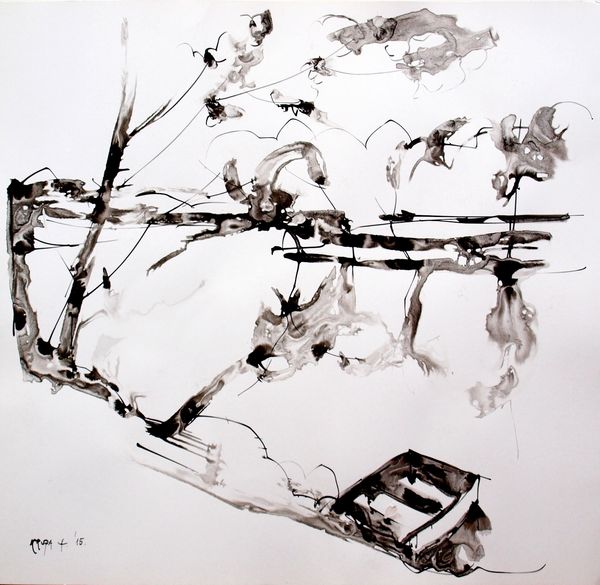
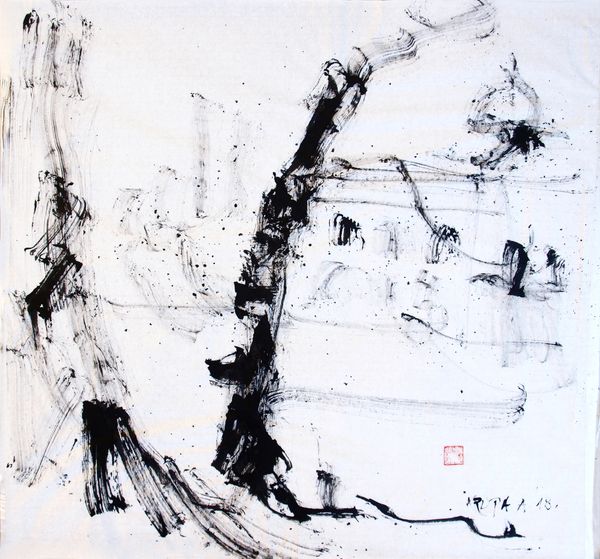
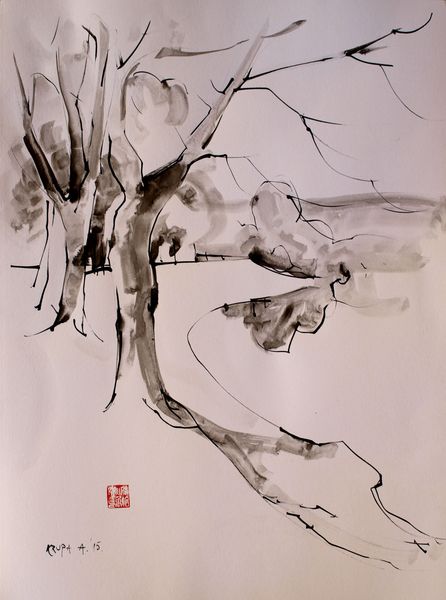
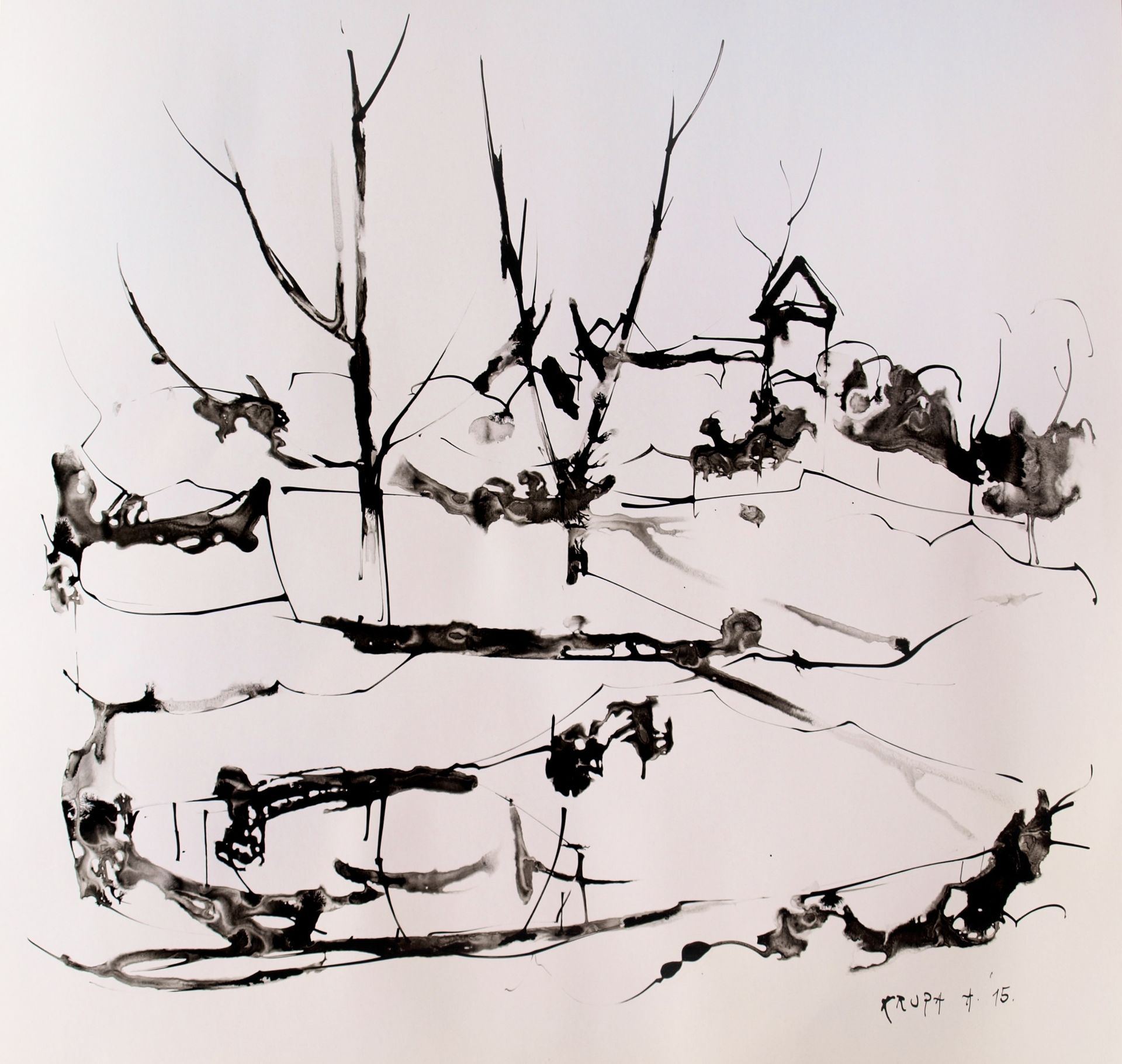
Editor: Here we have Alfred Freddy Krupa's "Dubovac," created in 2015, using ink on paper. It strikes me as desolate, a sort of post-apocalyptic landscape. What do you see in this piece, from your perspective? Curator: Desolate is a good word. I see a commentary on the relationship between humanity and nature. The starkness of the ink and the skeletal trees can be interpreted as a visual representation of environmental degradation, a consequence of unchecked human ambition and industrialization. Does that resonance at all, given the historical context of conflict in that region? Editor: It does. The bareness made me think more of something lost rather than active destruction, but I can see how those are linked. The house in the background, almost like a ghost, reinforces that. What historical context are you referring to specifically? Curator: Well, the Balkans have experienced considerable conflict and displacement, right? Krupa, being a Croatian artist, paints not just a physical landscape but also the psychological landscape of displacement, the feeling of being unmoored from history and tradition. The loose brushstrokes create a sense of instability. Do you pick up on that? Editor: Definitely, now that you mention it. It's not just a literal place, it’s also about the idea of place, and the disruption of identity connected to that. Curator: Exactly. The simplicity allows for multiple readings, each reflecting on issues from environmental destruction to the refugee experience. How does the title “Dubovac,” knowing it’s a place name, complicate this reading for you? Editor: It grounds it, in a way, but also universalizes it. It’s *this* place, but it also could be *any* place that’s been affected by these forces. I appreciate how you highlighted the interplay between personal history and broader sociopolitical issues. Curator: And I appreciate you pulling out the universality within such a culturally specific location. Thanks to Krupa’s work we’re having an intersectional dialogue across environmentalism, identity, and place.

Artwork details
- Medium
- drawing, ink
- Dimensions
- 61 x 61 cm
- Copyright
- Creative Commons NonCommercial
Tags
Comments
Share your thoughts
About this artwork
Editor: Here we have Alfred Freddy Krupa's "Dubovac," created in 2015, using ink on paper. It strikes me as desolate, a sort of post-apocalyptic landscape. What do you see in this piece, from your perspective? Curator: Desolate is a good word. I see a commentary on the relationship between humanity and nature. The starkness of the ink and the skeletal trees can be interpreted as a visual representation of environmental degradation, a consequence of unchecked human ambition and industrialization. Does that resonance at all, given the historical context of conflict in that region? Editor: It does. The bareness made me think more of something lost rather than active destruction, but I can see how those are linked. The house in the background, almost like a ghost, reinforces that. What historical context are you referring to specifically? Curator: Well, the Balkans have experienced considerable conflict and displacement, right? Krupa, being a Croatian artist, paints not just a physical landscape but also the psychological landscape of displacement, the feeling of being unmoored from history and tradition. The loose brushstrokes create a sense of instability. Do you pick up on that? Editor: Definitely, now that you mention it. It's not just a literal place, it’s also about the idea of place, and the disruption of identity connected to that. Curator: Exactly. The simplicity allows for multiple readings, each reflecting on issues from environmental destruction to the refugee experience. How does the title “Dubovac,” knowing it’s a place name, complicate this reading for you? Editor: It grounds it, in a way, but also universalizes it. It’s *this* place, but it also could be *any* place that’s been affected by these forces. I appreciate how you highlighted the interplay between personal history and broader sociopolitical issues. Curator: And I appreciate you pulling out the universality within such a culturally specific location. Thanks to Krupa’s work we’re having an intersectional dialogue across environmentalism, identity, and place.
Comments
Share your thoughts