About this artwork
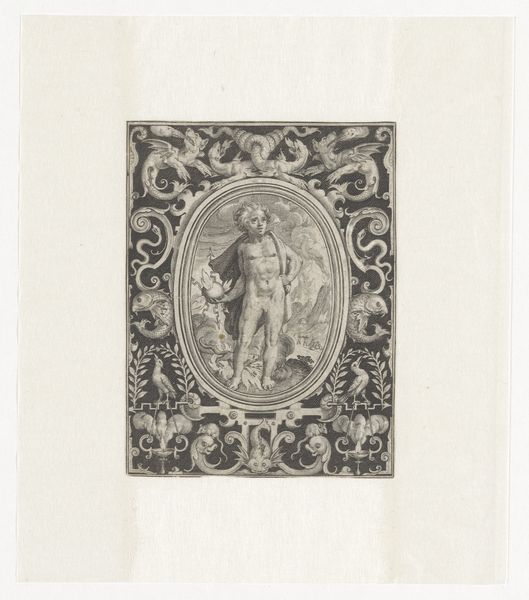
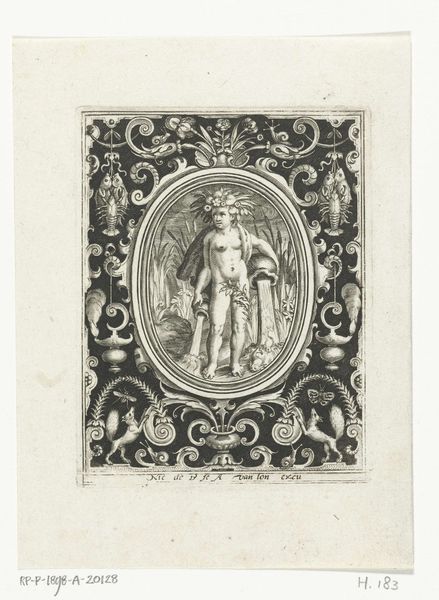
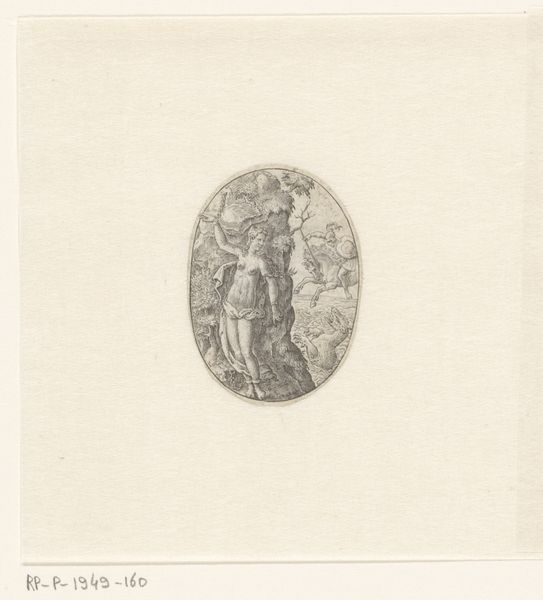
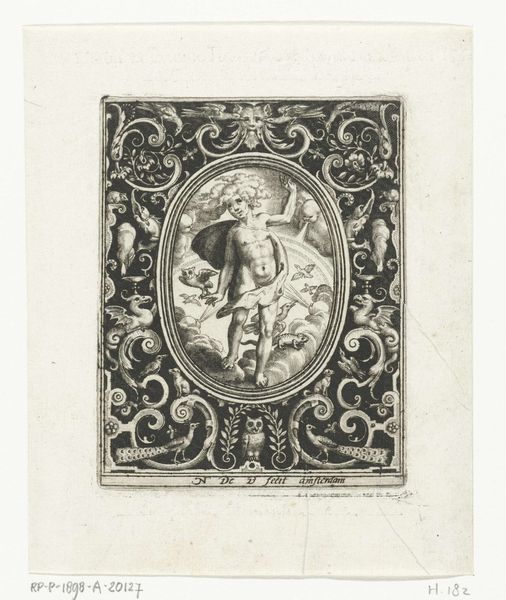
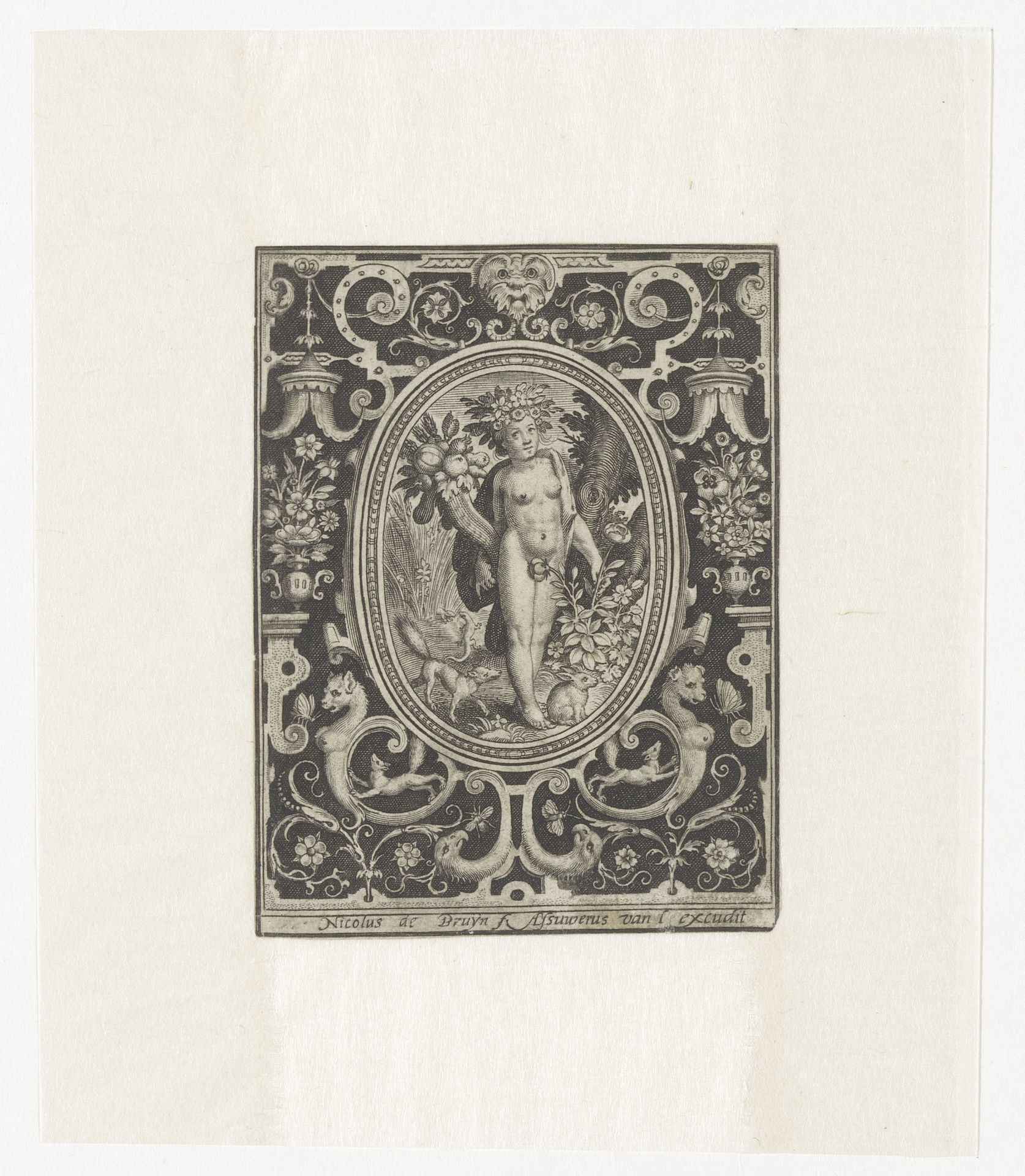
Curator: Here we have "Element aarde als jonge vrouw met hoorn des overvloeds en rozenstruik in omlijsting met ornamenten," which translates to "Earth as a Young Woman with Cornucopia and Rose Bush in Ornamented Frame," a print by Nicolaes de Bruyn created sometime between 1582 and 1635. Editor: It’s rather dark, isn’t it? Intricate, almost overwhelmingly so, but definitely somber. All that detail packed into such a small space gives it a strange density. Curator: The density speaks to the cultural moment. Prints like these served as decorative elements but also communicated complex allegorical messages. This particular work participates in the visual language of the Baroque, though not in paint, of course. Consider how the image of Earth aligns with broader shifts in European society. It signals evolving perceptions and presentations of nature itself. Editor: I’m immediately drawn to the technique—it is, after all, an engraving. Look at how the artist uses the materials, manipulating those lines to create texture and volume. All the detailed ornamentation functions almost like the product of specialized labor. Curator: Precisely! The idealization of Earth as a beautiful nude woman holding a cornucopia, for example, visualizes an ideal abundance, prosperity, and perhaps a tacit appeal to landowners of the time to sustainably manage their own resources to sustain the socio-economic stability that their wealth depended on. The composition becomes a site of political imagery through naturalized resources. Editor: This reminds me about broader questions of printmaking at the time: how many hands worked to produce such detailed results and what implications did that hold for disseminating cultural ideals across various social spheres? Each line required meticulous carving into the plate! Curator: Exactly, from dissemination of Baroque aesthetics to their intersection with civic responsibility. Thanks to advancements in printmaking technology, it certainly served that exact role across diverse social milieus. It is compelling to observe what an outsized effect engravings had on broader socio-political and artistic discussions in 17th-century Netherlands and beyond. Editor: Absolutely. And studying the materiality makes you consider who had access to such works of "art," what meaning they made with them, and how we, today, ascribe art value to an image whose original context of use was in wide circulation across the early modern world.
Element aarde als jonge vrouw met hoorn des overvloeds en rozenstruik in omlijsting met ornamenten
1582 - 1635

Nicolaes de Bruyn
1571 - 1656Location
RijksmuseumArtwork details
- Medium
- print, engraving
- Dimensions
- height 107 mm, width 82 mm
- Location
- Rijksmuseum
- Copyright
- Rijks Museum: Open Domain
Tags
Comments
Share your thoughts
About this artwork
Curator: Here we have "Element aarde als jonge vrouw met hoorn des overvloeds en rozenstruik in omlijsting met ornamenten," which translates to "Earth as a Young Woman with Cornucopia and Rose Bush in Ornamented Frame," a print by Nicolaes de Bruyn created sometime between 1582 and 1635. Editor: It’s rather dark, isn’t it? Intricate, almost overwhelmingly so, but definitely somber. All that detail packed into such a small space gives it a strange density. Curator: The density speaks to the cultural moment. Prints like these served as decorative elements but also communicated complex allegorical messages. This particular work participates in the visual language of the Baroque, though not in paint, of course. Consider how the image of Earth aligns with broader shifts in European society. It signals evolving perceptions and presentations of nature itself. Editor: I’m immediately drawn to the technique—it is, after all, an engraving. Look at how the artist uses the materials, manipulating those lines to create texture and volume. All the detailed ornamentation functions almost like the product of specialized labor. Curator: Precisely! The idealization of Earth as a beautiful nude woman holding a cornucopia, for example, visualizes an ideal abundance, prosperity, and perhaps a tacit appeal to landowners of the time to sustainably manage their own resources to sustain the socio-economic stability that their wealth depended on. The composition becomes a site of political imagery through naturalized resources. Editor: This reminds me about broader questions of printmaking at the time: how many hands worked to produce such detailed results and what implications did that hold for disseminating cultural ideals across various social spheres? Each line required meticulous carving into the plate! Curator: Exactly, from dissemination of Baroque aesthetics to their intersection with civic responsibility. Thanks to advancements in printmaking technology, it certainly served that exact role across diverse social milieus. It is compelling to observe what an outsized effect engravings had on broader socio-political and artistic discussions in 17th-century Netherlands and beyond. Editor: Absolutely. And studying the materiality makes you consider who had access to such works of "art," what meaning they made with them, and how we, today, ascribe art value to an image whose original context of use was in wide circulation across the early modern world.
Comments
Share your thoughts