1930
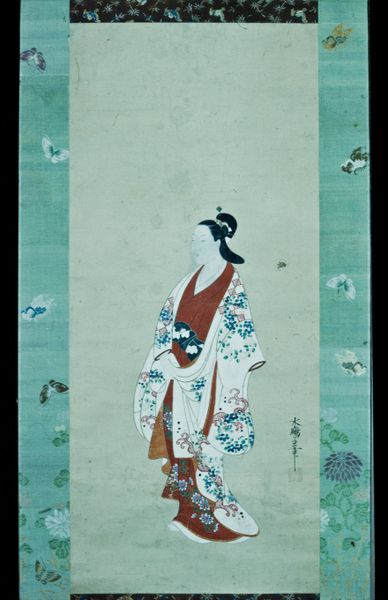
Hikaru Genji


Listen to curator's interpretation
Curatorial notes
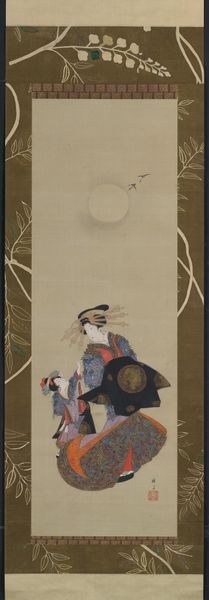
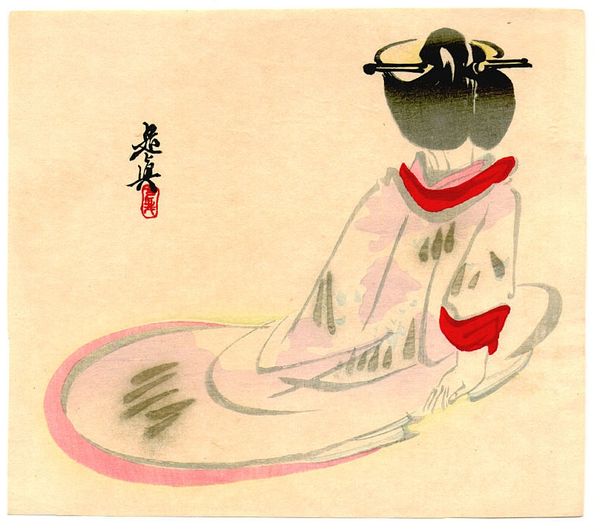
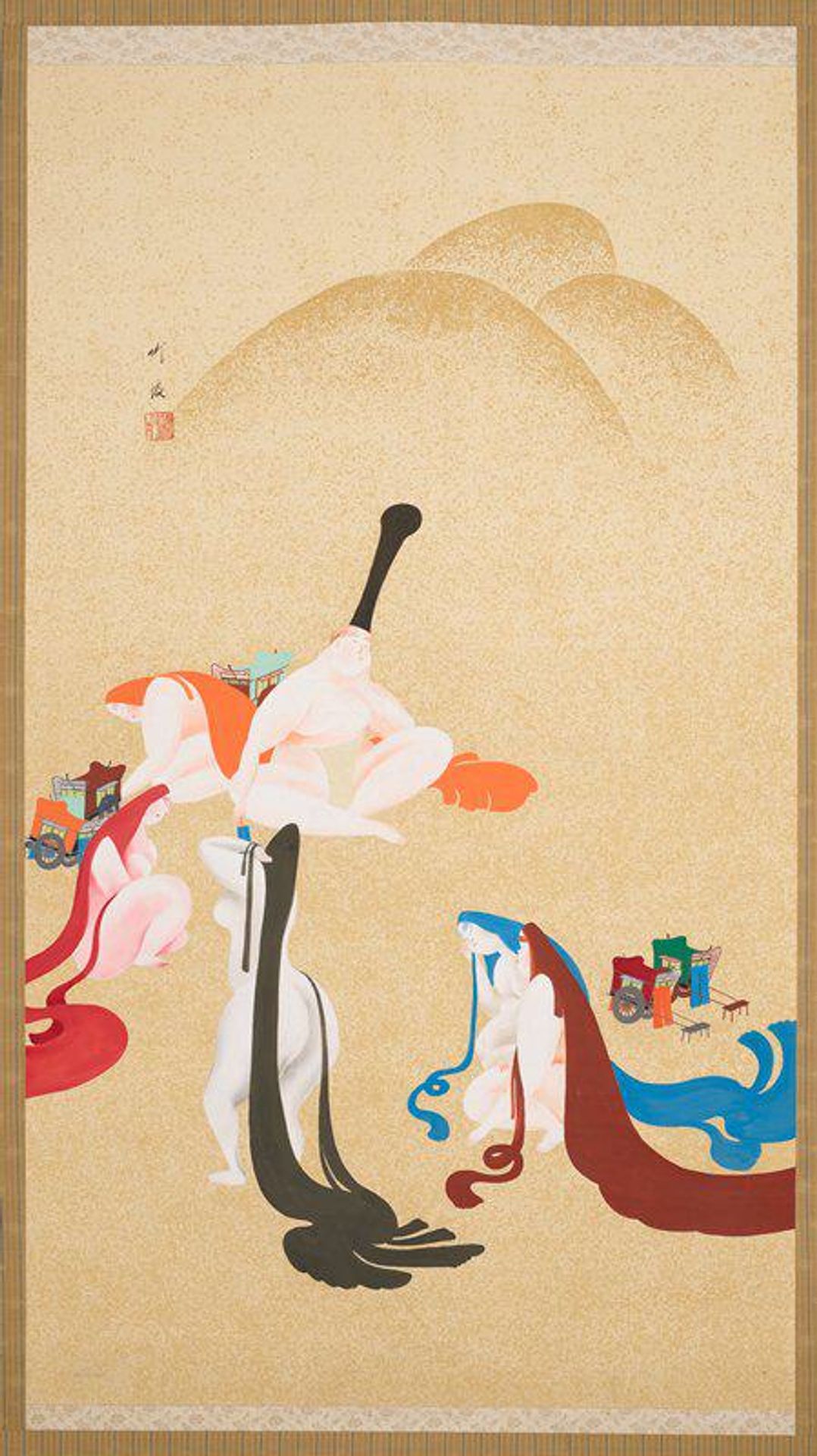
Curator: Otake Chikuha's "Hikaru Genji," made around 1930. It's a color-on-silk hanging scroll. At first glance, the flowing shapes feel quite dreamlike. I’m struck by the textile itself, and how integral it is to the work's presence. What catches your eye? Editor: I'm fascinated by the stylized figures and the muted color palette. The silk seems almost to dictate the flow and composition. I wonder, how did the materiality of silk influence the creation of this artwork, and its reception in its time? Curator: That's a key question. Consider the socio-economic context. Silk, particularly in the 1930s, carried connotations of luxury, trade, and established artistry. The artist's choice of silk speaks to both a continuity with traditional Japanese art and a subtle commentary on societal values, as does using the *ukiyo-e* style during a period when photography was emerging as an alternative way to capture figure. Don’t you think it is odd? Editor: It’s surprising that a fine material like silk is associated with Ukiyo-e. I'm used to Ukiyo-e as an affordable form of art, accessible to common people in the Edo period. Curator: Exactly. Now we arrive to the nuance. By imbuing this ‘popular’ art subject onto a material strongly associated with elitism, we can observe that Chikuha plays with ideas of value and accessibility in a world rapidly transforming via technological advancement. One can reasonably suppose it even explores class relations between materials, methods, and motifs of artworks. Editor: So, the very act of painting these figures on silk elevates their status but also maybe subverts expectations, blurring the lines between 'high' and 'low' art based on how artwork can circulate? Curator: Precisely! By choosing these materials and techniques, Chikuha forces us to confront those classifications, revealing how value is constructed through labor and, ultimately, consumption. How does the knowledge of materials add to your understanding of the piece? Editor: I now understand it as a commentary of consumerism that can take the shape of visual experience. Curator: Agreed, the materials do invite us to delve deeper into cultural complexities!