Copyright: Richard Estes,Fair Use
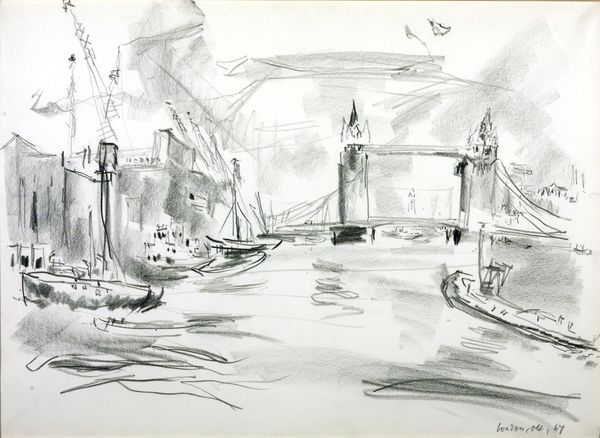
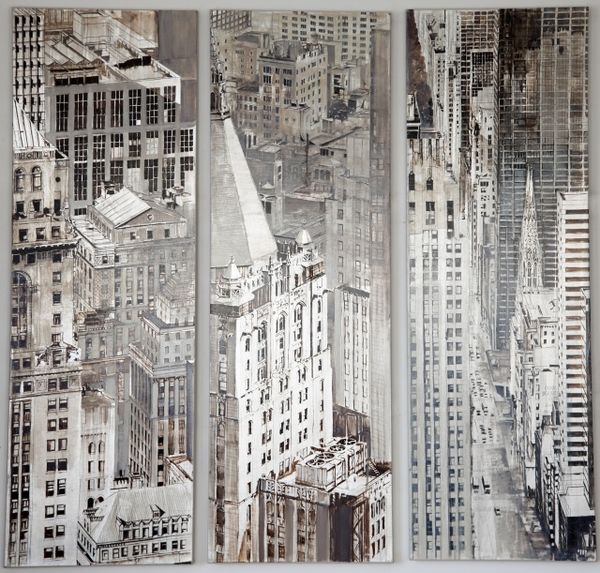
Editor: We're looking at Richard Estes's "Tower Bridge, London," created in 1989 using acrylic paint. It strikes me as a study in contrasts – the ornate historical architecture against the backdrop of a more modern skyline. What formal qualities stand out to you in this piece? Curator: Immediately, the composition presents a compelling dialectic. Note the interplay between the geometrical rigidity of the bridge's structure, offset against the relative organic fluidity of the water and sky. Estes’ use of color further underscores this tension. The cool blues and grays of the water and stone evoke a sense of industrial modernity, a theme pervasive in post-industrial art. What about the treatment of light? Editor: The light seems almost clinical, sharply defining the edges of the bridge and reflecting intensely on the wet surfaces. Curator: Precisely. This calculated rendering serves to flatten the picture plane, eschewing traditional illusionistic depth. The artist guides the viewer's eye not into, but across, the canvas, emphasizing the surface qualities of the painting itself. We must also consider how the steel verticals divide the space. Editor: Do they work to break the cityscape, almost as if a triptych but without defined boundaries? Curator: Indeed, those verticals operate as structural signifiers, not mere representational elements, that segment and reorganize our reading of the urban landscape. Through these disruptions and recombinations, what does Estes communicate, beyond simple depiction? Editor: I think the fragmentation captures a sense of the city's relentless dynamism, and it also directs how we understand urban reality and question assumptions about straightforward representation in art. Curator: A nuanced interpretation. It showcases Estes' masterful manipulation of form, color, and structure to challenge the very nature of pictorial space and representation, and asks the audience to do the same. Editor: I appreciate your insights. Looking beyond the obvious subject matter to consider its structural integrity is enriching! Curator: Indeed. Formal analysis allows for deeper, more complex encounters with a piece.
Comments
No comments
Be the first to comment and join the conversation on the ultimate creative platform.
 Collect
 React
React Comment
More like this