About this artwork
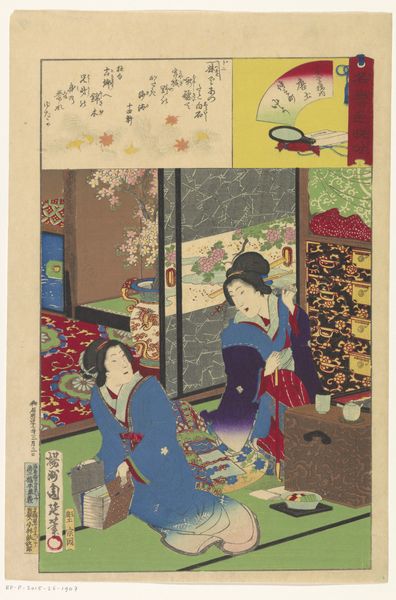
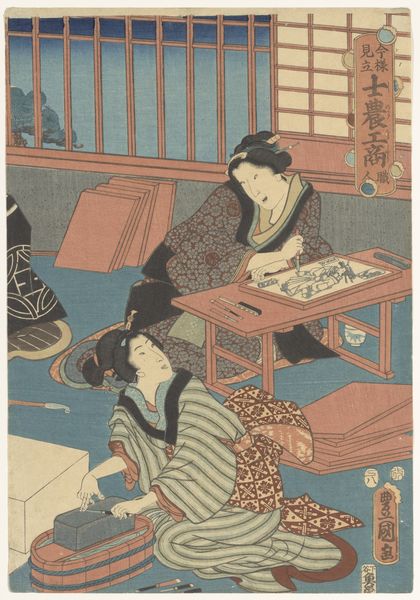
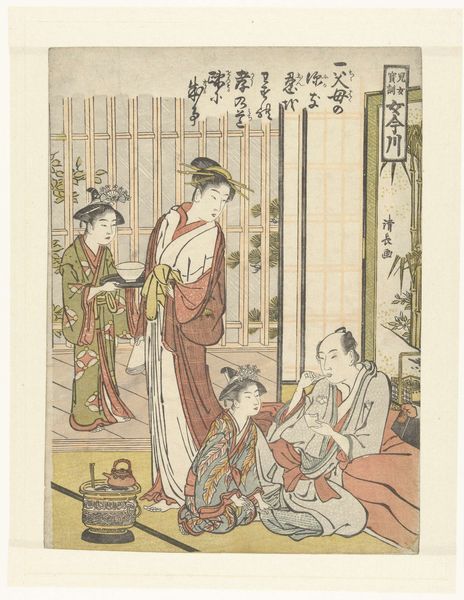
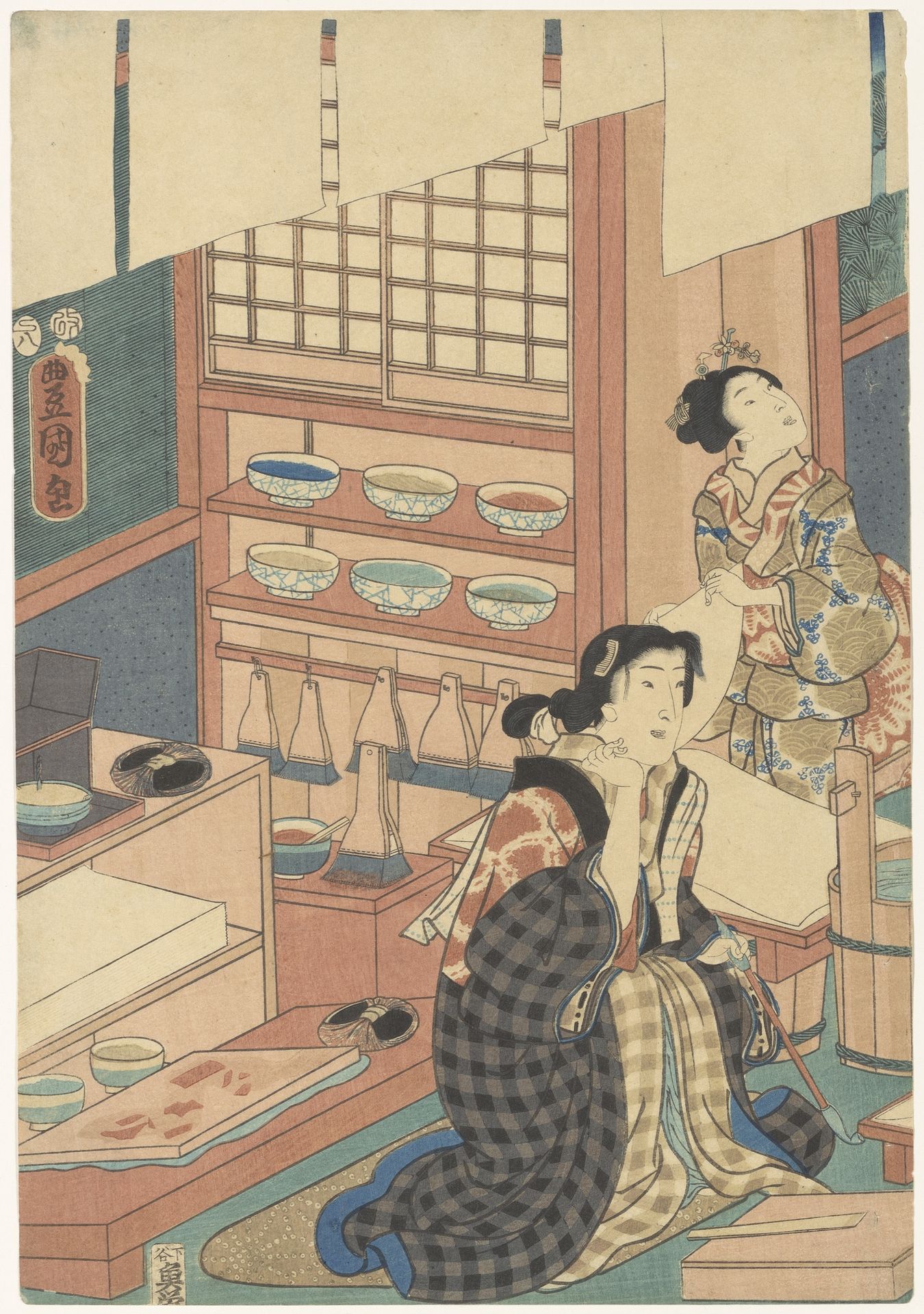
Curator: Utagawa Kunisada’s woodblock print, "Vrouwen maken prenten (linkerdeel)", which translates to “Women making prints (left part)”, created between 1796 and 1865, offers a glimpse into the artistic production of Ukiyo-e prints. Editor: It’s instantly appealing—a quiet scene rendered in muted blues and earth tones, incredibly balanced and harmonious. The composition is subtly complex with its geometric patterns. Curator: Kunisada's print draws us into the printmaking workshop. The detailed depiction highlights the division of labor, crucial in understanding Ukiyo-e's commercial success. Editor: Absolutely. The lines, the curves of the bowls and the women’s faces...it’s an exquisite orchestration of form. And observe the material handling—the woodblock printing’s tactile presence gives it unique textural interest. Curator: It emphasizes the collaborative, and at times, gendered nature of labor in the art world during the Edo period. Note the tools of production. One can examine each tool's place and how labor informs the final object. Editor: Yet within this meticulous record of process, it is the aesthetic qualities—the colour palette, for instance, along with how those tools are arrayed—which speak loudest about form. And I’m intrigued by the way it plays with perspective; how planes intersect and recede into an illusive space. Curator: Indeed. Perspective in ukiyo-e also allowed for the commercial dissemination of images, expanding audiences. This print's historical materiality reminds us of Ukiyo-e's broader social and economic implications. Editor: True, and ultimately, this piece is fascinating both as a social record and as a sophisticated essay in lines, colours, and space—it truly embodies a balanced dialogue between materiality and design. Curator: It is interesting how we might consider both design and modes of making prints from both social and economic context as equally contributing to the objects inherent qualities.
Vrouwen maken prenten (linkerdeel) 1796 - 1865

Utagawa Kunisada
1786 - 1865Location
RijksmuseumArtwork details
- Medium
- print, intaglio, woodblock-print
- Dimensions
- height 361 mm, width 249 mm
- Location
- Rijksmuseum
- Copyright
- Rijks Museum: Open Domain
Tags
portrait
intaglio
asian-art
caricature
ukiyo-e
perspective
figuration
woodblock-print
genre-painting
Comments
No comments
About this artwork
Curator: Utagawa Kunisada’s woodblock print, "Vrouwen maken prenten (linkerdeel)", which translates to “Women making prints (left part)”, created between 1796 and 1865, offers a glimpse into the artistic production of Ukiyo-e prints. Editor: It’s instantly appealing—a quiet scene rendered in muted blues and earth tones, incredibly balanced and harmonious. The composition is subtly complex with its geometric patterns. Curator: Kunisada's print draws us into the printmaking workshop. The detailed depiction highlights the division of labor, crucial in understanding Ukiyo-e's commercial success. Editor: Absolutely. The lines, the curves of the bowls and the women’s faces...it’s an exquisite orchestration of form. And observe the material handling—the woodblock printing’s tactile presence gives it unique textural interest. Curator: It emphasizes the collaborative, and at times, gendered nature of labor in the art world during the Edo period. Note the tools of production. One can examine each tool's place and how labor informs the final object. Editor: Yet within this meticulous record of process, it is the aesthetic qualities—the colour palette, for instance, along with how those tools are arrayed—which speak loudest about form. And I’m intrigued by the way it plays with perspective; how planes intersect and recede into an illusive space. Curator: Indeed. Perspective in ukiyo-e also allowed for the commercial dissemination of images, expanding audiences. This print's historical materiality reminds us of Ukiyo-e's broader social and economic implications. Editor: True, and ultimately, this piece is fascinating both as a social record and as a sophisticated essay in lines, colours, and space—it truly embodies a balanced dialogue between materiality and design. Curator: It is interesting how we might consider both design and modes of making prints from both social and economic context as equally contributing to the objects inherent qualities.
Comments
No comments