About this artwork
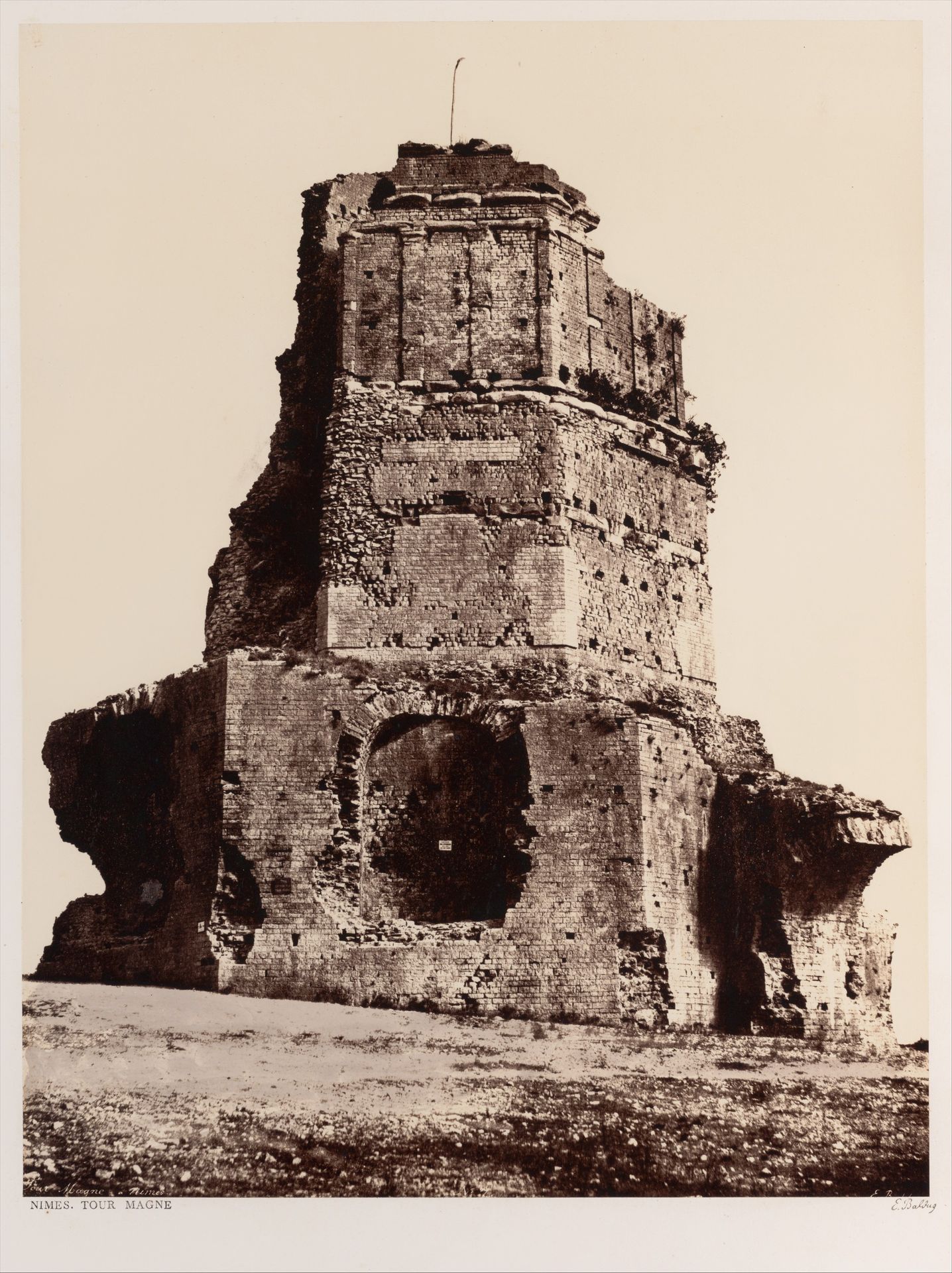
Curator: Looking at this print by Edouard Baldus, created in 1853, the “Nîmes, Tour Magne”, one is immediately struck by its imposing, albeit crumbling, presence. Editor: It evokes a sense of melancholy. That isolated tower, stark against the sky...it speaks to the passage of time, the impermanence of human ambition. The damage itself almost becomes a symbol of resilience, strangely. Curator: Indeed. Baldus was commissioned to document French architectural heritage at a time of significant political and social change. Photography became a powerful tool for national identity formation and architectural preservation efforts. Editor: And the tower itself? What does the Tour Magne signify in that cultural context? Curator: It was originally a Roman watchtower, built to oversee the city of Nîmes. By the 19th century, it had become a potent symbol of Roman antiquity, deeply intertwined with regional and French history. Baldus presents us with a deliberate record meant to showcase this. Editor: I'm drawn to how the light plays across the rough surfaces of the stone. It really accentuates the textures, those missing stones feel heavy with meaning. Curator: Baldus’s skill lies in imbuing this architecture with historical weight but also in capturing the mood of that era. This print isn’t simply documentation; it reflects the romantic ideals concerning ruins and history prevalent then. The city, now sprawling below the tower, is intentionally absent. Editor: So it really isolates the tower as an emblem, severing its immediate relationship with modern society. Making a symbol, perhaps, of the romantic past? Curator: Exactly! The Tower becomes timeless, suspended in a glorified past carefully curated for its public value. Editor: It's incredible how an image can function simultaneously as a historical record and a loaded symbol. Thanks for unpacking all this with me. Curator: My pleasure! This image truly speaks to how the politics of imagery shaped understandings of cultural history during the 19th century.
Nîmes, Tour Magne 1853


Artwork details
- Medium
- print, photography, architecture
- Dimensions
- Image: 42.9 x 33 cm (16 7/8 x 13 in.) Mount: 60.5 x 46 cm (23 13/16 x 18 1/8 in.)
- Location
- Metropolitan Museum of Art, New York, NY
- Copyright
- Public Domain
Tags
landscape
photography
ancient-mediterranean
arch
cityscape
scenic spot
architecture
Comments
No comments
About this artwork
Curator: Looking at this print by Edouard Baldus, created in 1853, the “Nîmes, Tour Magne”, one is immediately struck by its imposing, albeit crumbling, presence. Editor: It evokes a sense of melancholy. That isolated tower, stark against the sky...it speaks to the passage of time, the impermanence of human ambition. The damage itself almost becomes a symbol of resilience, strangely. Curator: Indeed. Baldus was commissioned to document French architectural heritage at a time of significant political and social change. Photography became a powerful tool for national identity formation and architectural preservation efforts. Editor: And the tower itself? What does the Tour Magne signify in that cultural context? Curator: It was originally a Roman watchtower, built to oversee the city of Nîmes. By the 19th century, it had become a potent symbol of Roman antiquity, deeply intertwined with regional and French history. Baldus presents us with a deliberate record meant to showcase this. Editor: I'm drawn to how the light plays across the rough surfaces of the stone. It really accentuates the textures, those missing stones feel heavy with meaning. Curator: Baldus’s skill lies in imbuing this architecture with historical weight but also in capturing the mood of that era. This print isn’t simply documentation; it reflects the romantic ideals concerning ruins and history prevalent then. The city, now sprawling below the tower, is intentionally absent. Editor: So it really isolates the tower as an emblem, severing its immediate relationship with modern society. Making a symbol, perhaps, of the romantic past? Curator: Exactly! The Tower becomes timeless, suspended in a glorified past carefully curated for its public value. Editor: It's incredible how an image can function simultaneously as a historical record and a loaded symbol. Thanks for unpacking all this with me. Curator: My pleasure! This image truly speaks to how the politics of imagery shaped understandings of cultural history during the 19th century.
Comments
No comments