About this artwork
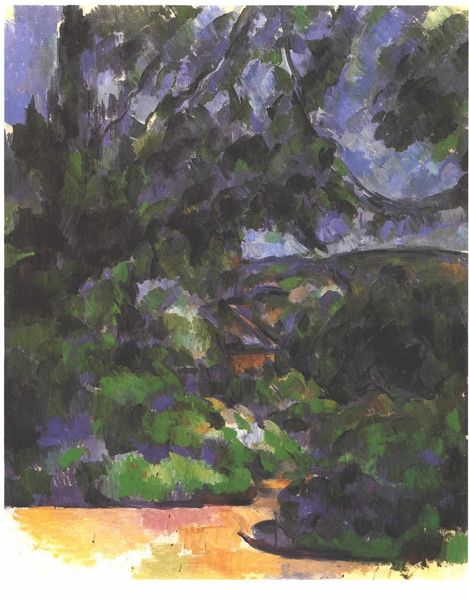
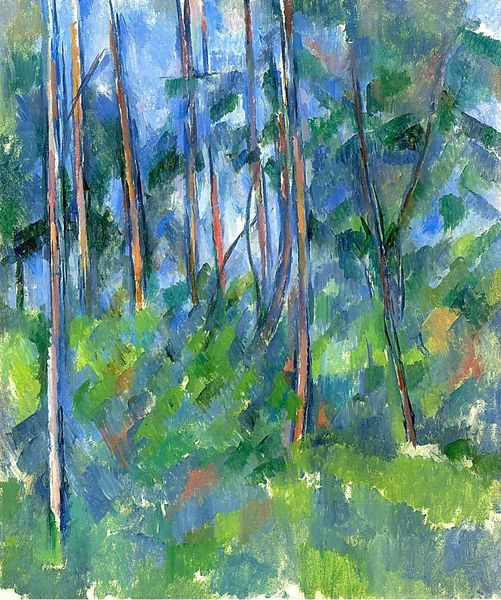
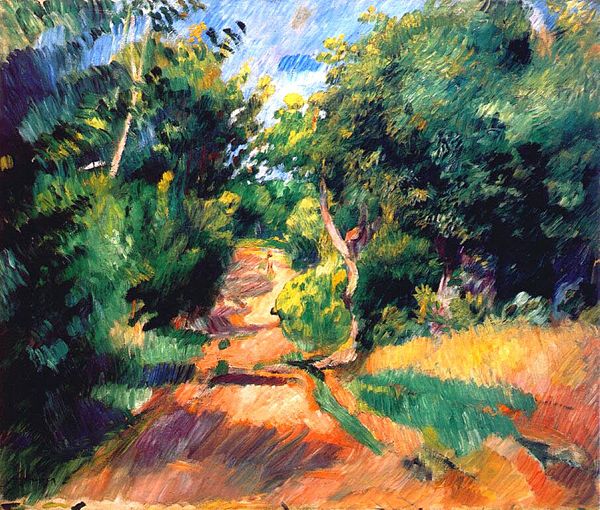
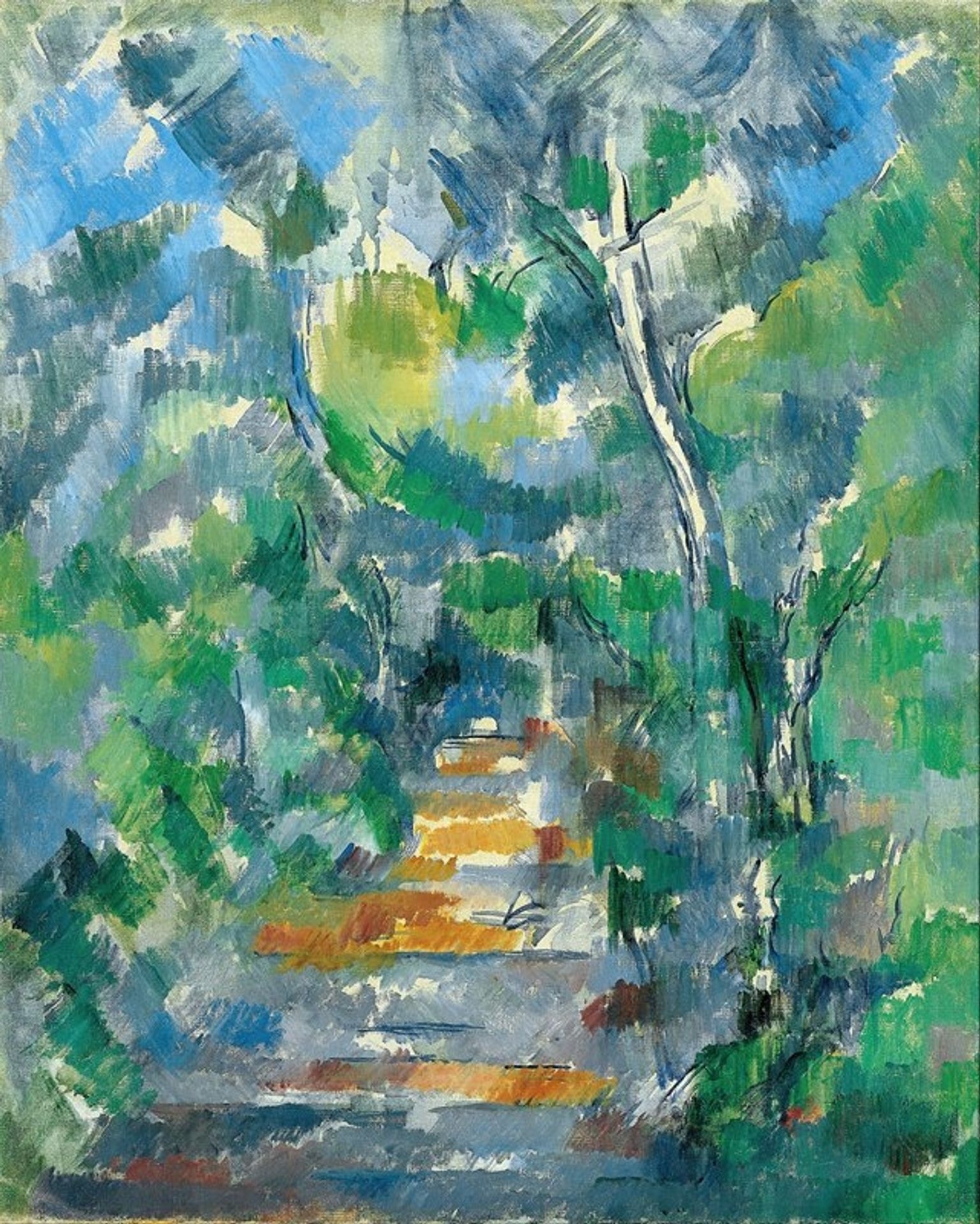
Curator: Oh, look! I think this piece by Paul Cezanne titled, "Forest Scene," done between 1900 and 1902 using oil paint, holds a certain mysterious allure. What's your initial reaction to it? Editor: Claustrophobia, almost. There's an incredible density to it. The light is struggling to get through all that green. It feels secretive, like you've stumbled onto something hidden deep within the woods. Curator: It certainly has a kind of compressed energy. For me, those chunky brushstrokes become symbolic. He wasn’t interested in merely depicting a forest. It's more about constructing form from color. Editor: Yes! You can practically feel the weight of each brushstroke. And the way he uses color—the blues almost fighting with the greens for dominance—creates a tension that I find captivating. Is there a road represented with the bright orange? Is it an altar? Curator: The composition makes it a visual game to try to solve. Notice how geometric forms break down the shapes and suggest rather than directly replicate the forest. Each element possesses a fundamental truth that alludes to greater significance. Editor: So, it's not about recreating the optical experience but getting at something deeper, the underlying structure? And perhaps it’s not the path forward as a visual representation but more as an emotional or spiritual suggestion of forward movement... Curator: Exactly! In the same way, color moves through the shapes not for definition or illusion but to act as building blocks and create a visual harmony. Editor: It's interesting to see how the "primitive hut" idea comes to mind here as well – a desire to uncover the core, foundational forms behind what we perceive. Curator: An urge toward abstraction, yes. Cezanne seems determined to uncover this "truth." It strikes me as so different from typical forest imagery. It presents such a powerful personal experience, it makes me question what reality is. Editor: I like that sense of questioning. Looking closer I find I like it too, so much. I suppose it is the painting, brushstroke by brushstroke, that really makes you think about seeing... thanks. Curator: Agreed; and the lasting impact resides in its capability to encourage viewers, in fact, to view and value the physical presence of color in our worlds.

Artwork details
- Copyright
- Public Domain: Artvee
Comments
No comments
About this artwork
Curator: Oh, look! I think this piece by Paul Cezanne titled, "Forest Scene," done between 1900 and 1902 using oil paint, holds a certain mysterious allure. What's your initial reaction to it? Editor: Claustrophobia, almost. There's an incredible density to it. The light is struggling to get through all that green. It feels secretive, like you've stumbled onto something hidden deep within the woods. Curator: It certainly has a kind of compressed energy. For me, those chunky brushstrokes become symbolic. He wasn’t interested in merely depicting a forest. It's more about constructing form from color. Editor: Yes! You can practically feel the weight of each brushstroke. And the way he uses color—the blues almost fighting with the greens for dominance—creates a tension that I find captivating. Is there a road represented with the bright orange? Is it an altar? Curator: The composition makes it a visual game to try to solve. Notice how geometric forms break down the shapes and suggest rather than directly replicate the forest. Each element possesses a fundamental truth that alludes to greater significance. Editor: So, it's not about recreating the optical experience but getting at something deeper, the underlying structure? And perhaps it’s not the path forward as a visual representation but more as an emotional or spiritual suggestion of forward movement... Curator: Exactly! In the same way, color moves through the shapes not for definition or illusion but to act as building blocks and create a visual harmony. Editor: It's interesting to see how the "primitive hut" idea comes to mind here as well – a desire to uncover the core, foundational forms behind what we perceive. Curator: An urge toward abstraction, yes. Cezanne seems determined to uncover this "truth." It strikes me as so different from typical forest imagery. It presents such a powerful personal experience, it makes me question what reality is. Editor: I like that sense of questioning. Looking closer I find I like it too, so much. I suppose it is the painting, brushstroke by brushstroke, that really makes you think about seeing... thanks. Curator: Agreed; and the lasting impact resides in its capability to encourage viewers, in fact, to view and value the physical presence of color in our worlds.
Comments
No comments