About this artwork
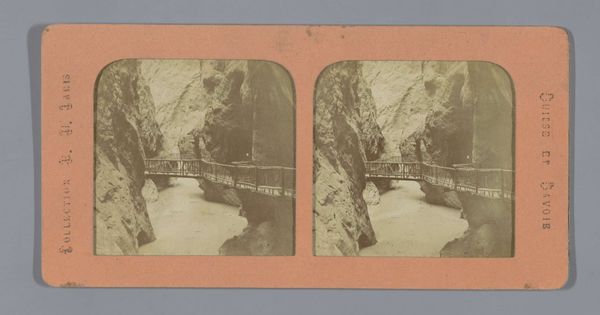
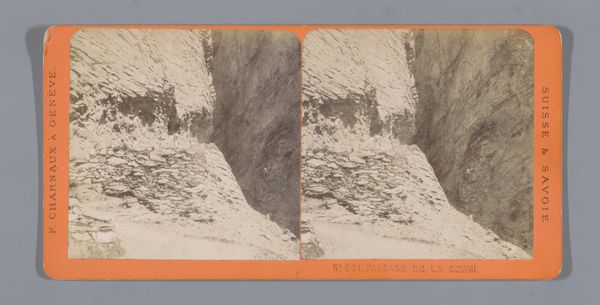
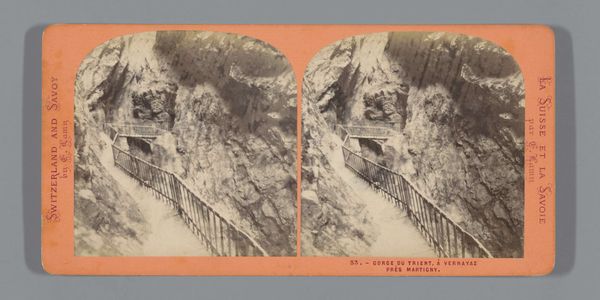
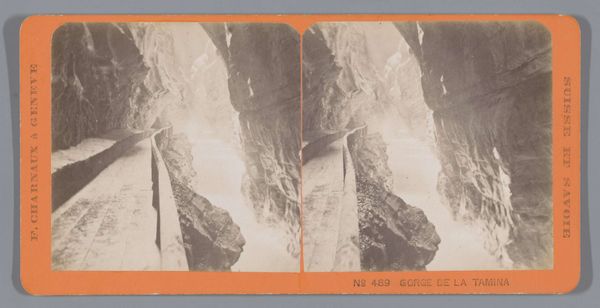
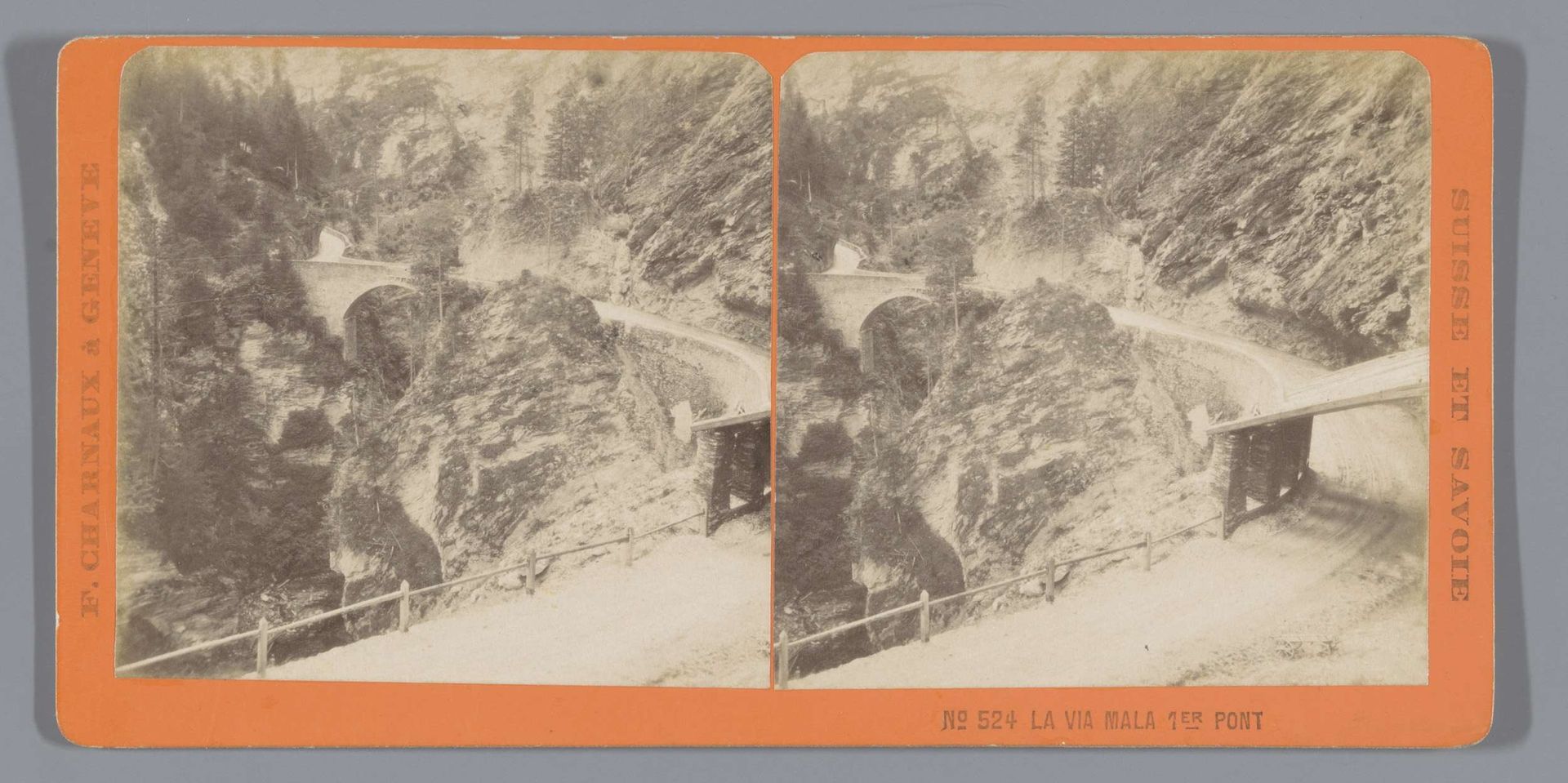
Editor: This is a stereo card photograph entitled "Gezicht op de Via Mala," taken by Florentin Charnaux after 1873. The Via Mala is stunning, yet I can't help but feel a slight apprehension looking at the precariousness of the road built on such rugged terrain. What are your impressions? Curator: That feeling of precariousness speaks to the tensions inherent in the late 19th-century romanticisation of nature. This was a period marked by industrial progress, alongside anxieties about its impact on the environment. Editor: Interesting... I wouldn't have immediately connected it to industrialization. Curator: Consider the very act of constructing a road like this: it's a physical intervention, a claiming of nature for human purposes. Roads facilitated tourism and resource extraction, altering landscapes and disrupting local communities, for better or for worse. We might also ask: who had access to this landscape and for what purposes? Editor: I see what you mean now. So this beautiful image also serves as a document of that transformation, a complex intersection of nature and society, power and access. Thanks, this has given me a new lens for thinking about landscape photography. Curator: Precisely! By analyzing the political, social, and economic conditions surrounding the work's creation and consumption, we can critically understand its power as an object, or an intervention within a moment in time. Editor: It highlights the importance of not only aesthetic beauty, but broader conversations about our relationship with our environment, then and now. Curator: Exactly. Looking at art with this critical lens creates space for dialogue that can activate ourselves, and future change.

Artwork details
- Medium
- photography
- Dimensions
- height 85 mm, width 170 mm
- Copyright
- Rijks Museum: Open Domain
Tags
landscape
photography
road
coloured pencil
mountain
Comments
No comments
About this artwork
Editor: This is a stereo card photograph entitled "Gezicht op de Via Mala," taken by Florentin Charnaux after 1873. The Via Mala is stunning, yet I can't help but feel a slight apprehension looking at the precariousness of the road built on such rugged terrain. What are your impressions? Curator: That feeling of precariousness speaks to the tensions inherent in the late 19th-century romanticisation of nature. This was a period marked by industrial progress, alongside anxieties about its impact on the environment. Editor: Interesting... I wouldn't have immediately connected it to industrialization. Curator: Consider the very act of constructing a road like this: it's a physical intervention, a claiming of nature for human purposes. Roads facilitated tourism and resource extraction, altering landscapes and disrupting local communities, for better or for worse. We might also ask: who had access to this landscape and for what purposes? Editor: I see what you mean now. So this beautiful image also serves as a document of that transformation, a complex intersection of nature and society, power and access. Thanks, this has given me a new lens for thinking about landscape photography. Curator: Precisely! By analyzing the political, social, and economic conditions surrounding the work's creation and consumption, we can critically understand its power as an object, or an intervention within a moment in time. Editor: It highlights the importance of not only aesthetic beauty, but broader conversations about our relationship with our environment, then and now. Curator: Exactly. Looking at art with this critical lens creates space for dialogue that can activate ourselves, and future change.
Comments
No comments