About this artwork
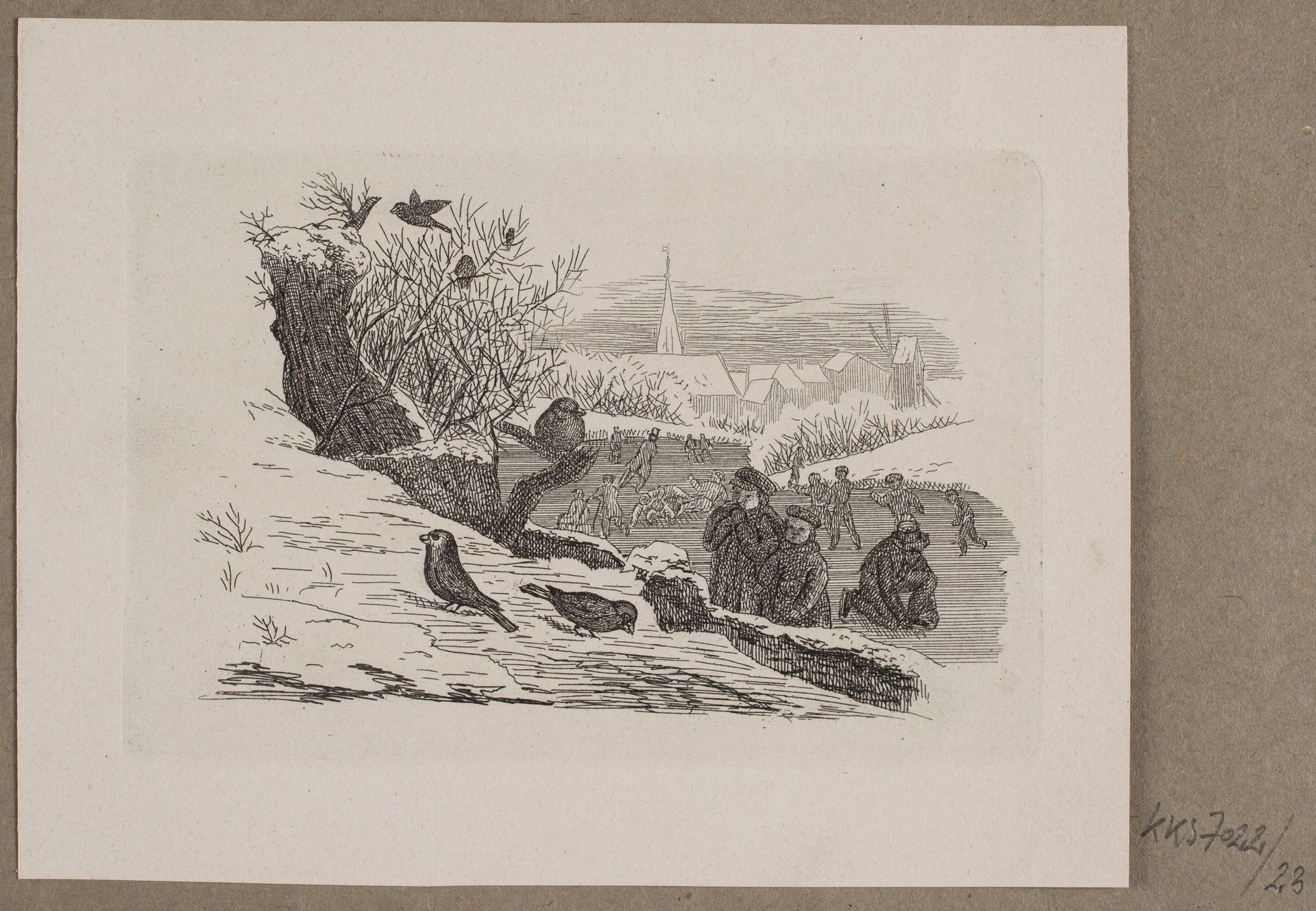
This illustration for O. Specter’s “Fabler for Børn” was made by Vilhelm Kyhn sometime in the 19th century, using the process of etching. The crisp, dark lines are characteristic of this technique, where the artist draws into a waxy ground on a metal plate, which is then exposed to acid. This eats away the exposed lines, leaving an image that can be inked and printed. But why etching for a children’s book? Consider the social context: in the 19th century, the rise of industrial production meant books could be printed and widely distributed. Etching, though more laborious than some other printing methods, allowed for detailed, reproducible images. Kyhn’s skillful use of line creates depth and texture, from the delicate birds to the snowy landscape and the figures skating in the distance. The choice of etching speaks to a desire to balance the efficiency of print with the personal touch of the artist’s hand. It blurs the line between mass production and individual craftsmanship, making art accessible to a wider audience while still retaining a sense of artistic integrity.
Illustration til O. Specter, "Fabler for Børn"
1838


Artwork details
- Medium
- drawing, print, engraving
- Dimensions
- 88 mm (height) x 110 mm (width) (plademaal)
- Location
- SMK - Statens Museum for Kunst
Tags
Comments
Share your thoughts
About this artwork
This illustration for O. Specter’s “Fabler for Børn” was made by Vilhelm Kyhn sometime in the 19th century, using the process of etching. The crisp, dark lines are characteristic of this technique, where the artist draws into a waxy ground on a metal plate, which is then exposed to acid. This eats away the exposed lines, leaving an image that can be inked and printed. But why etching for a children’s book? Consider the social context: in the 19th century, the rise of industrial production meant books could be printed and widely distributed. Etching, though more laborious than some other printing methods, allowed for detailed, reproducible images. Kyhn’s skillful use of line creates depth and texture, from the delicate birds to the snowy landscape and the figures skating in the distance. The choice of etching speaks to a desire to balance the efficiency of print with the personal touch of the artist’s hand. It blurs the line between mass production and individual craftsmanship, making art accessible to a wider audience while still retaining a sense of artistic integrity.
Comments
Share your thoughts