About this artwork
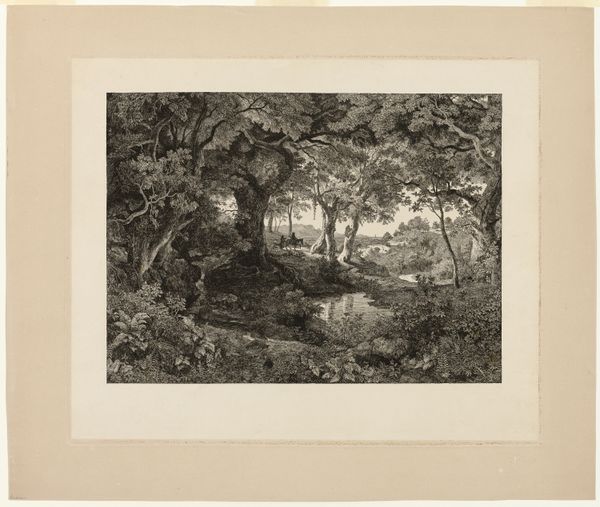
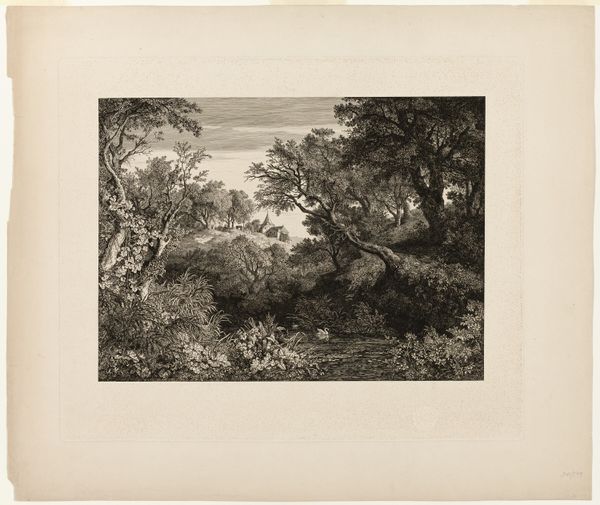
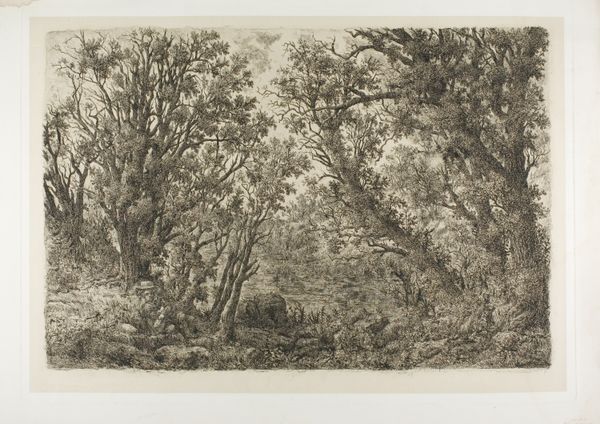
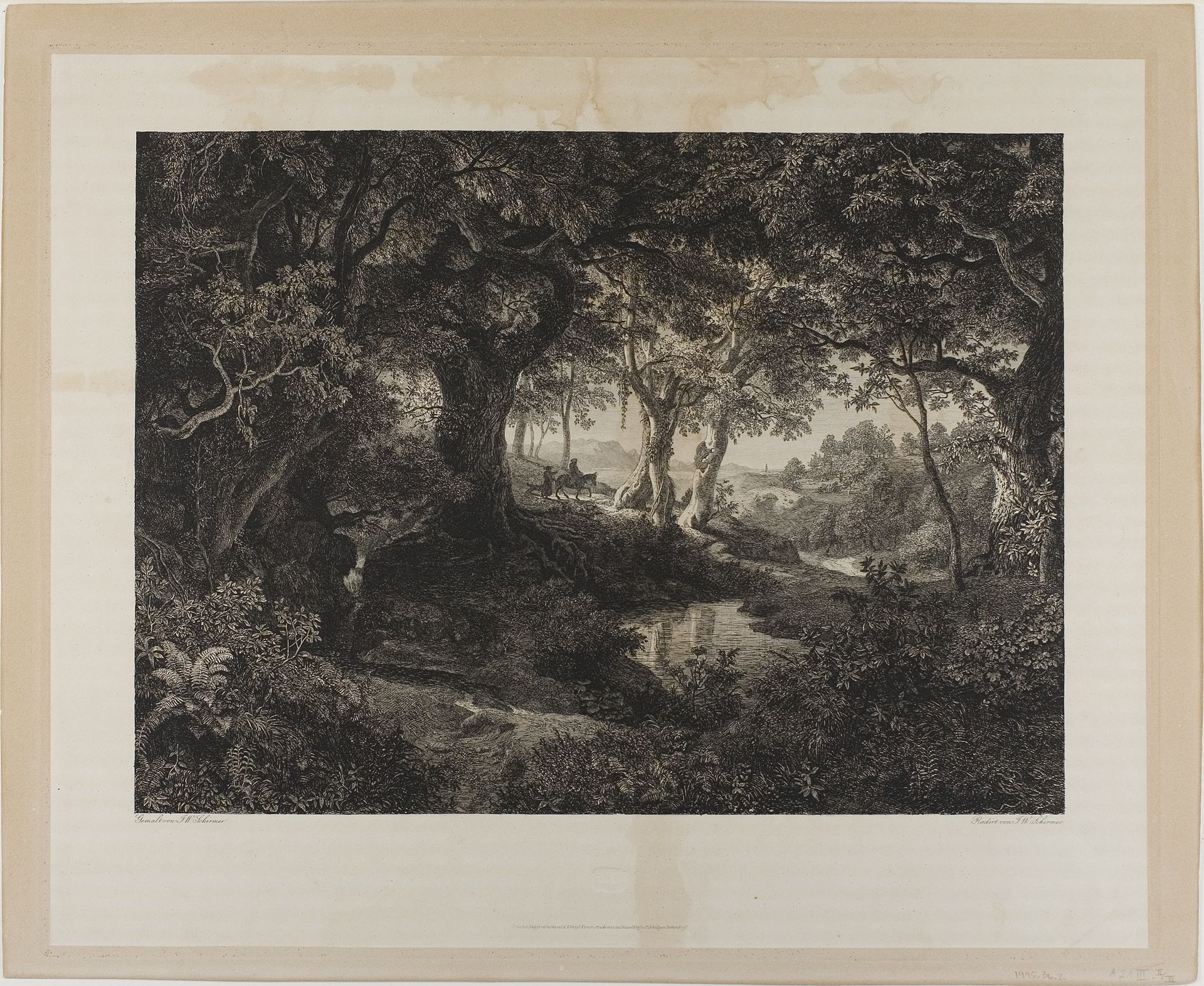
Johann Wilhelm Schirmer created this etching of an Italian landscape in the 19th century. The dense woods evoke a sense of enclosure, yet a path leads into the distance, inviting contemplation. The forest as a symbolic space is deeply rooted in the human psyche, representing both refuge and the unknown. The imagery of the woods, with its dual nature of safety and danger, echoes through art history, from classical myths to Romantic paintings. Think of the dark forests in Grimms' fairy tales, or even the mystical groves of ancient Greece. This archetype is powerful, engaging us on a subconscious level with primal fears and desires. Here, the image takes us back to Caspar David Friedrich, where the path into the distance and through the forest represents the cycles of life, death, and renewal. The lone traveler on the path becomes a poignant symbol of human fate, reflecting the cyclical progression of symbols, ever resurfacing and evolving across time.
The Large Italian Landscape
1841


Artwork details
- Medium
- drawing, print, etching, paper
- Dimensions
- 318 × 432 mm (image); 415 × 510 mm (chine); 427 × 520 mm (plate); 456 × 556 mm (sheet)
- Location
- The Art Institute of Chicago
- Copyright
- Public Domain
Tags
Comments
Share your thoughts
About this artwork
Johann Wilhelm Schirmer created this etching of an Italian landscape in the 19th century. The dense woods evoke a sense of enclosure, yet a path leads into the distance, inviting contemplation. The forest as a symbolic space is deeply rooted in the human psyche, representing both refuge and the unknown. The imagery of the woods, with its dual nature of safety and danger, echoes through art history, from classical myths to Romantic paintings. Think of the dark forests in Grimms' fairy tales, or even the mystical groves of ancient Greece. This archetype is powerful, engaging us on a subconscious level with primal fears and desires. Here, the image takes us back to Caspar David Friedrich, where the path into the distance and through the forest represents the cycles of life, death, and renewal. The lone traveler on the path becomes a poignant symbol of human fate, reflecting the cyclical progression of symbols, ever resurfacing and evolving across time.
Comments
Share your thoughts