About this artwork
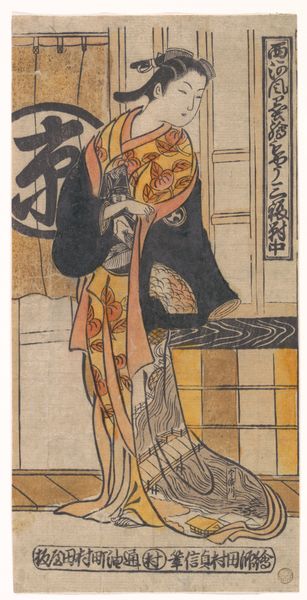
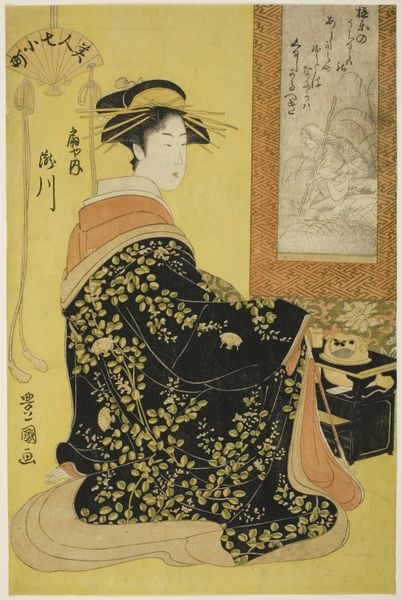
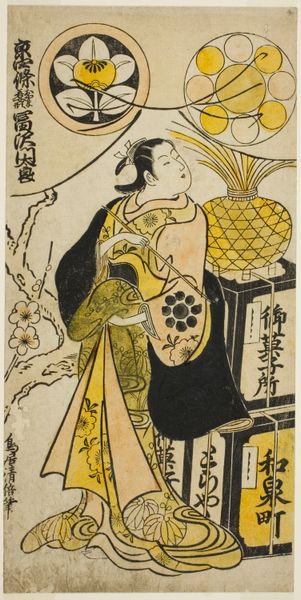
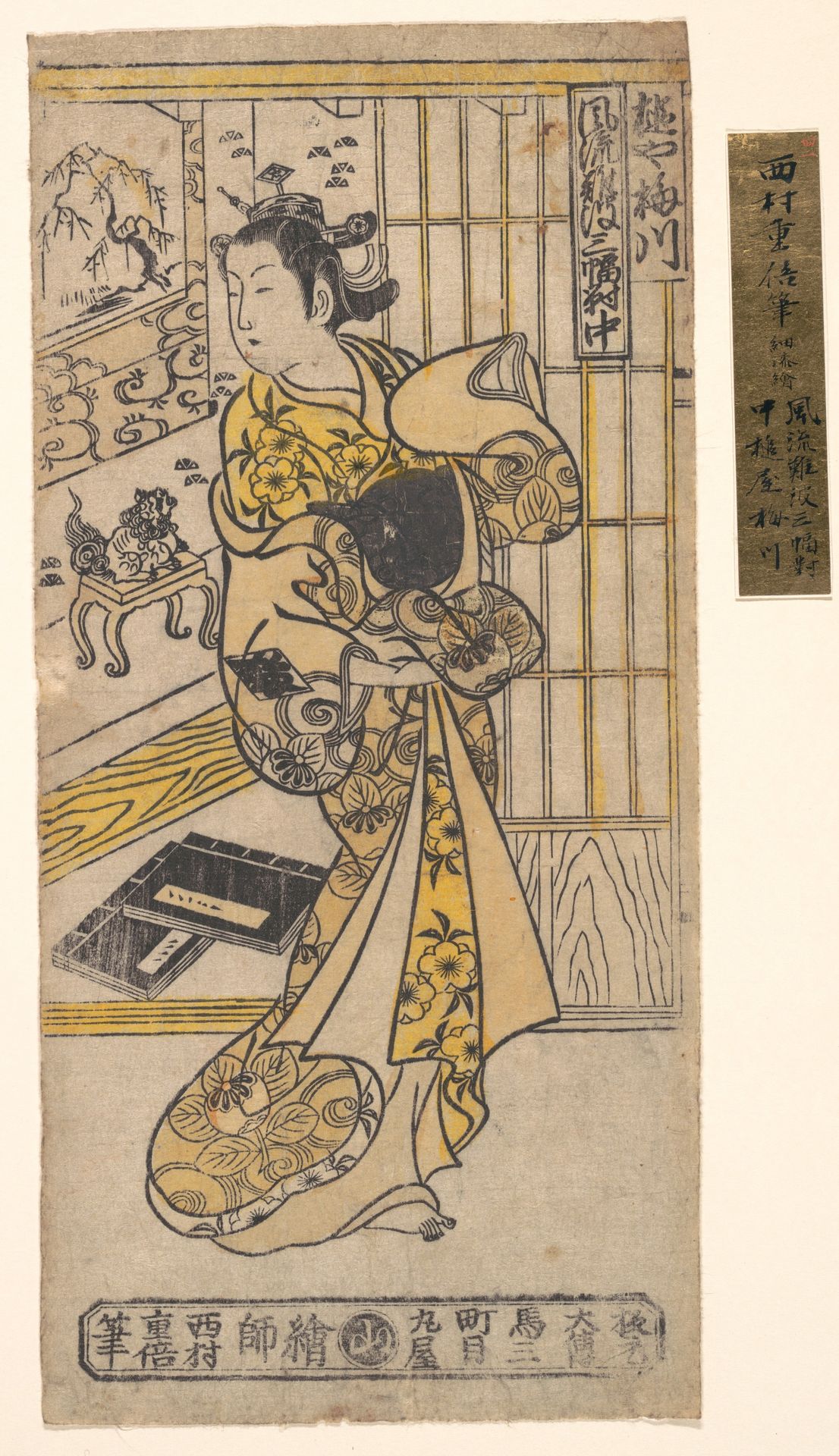
This woodblock print, "The House of Umegawa," by Nishimura Shigenobu, presents us with a window into the Edo period in Japan. The image is dominated by Umegawa herself. Notice the floral motifs adorning her kimono, symbols of beauty but also ephemerality. These blossoms, which recur throughout art history, evoke cycles of life and renewal. We might recall similar floral patterns in ancient Minoan frescoes, where nature embodies vitality. Yet, in Umegawa's time, these symbols carried complex meanings, reflecting a transient and often melancholic view of life. The almost spectral, lion-dog guardian statue to her left might bring to mind similar protective figures from ancient Egypt. Like the Sphinx, these figures guard sacred spaces, embodying vigilance. Here, the statue is reduced to a mere object, stripped of its religious significance. Ultimately, the image is imbued with a poignant sense of emotional complexity, the kind of cyclical nature of symbols, constantly reappearing, evolving, and resonating across centuries.
The House of Umegawa
1615 - 1868

Nishimura Shigenobu
1729 - 1739
The Metropolitan Museum of Art
Metropolitan Museum of Art, New York, NYArtwork details
- Medium
- print, ink
- Dimensions
- 12 1/2 in. x 6 in. (31.8 x 15.2 cm)
- Location
- Metropolitan Museum of Art, New York, NY
- Copyright
- Public Domain
Tags
Comments
Share your thoughts
About this artwork
This woodblock print, "The House of Umegawa," by Nishimura Shigenobu, presents us with a window into the Edo period in Japan. The image is dominated by Umegawa herself. Notice the floral motifs adorning her kimono, symbols of beauty but also ephemerality. These blossoms, which recur throughout art history, evoke cycles of life and renewal. We might recall similar floral patterns in ancient Minoan frescoes, where nature embodies vitality. Yet, in Umegawa's time, these symbols carried complex meanings, reflecting a transient and often melancholic view of life. The almost spectral, lion-dog guardian statue to her left might bring to mind similar protective figures from ancient Egypt. Like the Sphinx, these figures guard sacred spaces, embodying vigilance. Here, the statue is reduced to a mere object, stripped of its religious significance. Ultimately, the image is imbued with a poignant sense of emotional complexity, the kind of cyclical nature of symbols, constantly reappearing, evolving, and resonating across centuries.
Comments
Share your thoughts