Dimensions: 62 x 70 cm
Copyright: Public domain US
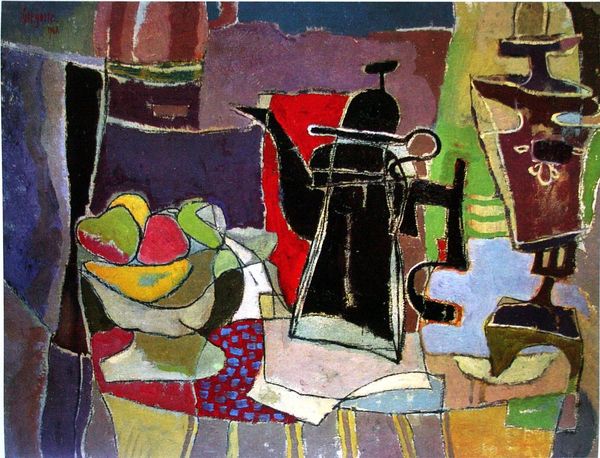
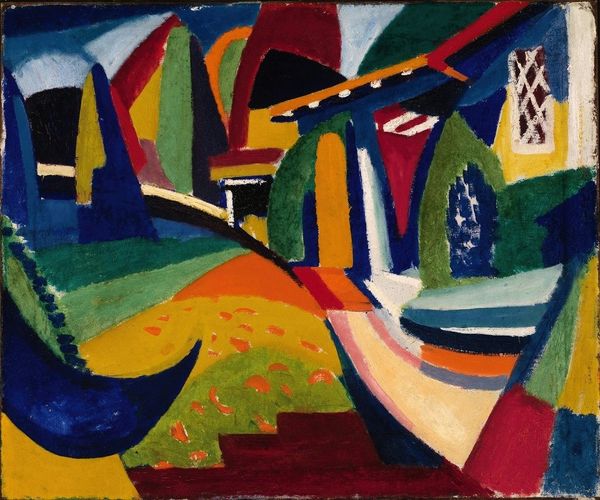
Curator: We're looking at "North South," a collage and oil painting by Joan Miró, created in 1917. It's currently held in a private collection. Editor: Woah. My first thought is... vibrant chaos. It’s like a joyful explosion on a canvas, but controlled chaos, you know? So many objects jammed together, it makes me feel energized, almost anxious, with all the colours. Curator: Precisely. Consider Miró's historical context here. It’s during the First World War, a time of intense societal upheaval. We can see elements of Cubism and early Dadaism bubbling, a rebellion against established artistic and social orders. That energy you're picking up? It's a generation questioning everything. Editor: Right! I can totally see that. Especially with the “Nord-Sud” label so prominently displayed; that was the name of Pierre Reverdy's avant-garde magazine at the time. It's like he's planting his flag firmly in the 'new'. There's something almost… punk about it. Curator: Exactly. And look at the still life arrangement—flowers, a birdcage, even a book titled “Goethe.” Everyday objects, but disrupted, fragmented, rendered almost unrecognizable through the lens of abstraction. Miró uses that tension between recognizable imagery and abstraction to question what art even *is*. Editor: True, you got your recognizable elements – bird in a cage, cute scissors... But everything's slightly off-kilter. The composition creates these jarring relationships – a playful juxtaposition, kind of cheeky, almost. And those intense greens, reds, and yellows – he wasn't shy! It screams personality to me. It’s an expression of inner space using these almost violent visual means. Curator: Indeed. Think of Fauvism—the use of wild, expressive color, untethered from reality. It also foreshadows his later forays into Surrealism, where the subconscious reigns supreme. Considering theories around artistic intentionality in early Modernist works, there seems to be no limitations when representing an artistic space for the author. This feels like it opened up the artist’s world to all possibilities, for the rest of his work to come. Editor: I completely agree. Now, seeing it this way, it feels a lot more profound than my initial read. The more you consider his intentions, it becomes apparent that those playful elements serve a bigger purpose – expressing something turbulent within that artistic landscape, opening up more than meets the eye.
Comments
No comments
Be the first to comment and join the conversation on the ultimate creative platform.
 Collect
 React
React Comment
More like this