About this artwork
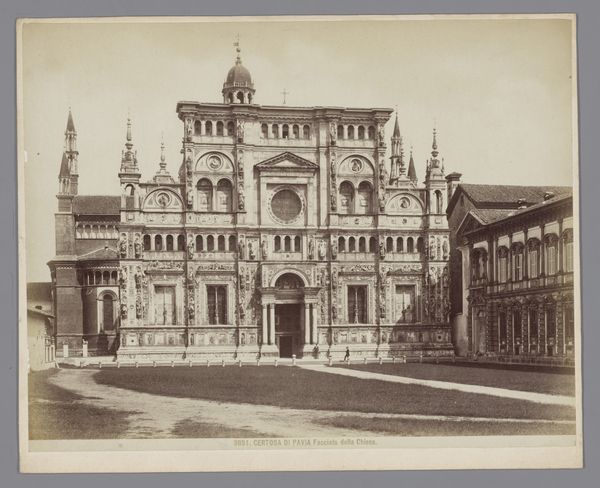
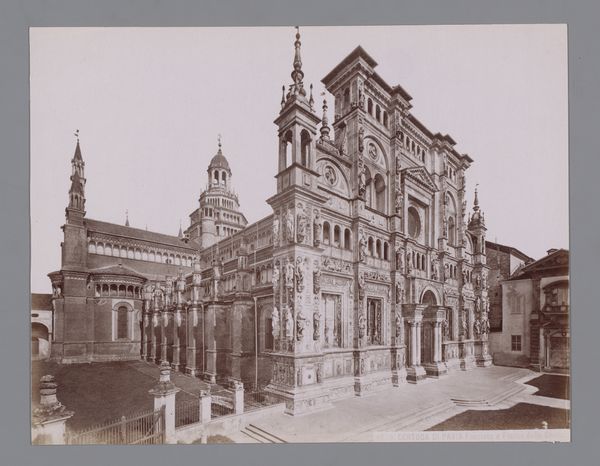
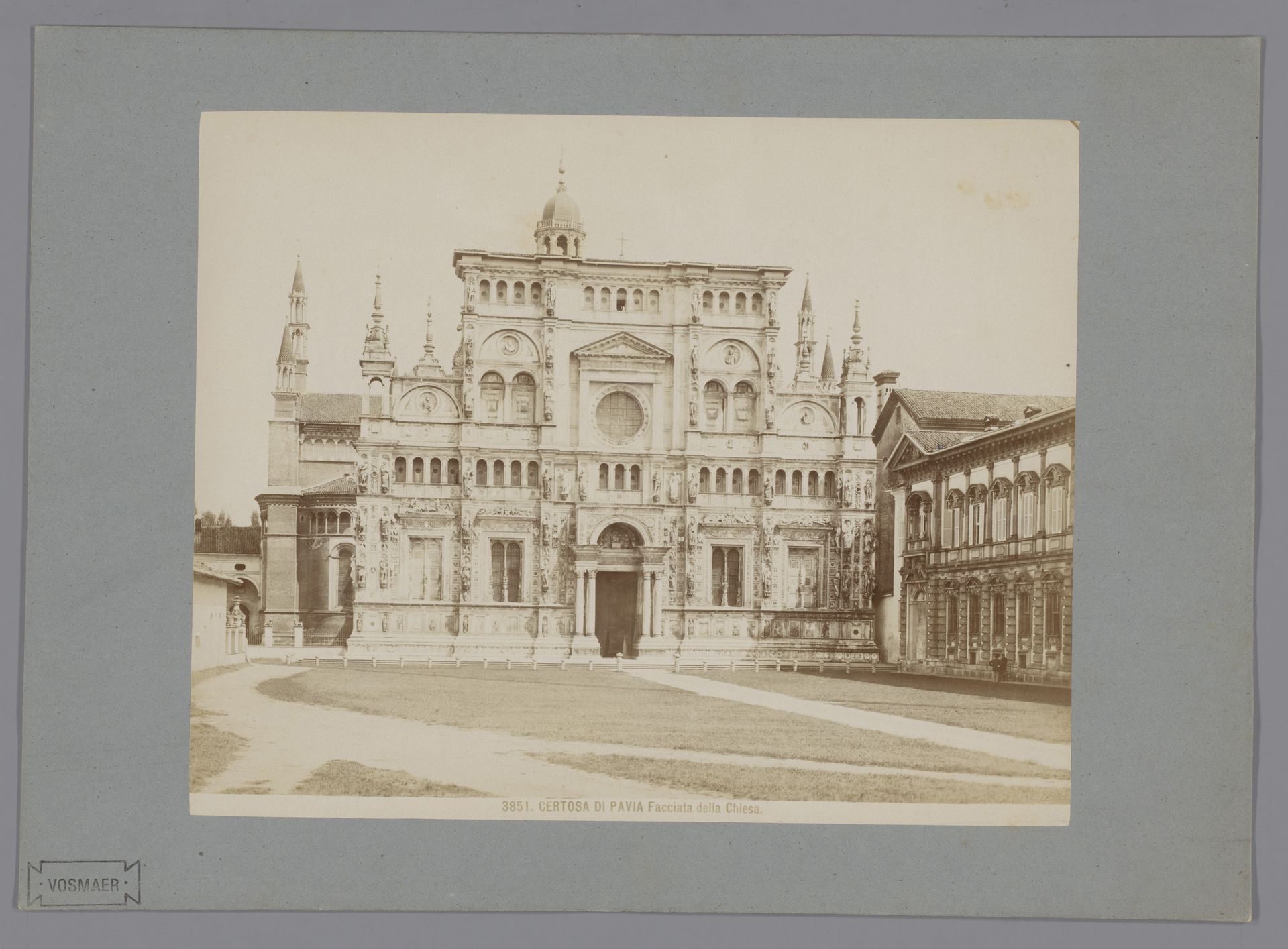
Curator: Before us, we have an albumen print by Giacomo Brogi, titled "Façade van de kloosterkerk van Pavia," dating between 1864 and 1884. Editor: The sheer scale! It almost overwhelms the frame. All those elaborate details captured with such clarity—the perfect symmetry of the facade is quite powerful. Curator: Indeed. Brogi, in capturing the Certosa di Pavia, presents more than just a building; he presents a symbol of power and piety. Consider how photography, at the time, played a crucial role in documenting and disseminating architectural achievements, reinforcing certain cultural values. Editor: From a formal perspective, look at the way light models the architecture. It's distributed evenly across the frontage—an intentional aesthetic choice, creating a harmonious surface instead of deep contrasting shadows. This treatment adds to the monumental presence. Curator: That evenness, I think, is partially a product of the technical constraints of early photography, but also reflects the desire to create an objective record. It was a time when institutions, including the Church, were grappling with modernity and photography offered a tool to project authority. Editor: Do you think that a deeper contrast would disrupt this "objective" effect? Curator: It might introduce drama or perhaps a critical perspective, unsettling the established order implied by the structure. Brogi, though, it appears, used soft light as a tool to emphasize a sense of enduring, unassailable power. Editor: It’s like he carefully avoids expressing his own views by way of contrasting shadows—he acts like a stenographer whose sole objective is accurate record. Very curious approach. What I am impressed by is how all those geometric masses—the blocks, arches, squares, and curves—form such a cohesive structure. Curator: Right. The photograph itself is thus not merely a snapshot, but a meticulously crafted cultural artifact reflecting and shaping perceptions of institutions and history. Editor: Ultimately, both the photographic technique and the careful artistic choices work in synergy, don't they, contributing to how the artwork can still engage the viewers more than a century later? Curator: Absolutely, and this understanding highlights the crucial interplay between visual language, technology and the dynamics of societal influence when looking at art history.

Artwork details
- Medium
- print, photography, albumen-print, architecture
- Dimensions
- height 204 mm, width 254 mm, height 255 mm, width 356 mm
- Copyright
- Rijks Museum: Open Domain
Tags
Comments
Share your thoughts
About this artwork
Curator: Before us, we have an albumen print by Giacomo Brogi, titled "Façade van de kloosterkerk van Pavia," dating between 1864 and 1884. Editor: The sheer scale! It almost overwhelms the frame. All those elaborate details captured with such clarity—the perfect symmetry of the facade is quite powerful. Curator: Indeed. Brogi, in capturing the Certosa di Pavia, presents more than just a building; he presents a symbol of power and piety. Consider how photography, at the time, played a crucial role in documenting and disseminating architectural achievements, reinforcing certain cultural values. Editor: From a formal perspective, look at the way light models the architecture. It's distributed evenly across the frontage—an intentional aesthetic choice, creating a harmonious surface instead of deep contrasting shadows. This treatment adds to the monumental presence. Curator: That evenness, I think, is partially a product of the technical constraints of early photography, but also reflects the desire to create an objective record. It was a time when institutions, including the Church, were grappling with modernity and photography offered a tool to project authority. Editor: Do you think that a deeper contrast would disrupt this "objective" effect? Curator: It might introduce drama or perhaps a critical perspective, unsettling the established order implied by the structure. Brogi, though, it appears, used soft light as a tool to emphasize a sense of enduring, unassailable power. Editor: It’s like he carefully avoids expressing his own views by way of contrasting shadows—he acts like a stenographer whose sole objective is accurate record. Very curious approach. What I am impressed by is how all those geometric masses—the blocks, arches, squares, and curves—form such a cohesive structure. Curator: Right. The photograph itself is thus not merely a snapshot, but a meticulously crafted cultural artifact reflecting and shaping perceptions of institutions and history. Editor: Ultimately, both the photographic technique and the careful artistic choices work in synergy, don't they, contributing to how the artwork can still engage the viewers more than a century later? Curator: Absolutely, and this understanding highlights the crucial interplay between visual language, technology and the dynamics of societal influence when looking at art history.
Comments
Share your thoughts