1625 - 1690
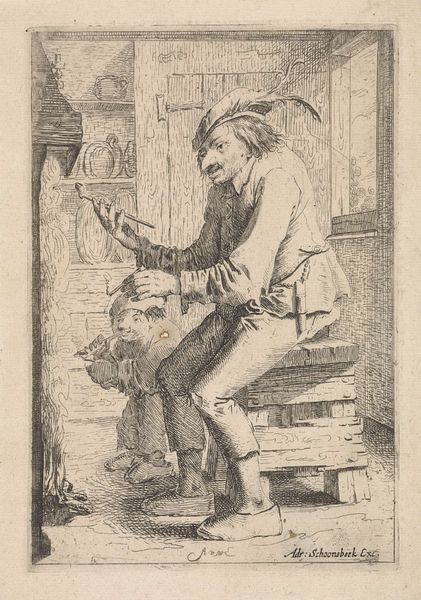
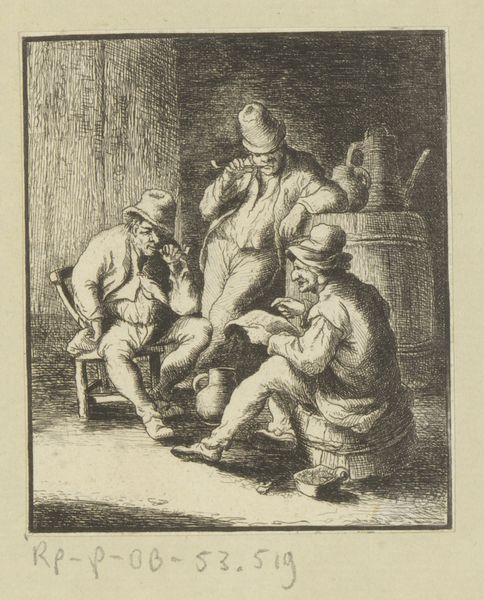
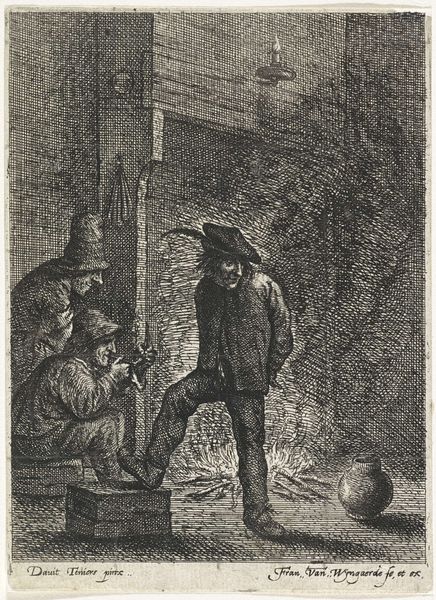
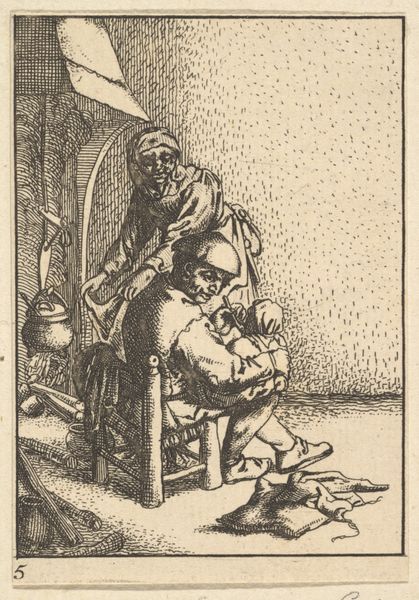
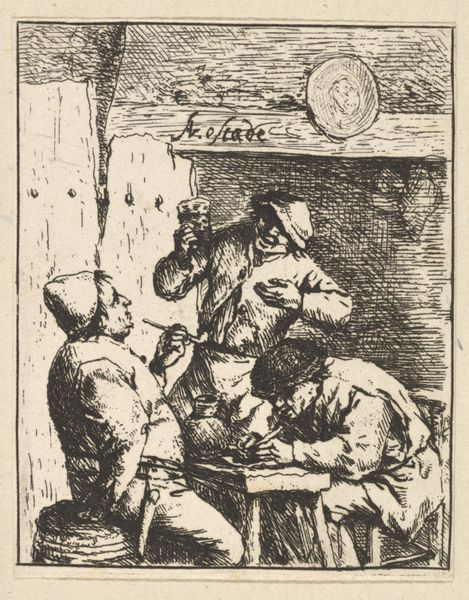
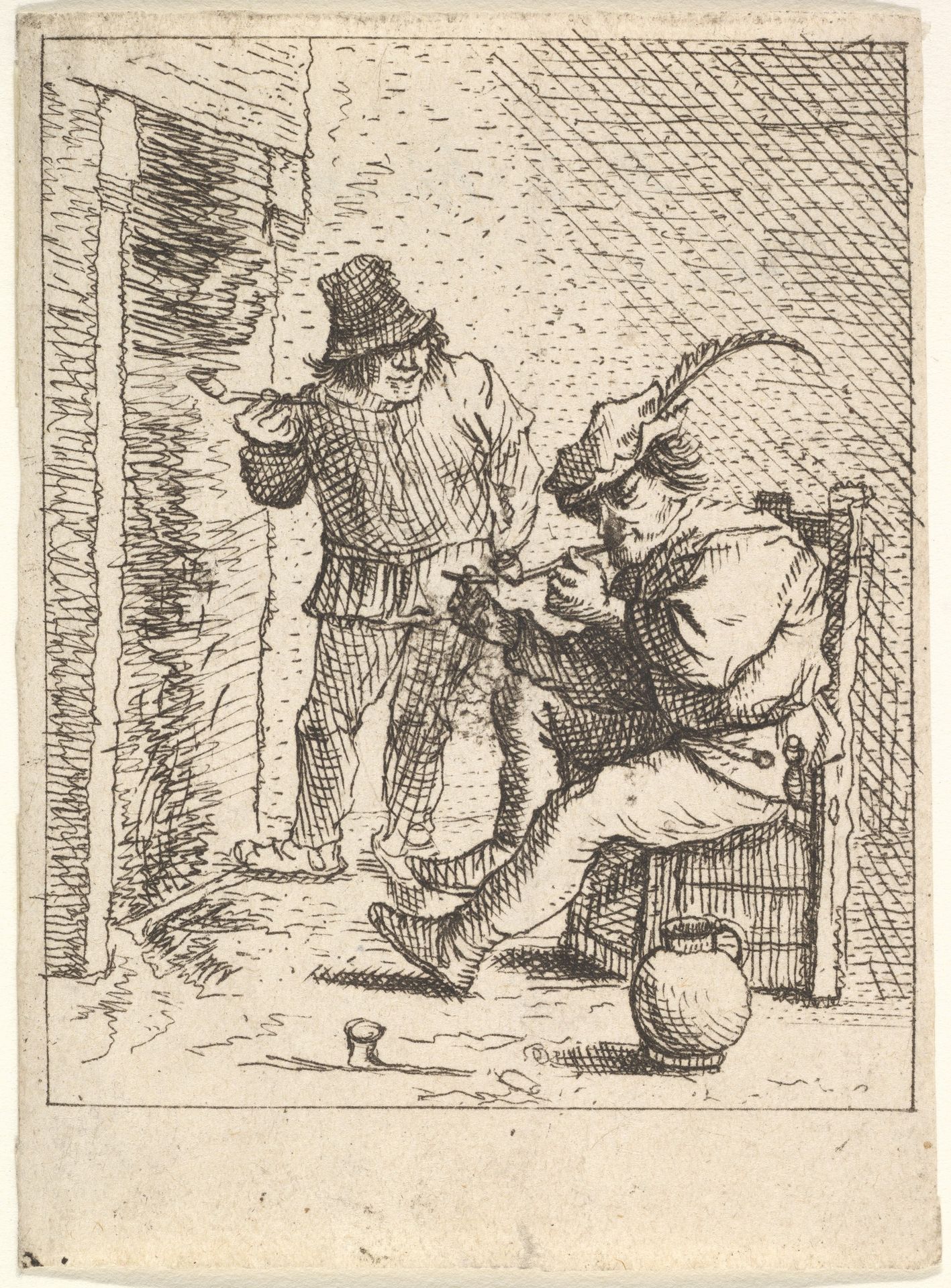
Two male peasants holding pipes before a fireplace, one seated with the pipe held to his mouth, to his left the other stands with the pipe in his right hand, after a series of four prints of peasants by David Teniers the Younger

David Teniers The Younger
1610 - 1690
The Metropolitan Museum of Art
Metropolitan Museum of Art, New York, NYListen to curator's interpretation
Curatorial notes
Curator: Before us is a rather intimate genre scene rendered in etching. The piece, attributed to David Teniers the Younger and created sometime between 1625 and 1690, is entitled "Two male peasants holding pipes before a fireplace, one seated with the pipe held to his mouth, to his left the other stands with the pipe in his right hand, after a series of four prints of peasants." Editor: It evokes a strong sense of relaxation and camaraderie, wouldn't you agree? The loose hatching gives the whole piece a smoky, almost hazy atmosphere, and its compact size focuses on the figures. Curator: Yes, the scale is essential. The artist manipulates line weight to distinguish forms; notice the cross-hatching creating depth. Consider how these technical choices reflect the core Baroque aesthetic. Editor: Absolutely. The pipes, of course, are central. The figure on the left presents his pipe with a hand gesture, and that pipe-offering stands out as a motif—suggesting hospitality, bonding. The visual of the pipe has long symbolized relaxation but can signify more complex social contracts, too. Curator: Certainly. And look at how the artist creates spatial ambiguity within this planar work. The lack of sharp perspective and inconsistent hatching generate a tension, denying the viewer a stable sense of location. Editor: But, the heart and meaning of the scene are obvious, even to contemporary viewers—a shared smoke, a convivial exchange, sheltered from some bitter wind outside; human rituals and symbols never truly fade. Curator: That's perceptive. Considering these observations, it’s the interplay between what is evident and what remains stylistically enigmatic that makes the piece particularly engaging for me. Editor: Indeed, and for me, it is about accessing what endures in human culture, represented here in this image, which serves to represent and embody universal aspects of companionship.