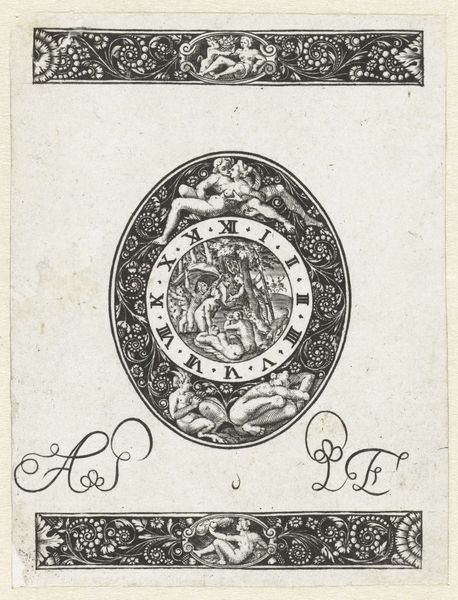
Embleem met krab en vlinder in ovale cartouche met rolwerk 1538 - 1562
0:00
0:00

hansiiholbein
Rijksmuseum
Dimensions: height 46 mm, width 35 mm
Copyright: Rijks Museum: Open Domain
This emblem, featuring a crab and butterfly, was made by Hans Holbein the Younger using the printmaking technique of engraving. This involved meticulously incising lines into a metal plate, which would then be inked and printed. Look closely, and you’ll notice the crisp precision of the engraved lines. The stark contrast between the black ink and the white paper gives the image a graphic punch. The design itself, with its symmetrical composition and symbolic imagery, speaks to the broader cultural context of the Renaissance. The crab and butterfly motif, framed within an ornate cartouche, probably carried allegorical meaning for viewers at the time. It demonstrates Holbein’s mastery of a demanding process, one that required not only technical skill, but also a deep understanding of visual language. By considering the materials and making of this emblem, we appreciate how printmaking enabled the wide distribution of images. This engraving testifies to the value placed on craftsmanship, design, and the power of visual communication.
Comments
No comments
Be the first to comment and join the conversation on the ultimate creative platform.
 Collect
 React
React Comment
More like this