About this artwork
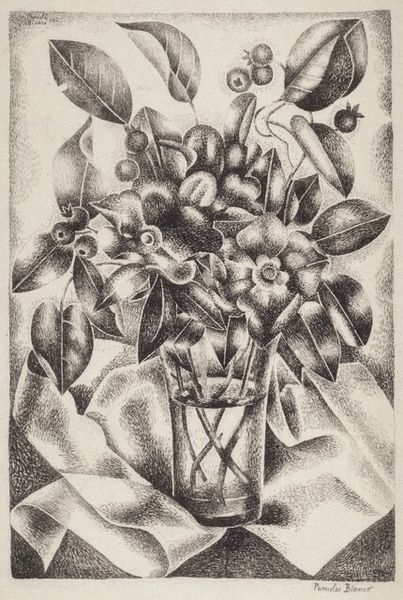
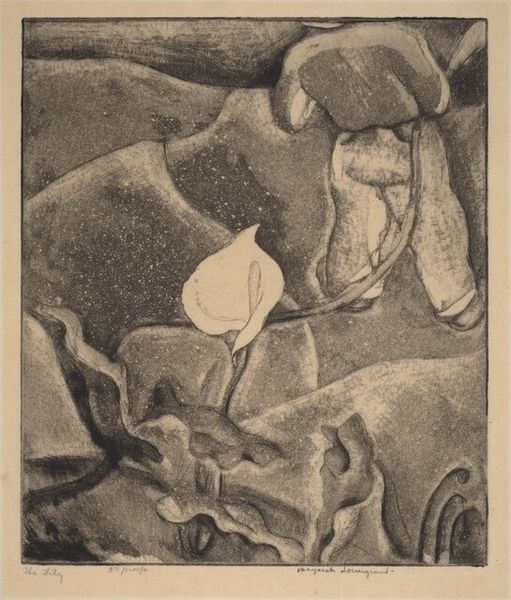
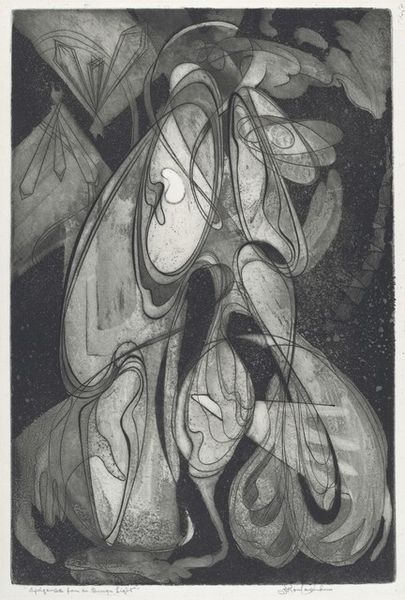
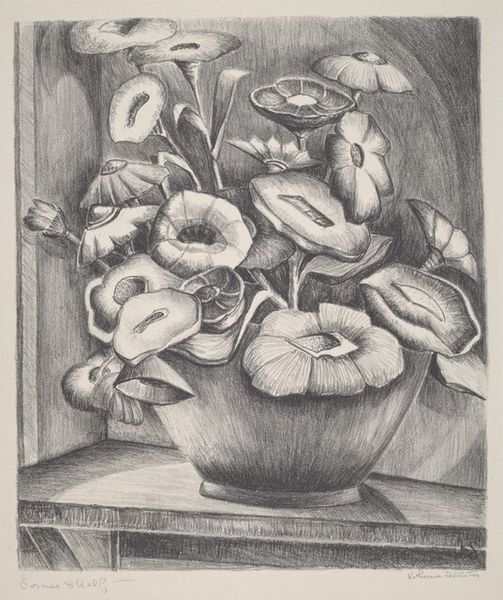
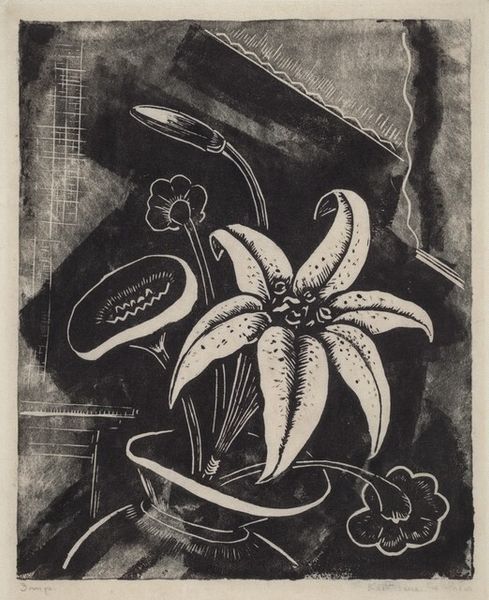
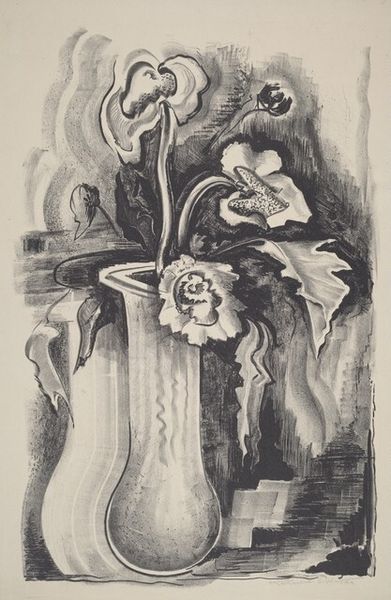
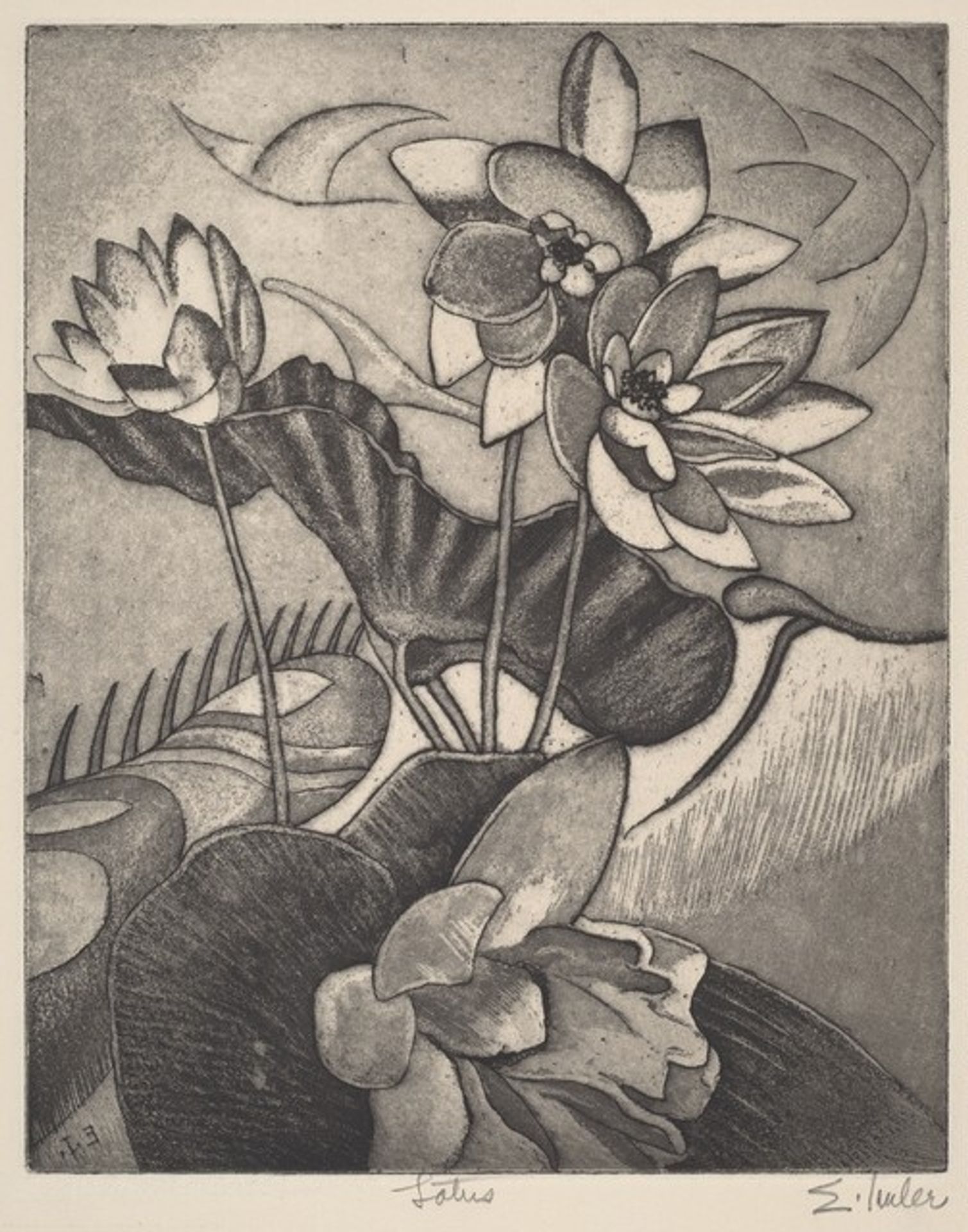
Editor: This is Edgar Imler's "Lotus," made sometime between 1935 and 1943. It's a black and white print that strikes me as both delicate and boldly graphic. I'm drawn to the interplay between the abstract and the representational. What do you see in this piece, particularly given the period it was made? Curator: The period is key. The 30s and early 40s were dominated by social realism, but also, and crucially, by the Works Progress Administration. The WPA's Federal Art Project employed artists to create works, and provided opportunities. Looking at this "Lotus" through that lens, I wonder: how did Imler navigate the demands for accessibility, the push towards American Scene painting, and maintain a clear engagement with Modernist abstraction? Do you see a tension here? Editor: I do, now that you mention it. The lotus, of course, has symbolic associations that might resonate with a wider public, particularly around spiritual or natural themes. But the stylized leaves and almost cubist rendering complicate a straightforward reading. Was he perhaps trying to balance artistic integrity with broader accessibility? Curator: Precisely. Think about the public role of art in that era. Artists were practically being asked to perform patriotism through imagery, while institutions navigated funding pressures. This "Lotus" almost seems to resist a total surrender to either extreme – accessible subject matter but through a modernist style. How do you think the printmaking medium factors into this discussion? Editor: That's interesting, because printmaking democratizes art by its very nature, right? This could've been widely disseminated, reaching people outside of traditional gallery settings. So maybe the abstraction functions not as elitism but as a contemporary visual language presented to the masses. Curator: Exactly! It invites people in, hopefully sparking discussion. What a simple yet very complex little print. Editor: Absolutely! It highlights how intertwined artistic expression, political expectations, and social reach can be. Curator: And challenges assumptions about abstraction, showing us its role in democratizing access to art.


Artwork details
- Medium
- drawing, graphic-art, print
- Dimensions
- image: 250 x 220 mm sheet: 405 x 292 mm
- Copyright
- National Gallery of Art: CC0 1.0
Tags
drawing
graphic-art
abstraction
modernism
Comments
No comments
About this artwork
Editor: This is Edgar Imler's "Lotus," made sometime between 1935 and 1943. It's a black and white print that strikes me as both delicate and boldly graphic. I'm drawn to the interplay between the abstract and the representational. What do you see in this piece, particularly given the period it was made? Curator: The period is key. The 30s and early 40s were dominated by social realism, but also, and crucially, by the Works Progress Administration. The WPA's Federal Art Project employed artists to create works, and provided opportunities. Looking at this "Lotus" through that lens, I wonder: how did Imler navigate the demands for accessibility, the push towards American Scene painting, and maintain a clear engagement with Modernist abstraction? Do you see a tension here? Editor: I do, now that you mention it. The lotus, of course, has symbolic associations that might resonate with a wider public, particularly around spiritual or natural themes. But the stylized leaves and almost cubist rendering complicate a straightforward reading. Was he perhaps trying to balance artistic integrity with broader accessibility? Curator: Precisely. Think about the public role of art in that era. Artists were practically being asked to perform patriotism through imagery, while institutions navigated funding pressures. This "Lotus" almost seems to resist a total surrender to either extreme – accessible subject matter but through a modernist style. How do you think the printmaking medium factors into this discussion? Editor: That's interesting, because printmaking democratizes art by its very nature, right? This could've been widely disseminated, reaching people outside of traditional gallery settings. So maybe the abstraction functions not as elitism but as a contemporary visual language presented to the masses. Curator: Exactly! It invites people in, hopefully sparking discussion. What a simple yet very complex little print. Editor: Absolutely! It highlights how intertwined artistic expression, political expectations, and social reach can be. Curator: And challenges assumptions about abstraction, showing us its role in democratizing access to art.
Comments
No comments