About this artwork
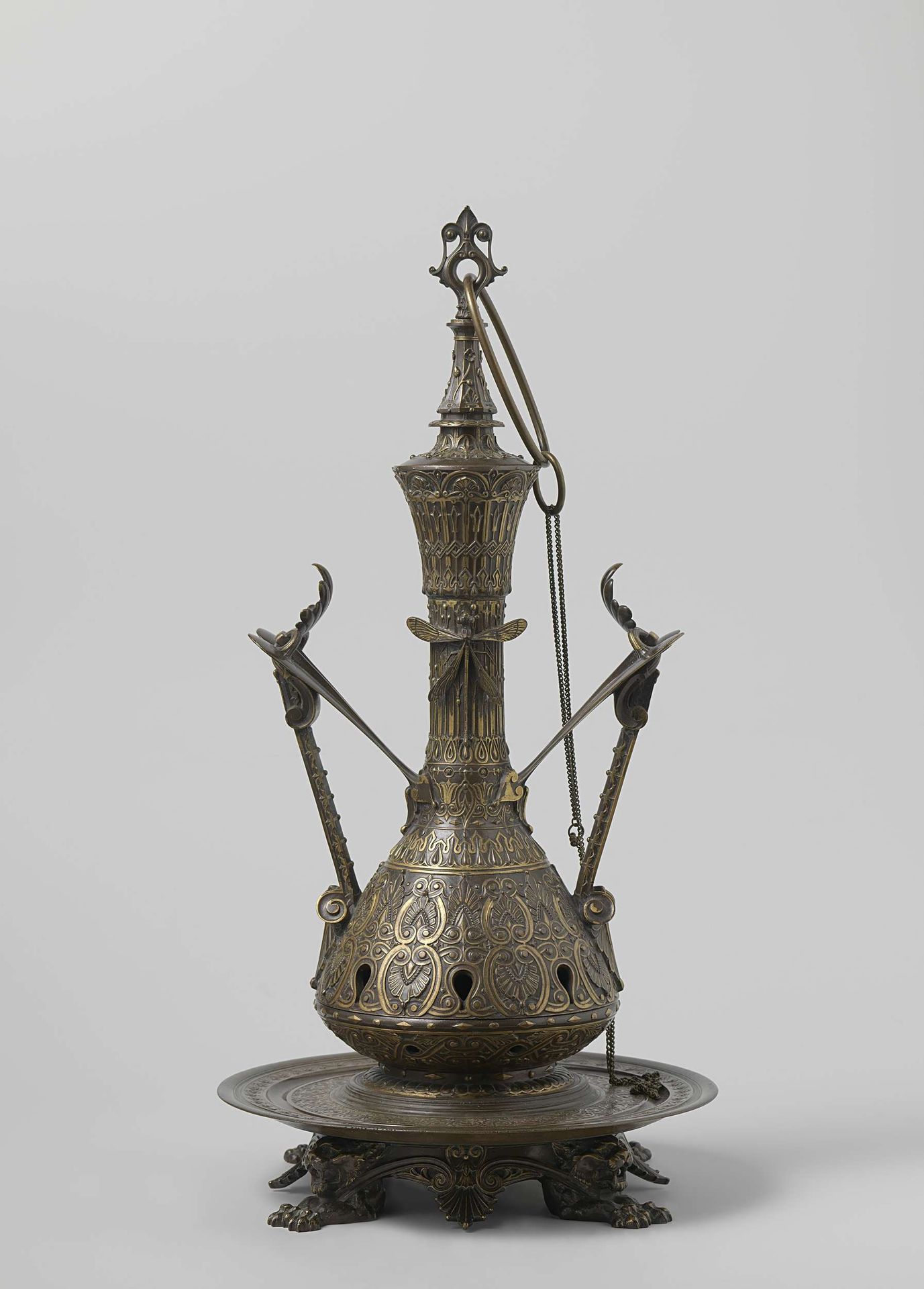
Editor: Here we have Ferdinand Barbedienne's incense burner, likely crafted between 1855 and 1865, made of bronze. It strikes me as incredibly ornate; the level of detail is astonishing, almost overwhelming. What do you see in this piece, particularly regarding its historical and cultural context? Curator: It’s fascinating how this incense burner embodies the 19th-century European fascination with and appropriation of Islamic art. It reflects Orientalism, a Western gaze that exoticized the East. Think about the power dynamics inherent in that gaze – who is looking, and who is being looked at? Consider how objects like these played a role in shaping European perceptions and often misrepresentations of Islamic culture. Does the burner remind you of any colonial exhibitions that idealized a 'mysterious' Orient? Editor: I hadn’t considered the idea of Orientalism here, although the visual cues are so strong, I suppose I’d never really dug beneath the surface. The almost cartoonish extravagance maybe even participates in the act. I wonder, how do we reconcile appreciating the artistry while acknowledging the problematic context? Curator: It’s a tightrope walk, isn't it? We can appreciate the craftsmanship, the technical skill involved, while simultaneously interrogating the object’s role in perpetuating harmful stereotypes. Thinking critically about its original setting—likely a wealthy European home—forces us to confront issues of class, wealth, and the power to collect and display objects from other cultures. This piece becomes more than just a decorative object; it's a conversation starter. It makes you consider both power and privilege, right? Editor: Yes, absolutely! It definitely gives me much more to think about. Thanks for pointing out those layers. Curator: It's been a stimulating conversation. Now I am questioning my own reading and relation to the object too.

Artwork details
- Medium
- metal, bronze, sculpture
- Dimensions
- height 58 cm, diameter 29 cm
- Copyright
- Rijks Museum: Open Domain
Tags
Comments

The French bronze-founder Ferdinand Barbedienne exhibited this design at the international exhibitions in Paris (1855) and London (1862). The incense burner caused a furore. Its style was referred to as Greek Revival in reviews of these world fairs, but it is actually a mixture of assorted Middle Eastern and natural motifs, such as the large dragonfly on the burner’s neck.
About this artwork
Editor: Here we have Ferdinand Barbedienne's incense burner, likely crafted between 1855 and 1865, made of bronze. It strikes me as incredibly ornate; the level of detail is astonishing, almost overwhelming. What do you see in this piece, particularly regarding its historical and cultural context? Curator: It’s fascinating how this incense burner embodies the 19th-century European fascination with and appropriation of Islamic art. It reflects Orientalism, a Western gaze that exoticized the East. Think about the power dynamics inherent in that gaze – who is looking, and who is being looked at? Consider how objects like these played a role in shaping European perceptions and often misrepresentations of Islamic culture. Does the burner remind you of any colonial exhibitions that idealized a 'mysterious' Orient? Editor: I hadn’t considered the idea of Orientalism here, although the visual cues are so strong, I suppose I’d never really dug beneath the surface. The almost cartoonish extravagance maybe even participates in the act. I wonder, how do we reconcile appreciating the artistry while acknowledging the problematic context? Curator: It’s a tightrope walk, isn't it? We can appreciate the craftsmanship, the technical skill involved, while simultaneously interrogating the object’s role in perpetuating harmful stereotypes. Thinking critically about its original setting—likely a wealthy European home—forces us to confront issues of class, wealth, and the power to collect and display objects from other cultures. This piece becomes more than just a decorative object; it's a conversation starter. It makes you consider both power and privilege, right? Editor: Yes, absolutely! It definitely gives me much more to think about. Thanks for pointing out those layers. Curator: It's been a stimulating conversation. Now I am questioning my own reading and relation to the object too.
Comments
The French bronze-founder Ferdinand Barbedienne exhibited this design at the international exhibitions in Paris (1855) and London (1862). The incense burner caused a furore. Its style was referred to as Greek Revival in reviews of these world fairs, but it is actually a mixture of assorted Middle Eastern and natural motifs, such as the large dragonfly on the burner’s neck.