About this artwork
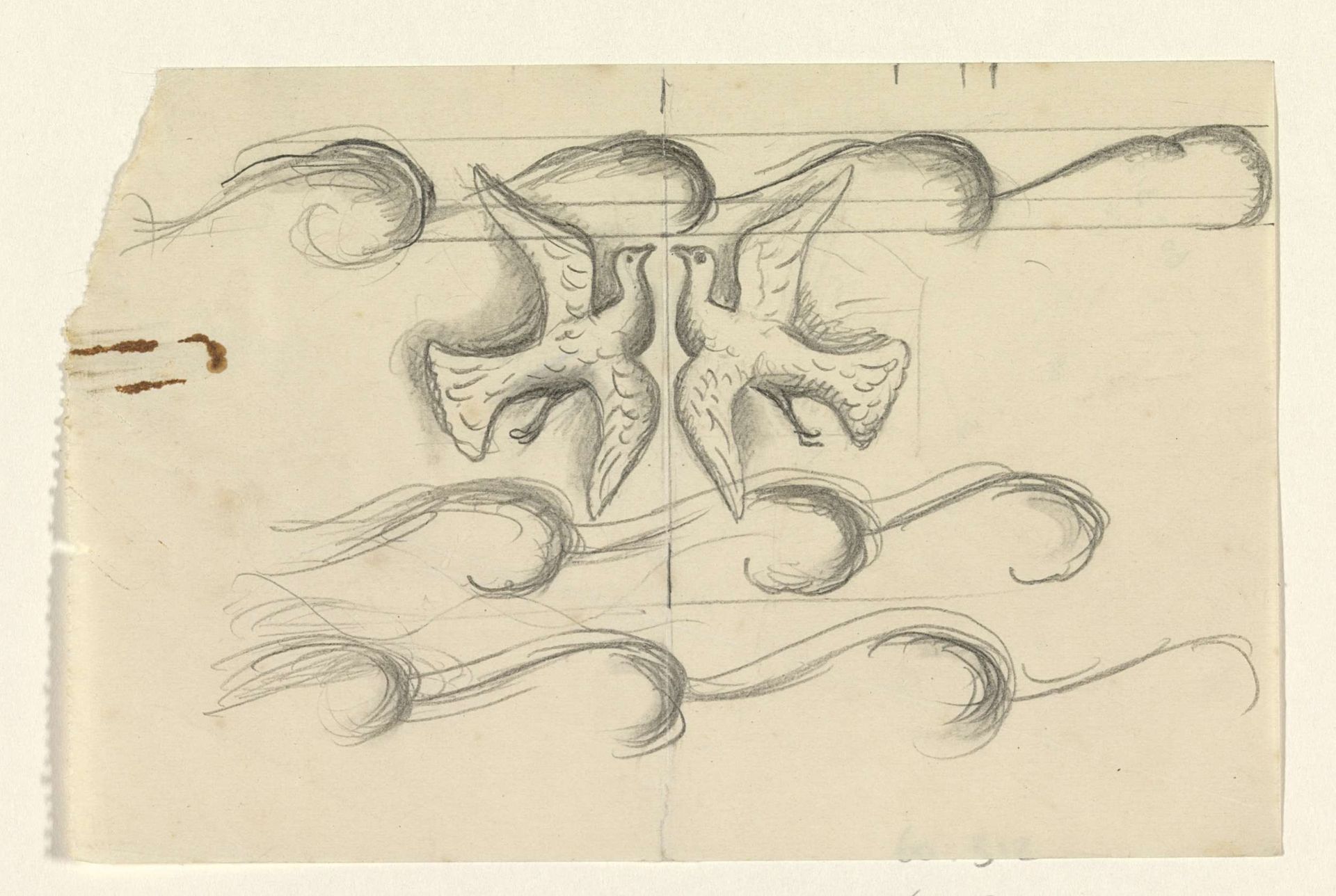
Editor: Here we have Leo Gestel’s "Two Doves Flying Above the Waves," made between 1939 and 1941, a pencil drawing on paper. I'm immediately struck by the repeated wavy lines – it feels both simple and evocative. What do you see in this piece? Curator: As a materialist, I look beyond the doves themselves, beautiful as they are. Consider the physical properties: graphite on paper. What kind of paper? A torn scrap, it seems. Notice the horizontal lines—guidelines. This wasn’t intended as a finished artwork, but perhaps a preparatory sketch for a larger project. The 'waves' are stylized, almost ornamental, like a design for mass production. Does this shift our understanding of Gestel's intent? Editor: So you're saying the process itself is more revealing than the subject matter? The *how* overshadows the *what*? Curator: Precisely. The method hints at the socio-economic context. War was raging, materials were scarce. A larger painting requires significant resources. Perhaps this drawing allowed Gestel to work through ideas without the constraints of costly materials, or, perhaps, he was sketching a textile design to be printed, a more viable form of production during wartime. Editor: I hadn't thought about wartime material constraints impacting art choices! The pencil sketch now speaks of a very different story than I initially understood! Curator: Indeed! We see art not as an isolated creation, but as a product of its time, intimately linked to the material conditions of its making. Looking closely at process and material opens our minds to those possibilities.

Artwork details
- Medium
- drawing, paper, pencil
- Dimensions
- height 100 mm, width 154 mm
- Location
- Rijksmuseum
- Copyright
- Rijks Museum: Open Domain
Tags
Comments
Share your thoughts
About this artwork
Editor: Here we have Leo Gestel’s "Two Doves Flying Above the Waves," made between 1939 and 1941, a pencil drawing on paper. I'm immediately struck by the repeated wavy lines – it feels both simple and evocative. What do you see in this piece? Curator: As a materialist, I look beyond the doves themselves, beautiful as they are. Consider the physical properties: graphite on paper. What kind of paper? A torn scrap, it seems. Notice the horizontal lines—guidelines. This wasn’t intended as a finished artwork, but perhaps a preparatory sketch for a larger project. The 'waves' are stylized, almost ornamental, like a design for mass production. Does this shift our understanding of Gestel's intent? Editor: So you're saying the process itself is more revealing than the subject matter? The *how* overshadows the *what*? Curator: Precisely. The method hints at the socio-economic context. War was raging, materials were scarce. A larger painting requires significant resources. Perhaps this drawing allowed Gestel to work through ideas without the constraints of costly materials, or, perhaps, he was sketching a textile design to be printed, a more viable form of production during wartime. Editor: I hadn't thought about wartime material constraints impacting art choices! The pencil sketch now speaks of a very different story than I initially understood! Curator: Indeed! We see art not as an isolated creation, but as a product of its time, intimately linked to the material conditions of its making. Looking closely at process and material opens our minds to those possibilities.
Comments
Share your thoughts