About this artwork
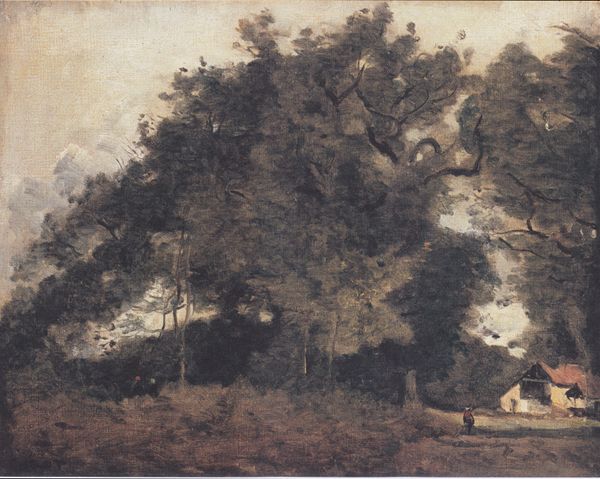
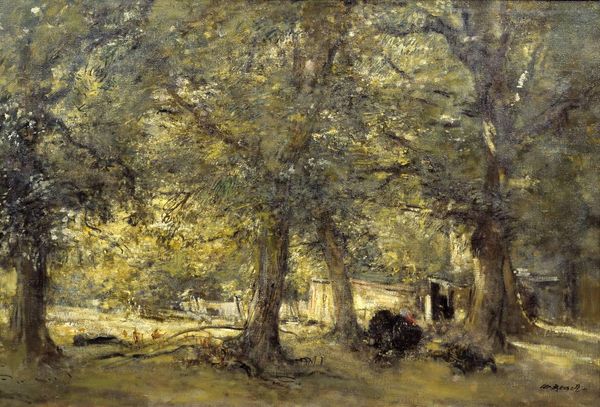
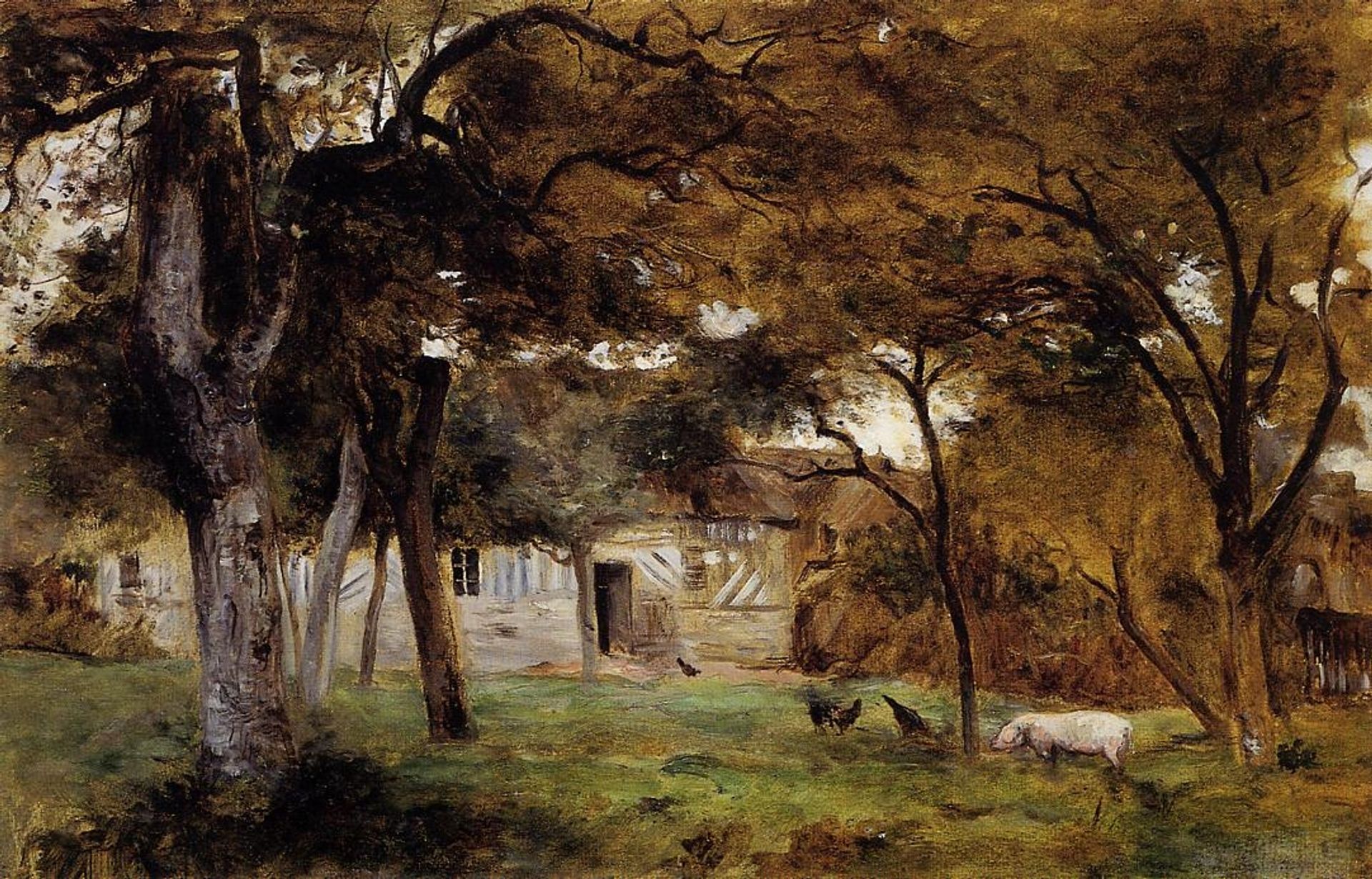
Curator: Standing before us is Berthe Morisot's "Farm in Normandy," painted around 1860. It's an oil painting, very much in the plein-air style, now held in a private collection. Editor: Right away, I get this almost dreamy, dappled feeling. The light is so soft, filtering through the trees, and the whole scene feels very intimate, almost like a secret glimpsed through a leafy curtain. Curator: That sensation of being hidden and privy resonates with Impressionist concerns—capturing a fleeting moment. The farm, shrouded by trees, can symbolize both refuge and concealment. Farms were crucial societal symbols. Are we, perhaps, also observing the transience of a specific way of life? Editor: Maybe. Or, she just liked the way the light played on the leaves! I do see what you mean, though. It’s not a grand, sweeping landscape, but a very contained one. There is a pig in the foreground – perhaps symbols of sustenance, wealth, or even earthly delights? It looks content, doesn’t it? There is also this beautiful muted palette—mostly browns, greens, and creams—creating such a sense of warmth. Curator: I see how the limited palette can seem soothing. We need to remember how the Impressionists valued light, and here Morisot certainly explores luminosity. We could argue that pigs and chickens stand for bucolic charm, referencing classic landscape painting... a comforting vision. I read also something else. The animals might represent freedom since they are wandering without a watchman... Editor: You think? Maybe those chickens represent all of us trying to find our place in the pecking order! But seriously, thinking of it as something bigger... Maybe it speaks to this inherent human desire to escape into nature, find that peaceful simplicity, which is becoming rarer nowadays. The Impressionists valued a sense of realism and, sometimes, escape too, no? Curator: Indeed, as the countryside changed due to industrialism and agricultural practices. “Farm in Normandy” seems timeless. Even now, so many still fantasize about an idealized rural setting far from civilization...a potent archetype and dream. Editor: Well, it definitely makes you want to trade in your keyboard for a spade! The layers within a moment…that is some real depth.

Artwork details
- Medium
- painting, plein-air, oil-paint
- Location
- Private Collection
- Copyright
- Public domain
Tags
Comments
Share your thoughts
About this artwork
Curator: Standing before us is Berthe Morisot's "Farm in Normandy," painted around 1860. It's an oil painting, very much in the plein-air style, now held in a private collection. Editor: Right away, I get this almost dreamy, dappled feeling. The light is so soft, filtering through the trees, and the whole scene feels very intimate, almost like a secret glimpsed through a leafy curtain. Curator: That sensation of being hidden and privy resonates with Impressionist concerns—capturing a fleeting moment. The farm, shrouded by trees, can symbolize both refuge and concealment. Farms were crucial societal symbols. Are we, perhaps, also observing the transience of a specific way of life? Editor: Maybe. Or, she just liked the way the light played on the leaves! I do see what you mean, though. It’s not a grand, sweeping landscape, but a very contained one. There is a pig in the foreground – perhaps symbols of sustenance, wealth, or even earthly delights? It looks content, doesn’t it? There is also this beautiful muted palette—mostly browns, greens, and creams—creating such a sense of warmth. Curator: I see how the limited palette can seem soothing. We need to remember how the Impressionists valued light, and here Morisot certainly explores luminosity. We could argue that pigs and chickens stand for bucolic charm, referencing classic landscape painting... a comforting vision. I read also something else. The animals might represent freedom since they are wandering without a watchman... Editor: You think? Maybe those chickens represent all of us trying to find our place in the pecking order! But seriously, thinking of it as something bigger... Maybe it speaks to this inherent human desire to escape into nature, find that peaceful simplicity, which is becoming rarer nowadays. The Impressionists valued a sense of realism and, sometimes, escape too, no? Curator: Indeed, as the countryside changed due to industrialism and agricultural practices. “Farm in Normandy” seems timeless. Even now, so many still fantasize about an idealized rural setting far from civilization...a potent archetype and dream. Editor: Well, it definitely makes you want to trade in your keyboard for a spade! The layers within a moment…that is some real depth.
Comments
Share your thoughts