About this artwork
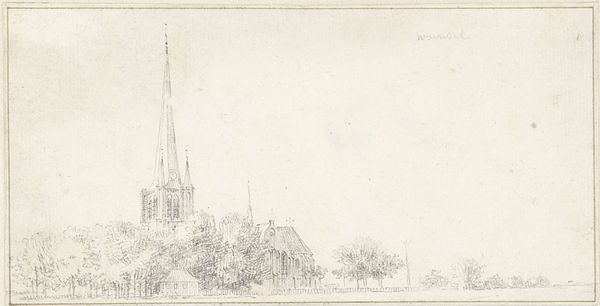
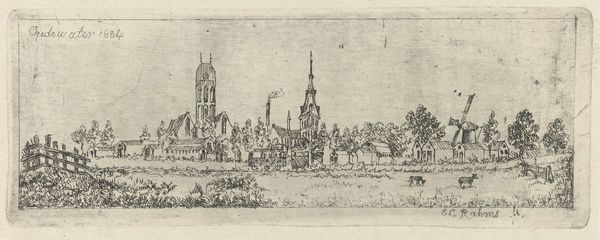
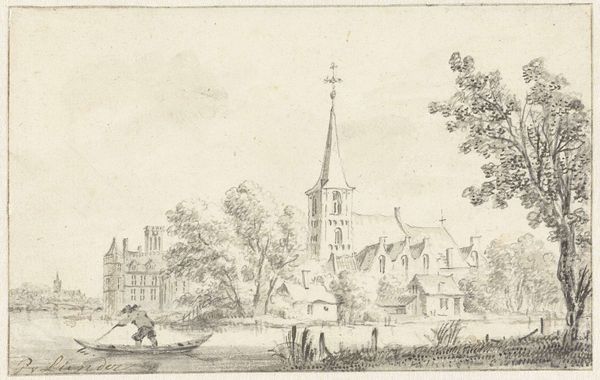
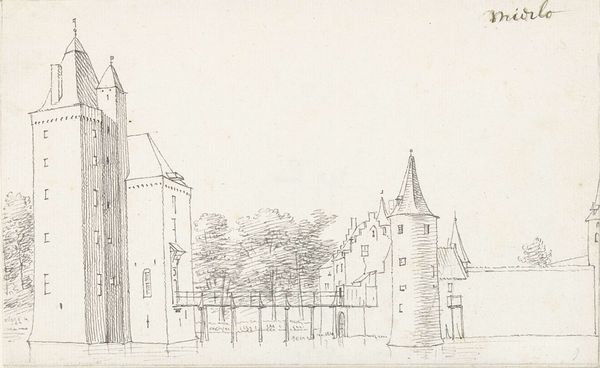
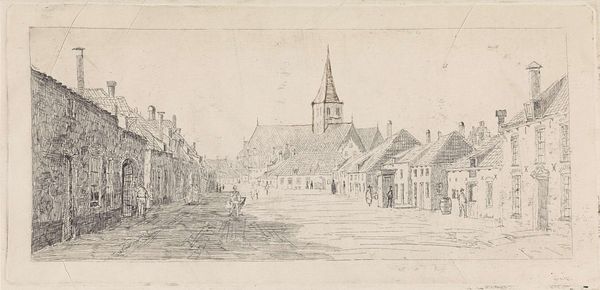
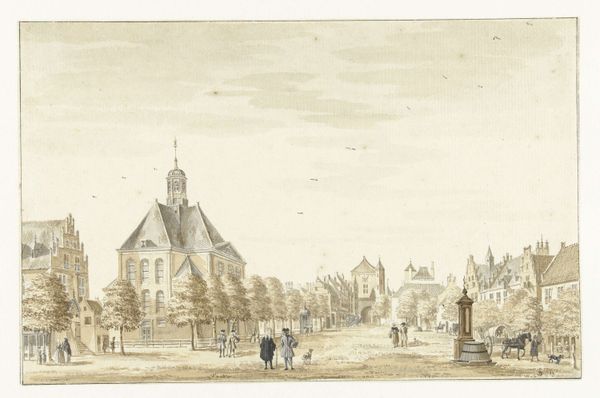
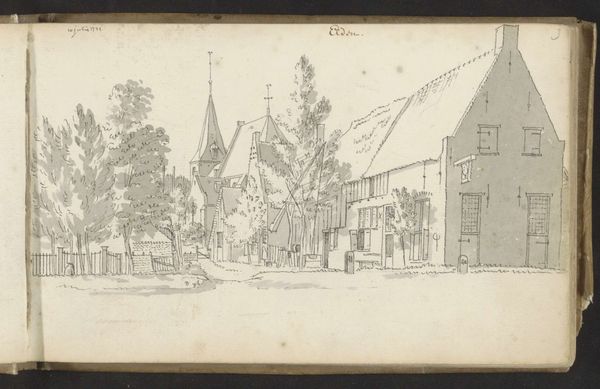
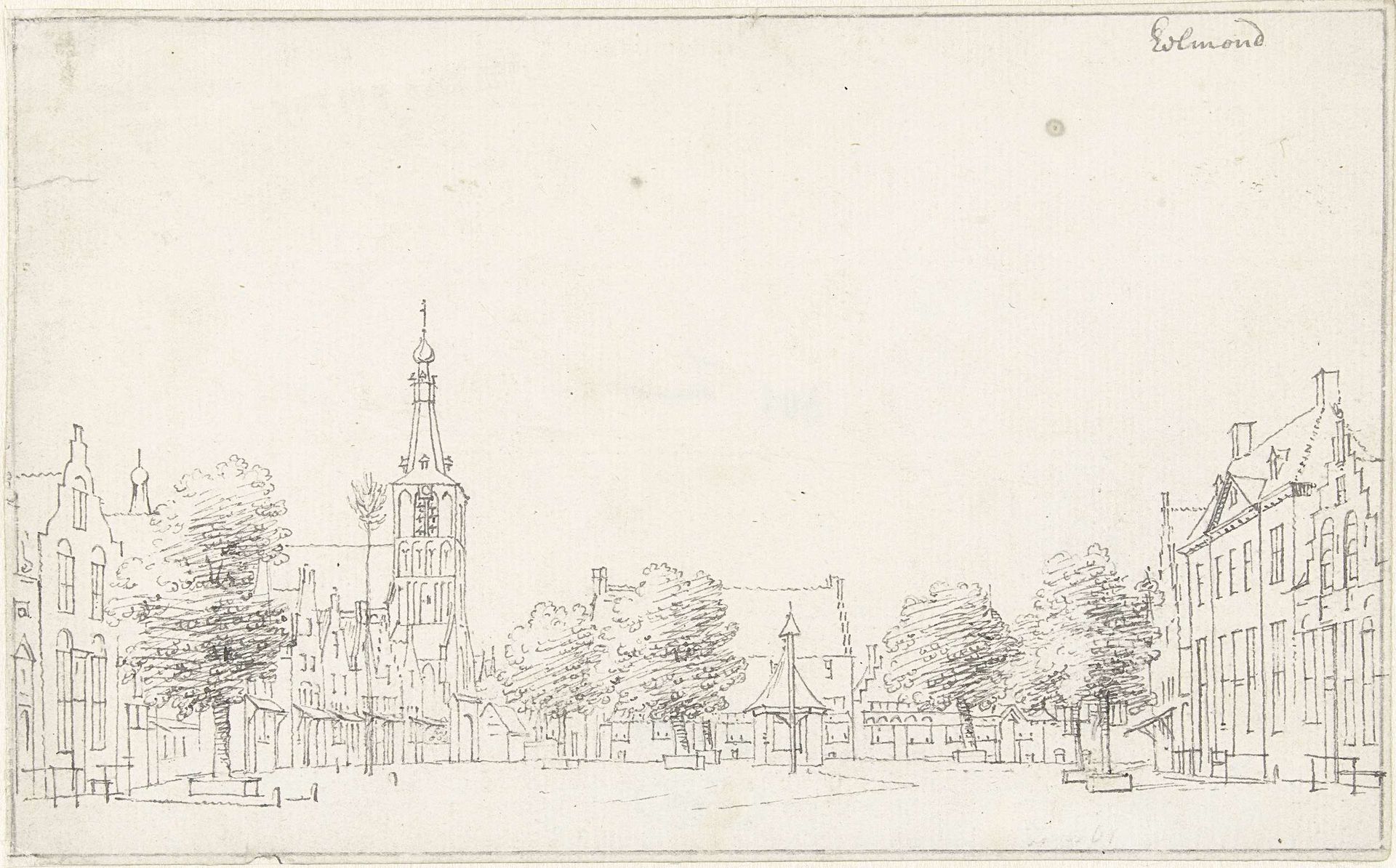
Curator: Looking at this delicate ink and pen drawing by Cornelis Pronk, created sometime between 1720 and 1740, titled "Helmond," you’re immediately transported to what must have been a typical Dutch cityscape of the Golden Age. Editor: It feels incredibly light, almost ethereal. The ink lines are so fine, giving the impression of a fleeting moment captured. It’s sparse, almost empty, but peaceful. What stands out to me is how the church tower dominates the space, yet somehow doesn’t feel imposing. Curator: Pronk was a master of detail, documenting places and events with remarkable precision. It’s more than just a landscape, it's an act of preservation. What we are seeing is Dutch Golden Age through his contemporary lens. Consider that during this period, the Dutch Republic was an artistic epicenter, but also a crucial point for international commerce and burgeoning social complexities. Editor: Right, the social context is everything. Was he commissioned for this, to give Helmond a face? Or perhaps it was just a study? I'm particularly interested in the blank space around it - it does make the town feel slightly…isolated? Was that intentional, do you think? Curator: Isolation isn’t necessarily the symbolic note that I’m taking away here; perhaps instead what it means to define ‘center’ and ‘periphery’, through faith and civic life. See the symmetry created by those rows of houses, meeting that very impressive spire - society reaching to the heavens and the heavens reflecting in a highly ordered urban plan. The church is the spiritual anchor but those townhouses represent trade, law, family... everything a stable culture requires to thrive. Editor: You're making me reconsider my initial read of sparseness. Maybe it's about showcasing that the vital is already here, right here in this place: the bare bones are enough? Which, dare I say it, also hints to Dutch sensibilities when it comes to 'bling' at the time? Curator: Precisely, and notice, the realism; the grounded-ness through this lens underscores a potent symbol: sustainable cultural health is not about flashiness or grandiosity, it is about simple, sustained growth of traditions, families, faith. Editor: That’s such an interesting read! This unassuming sketch reveals a surprising amount, when you bring it all together. Curator: Indeed. The interplay between visible imagery and cultural narratives keeps the piece both historically informative and deeply resonant.

Artwork details
- Medium
- drawing, ink, pen, architecture
- Dimensions
- height 205 mm, width 128 mm
- Location
- Rijksmuseum
- Copyright
- Rijks Museum: Open Domain
Tags
Comments
Share your thoughts
About this artwork
Curator: Looking at this delicate ink and pen drawing by Cornelis Pronk, created sometime between 1720 and 1740, titled "Helmond," you’re immediately transported to what must have been a typical Dutch cityscape of the Golden Age. Editor: It feels incredibly light, almost ethereal. The ink lines are so fine, giving the impression of a fleeting moment captured. It’s sparse, almost empty, but peaceful. What stands out to me is how the church tower dominates the space, yet somehow doesn’t feel imposing. Curator: Pronk was a master of detail, documenting places and events with remarkable precision. It’s more than just a landscape, it's an act of preservation. What we are seeing is Dutch Golden Age through his contemporary lens. Consider that during this period, the Dutch Republic was an artistic epicenter, but also a crucial point for international commerce and burgeoning social complexities. Editor: Right, the social context is everything. Was he commissioned for this, to give Helmond a face? Or perhaps it was just a study? I'm particularly interested in the blank space around it - it does make the town feel slightly…isolated? Was that intentional, do you think? Curator: Isolation isn’t necessarily the symbolic note that I’m taking away here; perhaps instead what it means to define ‘center’ and ‘periphery’, through faith and civic life. See the symmetry created by those rows of houses, meeting that very impressive spire - society reaching to the heavens and the heavens reflecting in a highly ordered urban plan. The church is the spiritual anchor but those townhouses represent trade, law, family... everything a stable culture requires to thrive. Editor: You're making me reconsider my initial read of sparseness. Maybe it's about showcasing that the vital is already here, right here in this place: the bare bones are enough? Which, dare I say it, also hints to Dutch sensibilities when it comes to 'bling' at the time? Curator: Precisely, and notice, the realism; the grounded-ness through this lens underscores a potent symbol: sustainable cultural health is not about flashiness or grandiosity, it is about simple, sustained growth of traditions, families, faith. Editor: That’s such an interesting read! This unassuming sketch reveals a surprising amount, when you bring it all together. Curator: Indeed. The interplay between visible imagery and cultural narratives keeps the piece both historically informative and deeply resonant.
Comments
Share your thoughts