About this artwork
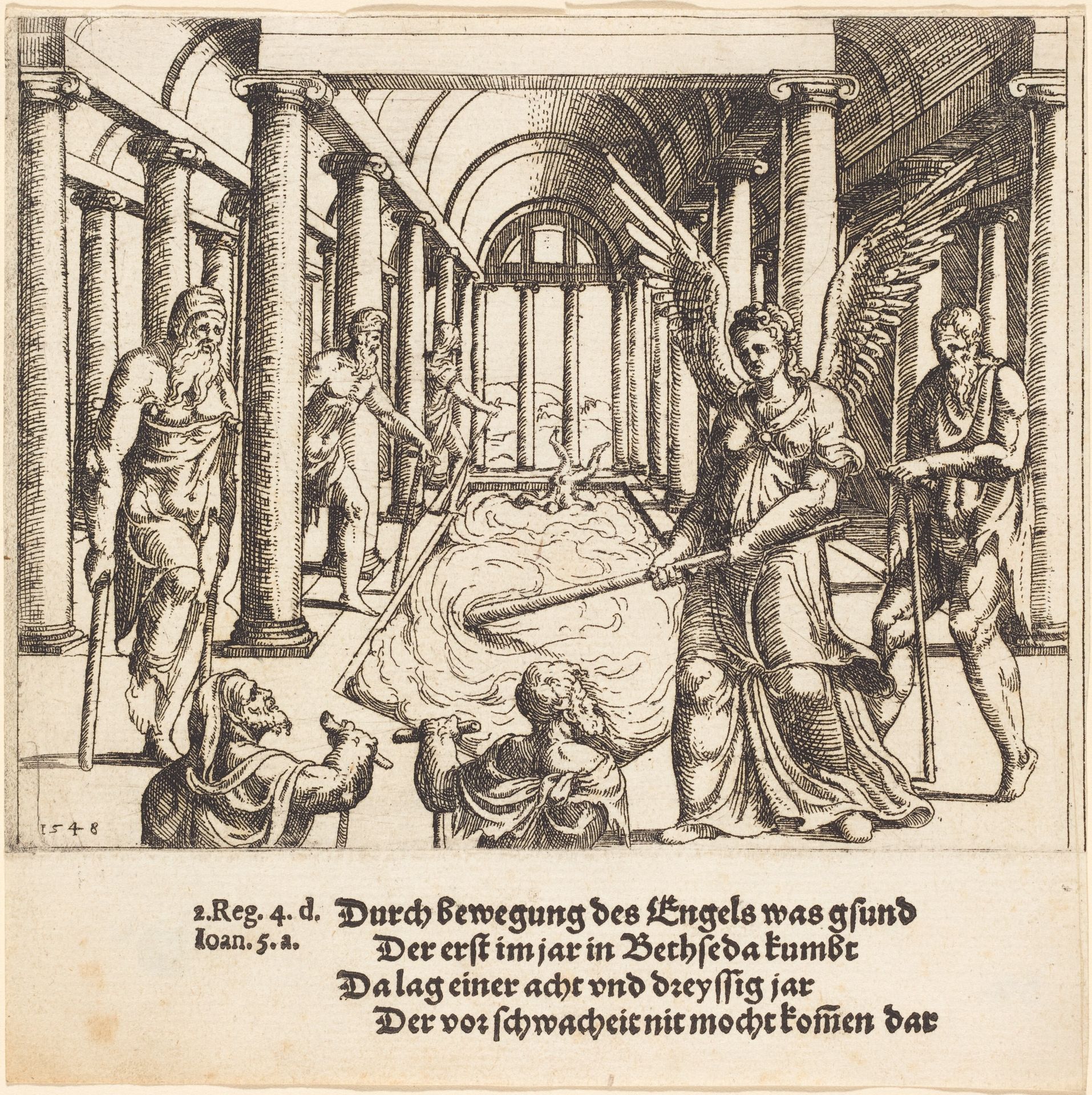
Editor: We’re looking at "The Angel Agitating the Pool of Bethesda," an engraving made by Augustin Hirschvogel in 1548. It's incredibly detailed, and honestly, the whole scene looks rather turbulent! I'm struck by how much is going on in a relatively small space. What’s your take on this, considering its context? Curator: Indeed, its visual intensity is quite characteristic of the period. As a product of the Northern Renaissance, it reflects a complex negotiation of religious doctrine, artistic ambition, and the socio-political climate. Consider the setting: it's not just a depiction of a biblical scene but a construction of space reflecting the architectural ideals circulating at the time. What purpose does that serve, do you think? Editor: Perhaps it lends an air of authority and grandeur, grounding the biblical narrative within a familiar framework for its contemporary audience? Curator: Exactly. This image performs a vital public role, reaffirming faith through visual rhetoric at a time when the Reformation was deeply challenging religious authority. Also, note how printmaking facilitated the broad dissemination of such imagery, engaging a wide public in religious narratives while promoting specific interpretations of faith. What implications do you see from its reproducibility? Editor: Well, wider distribution meant more people had access to these religious ideas. It’s almost like early mass media shaping public perception. But also, perhaps each print carried slightly different weight depending on where it ended up and who owned it? Curator: Precisely! Its reception varied depending on the print's journey through different social strata. Ultimately, Hirschvogel’s work illustrates the interwoven nature of artistic production, religious power, and early public sphere formation. Editor: That’s really changed how I see it. It’s more than just a biblical scene; it's a commentary on faith, power, and public perception at a crucial point in history.
The Angel Agitating the Pool of Bethesda
1548


Artwork details
- Medium
- print, engraving
- Copyright
- National Gallery of Art: CC0 1.0
Tags
narrative-art
figuration
11_renaissance
history-painting
northern-renaissance
engraving
Comments
Be the first to share your thoughts about this work.
About this artwork
Editor: We’re looking at "The Angel Agitating the Pool of Bethesda," an engraving made by Augustin Hirschvogel in 1548. It's incredibly detailed, and honestly, the whole scene looks rather turbulent! I'm struck by how much is going on in a relatively small space. What’s your take on this, considering its context? Curator: Indeed, its visual intensity is quite characteristic of the period. As a product of the Northern Renaissance, it reflects a complex negotiation of religious doctrine, artistic ambition, and the socio-political climate. Consider the setting: it's not just a depiction of a biblical scene but a construction of space reflecting the architectural ideals circulating at the time. What purpose does that serve, do you think? Editor: Perhaps it lends an air of authority and grandeur, grounding the biblical narrative within a familiar framework for its contemporary audience? Curator: Exactly. This image performs a vital public role, reaffirming faith through visual rhetoric at a time when the Reformation was deeply challenging religious authority. Also, note how printmaking facilitated the broad dissemination of such imagery, engaging a wide public in religious narratives while promoting specific interpretations of faith. What implications do you see from its reproducibility? Editor: Well, wider distribution meant more people had access to these religious ideas. It’s almost like early mass media shaping public perception. But also, perhaps each print carried slightly different weight depending on where it ended up and who owned it? Curator: Precisely! Its reception varied depending on the print's journey through different social strata. Ultimately, Hirschvogel’s work illustrates the interwoven nature of artistic production, religious power, and early public sphere formation. Editor: That’s really changed how I see it. It’s more than just a biblical scene; it's a commentary on faith, power, and public perception at a crucial point in history.
Comments
Be the first to share your thoughts about this work.