painting, watercolor
#
boat
#
narrative-art
#
painting
#
landscape
#
ukiyo-e
#
fantasy-art
#
figuration
#
watercolor
#
orientalism
#
erotic-art
Copyright: Edmund Dulac,Fair Use
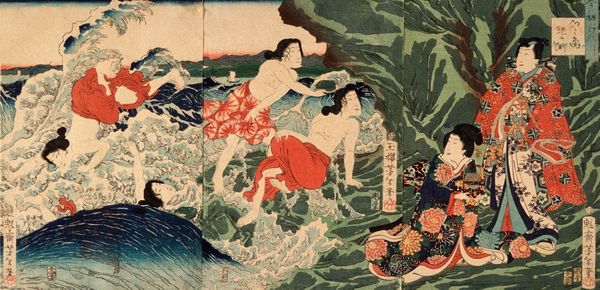
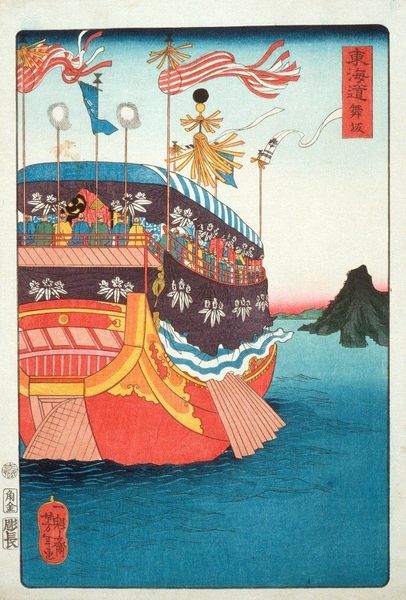
Curator: Welcome. We're looking at "The Pearl of the Fish, from The Kingdom of the Pearl" by Edmund Dulac, executed with watercolors. What are your initial thoughts? Editor: Exotic. And sensual. The color palette feels muted, yet there's a dreamlike quality. It's giving me very gendered imperial fantasy... how much did Dulac borrow and appropriate here? Curator: Let’s observe the lines—delicate and precise, creating a distinct flatness. The figures are stylized, almost decorative, embedded into the overall compositional structure. See the contrast of the ornate boat against the simplicity of the wave patterns? It emphasizes the artificiality of the scene. Editor: Yes, I see it. I am struck by the reclining figures. There is a strong hint of Orientalism here—a Western male gaze exoticizing and sexualizing non-Western bodies within an imaginary landscape. Curator: You might have a point. But the arrangement, colors and the way figures interact with the pictorial plane, makes the eye travel across the surface with little regard to depth. The use of symbolism elevates the image beyond mere representation, urging deeper exploration. What are we looking at beyond "Orientalism"? Editor: We cannot look past "Orientalism." Given Dulac’s time and context, these aesthetics served imperial ideologies and reinforced stereotypes. Even the pearl in the fish alludes to desires for riches and resources that serve to legitimize exploitation. Curator: But even that reference becomes highly artificial! The artist does not really believe in its cultural meanings—he exploits it as purely aesthetic resource. And, if one is still committed to social investigation, look how the artist presents and positions women, a point that can transcend both Orientalist gaze and the art historical narratives. Editor: True. It can serve as an opportunity to discuss the intersectional experience of the female figure. What does it mean for women who become bearers of the burden of these complex themes, positioned somewhere between agency and fetishization? Curator: Food for thought. Ultimately, "The Pearl of the Fish" encourages a dialogue between aesthetic beauty, visual structure, and sociohistorical criticism. Thank you for opening up that door for us. Editor: Absolutely. These dialogues help us remain more attuned to the dynamics between artists and historical and social contexts that reflect the politics of knowledge and power.
Comments
No comments
Be the first to comment and join the conversation on the ultimate creative platform.
 Collect
 React
React Comment
More like this