About this artwork
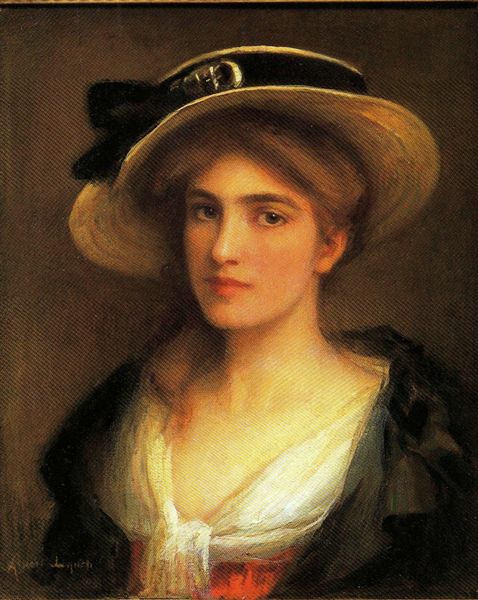
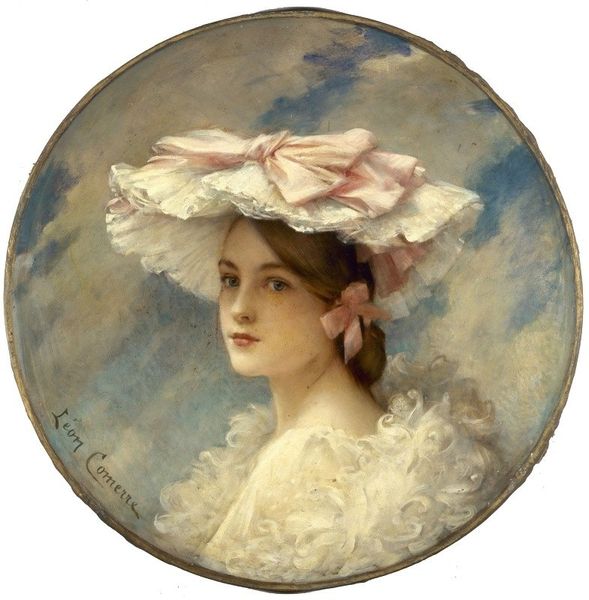
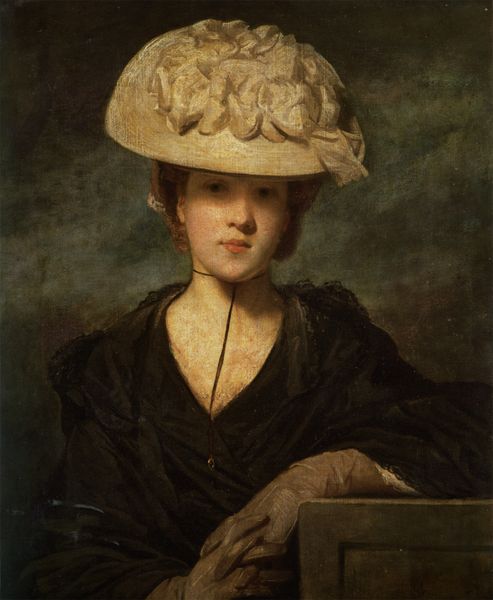
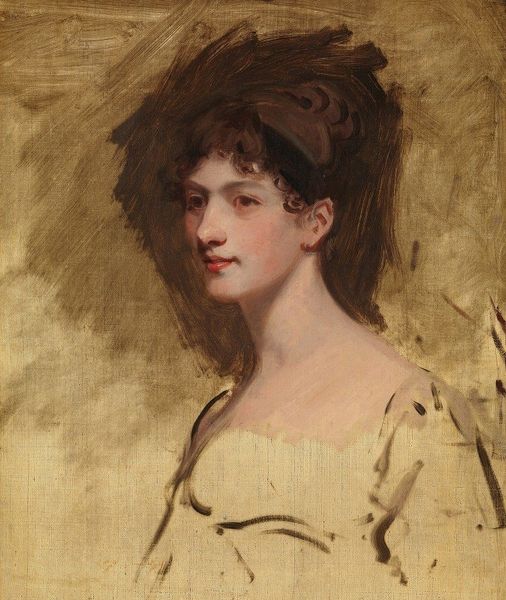
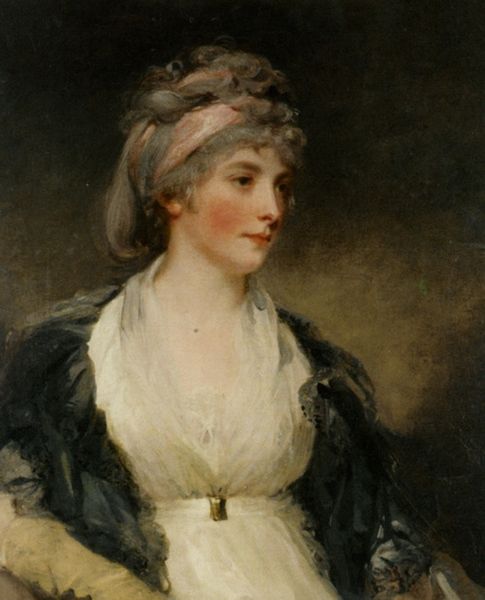
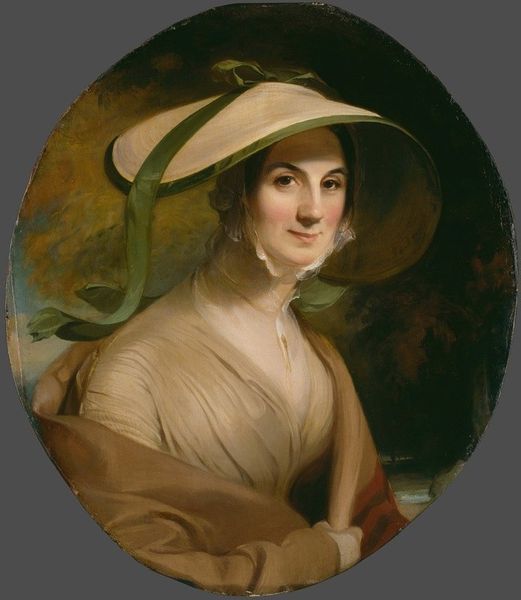
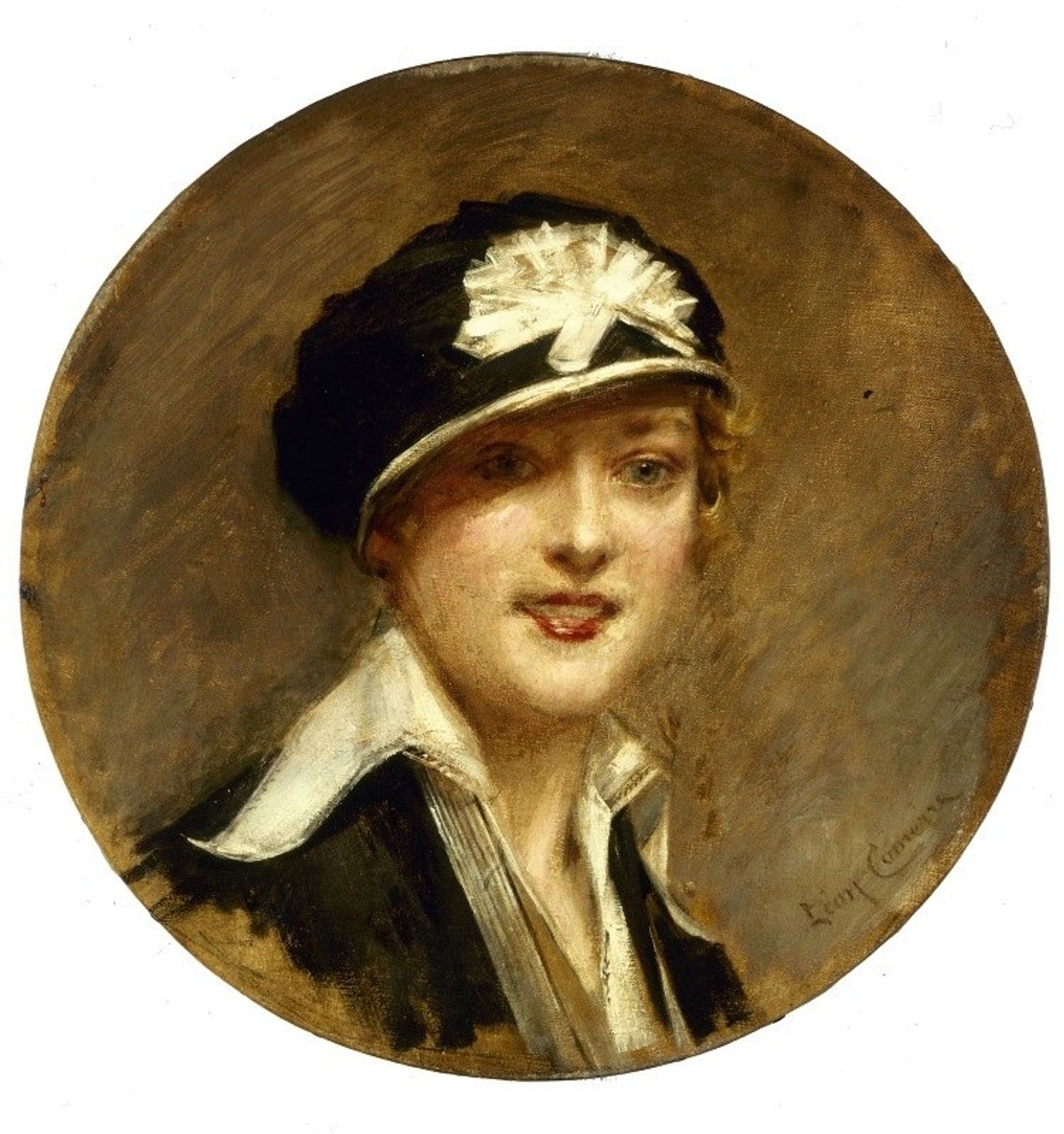
Curator: Here we have "La casquette de Poiret," a portrait rendered in 1914 by Léon François Comerre, crafted with oil on what appears to be a wooden panel. It strikes me as a really charming little confection, doesn't it? Editor: It does. Immediately, I see a deliberate blurring of gender roles and a comment on the social mobility of women. The stark contrast of the white collar against the darker clothing suggests a defiance against Victorian ideals of femininity. Curator: Defiance, eh? I saw her hat first, a little black number with a sassy white flourish, as though the painter was utterly besotted. It feels like a love letter in paint. It does recall Poiret and his avant-garde fashions though... Editor: Exactly! Fashion, then, was rapidly changing and influencing how women navigated public life and asserted independence, though certainly not for all women. How do you read the circular format itself? Curator: Hmm, that's interesting, almost feels like looking into a particularly fancy hand mirror from that period, reflecting this emerging 'New Woman.' There's a vulnerability there as well. The muted palette gives her a dreamlike quality, which might diminish the read you have of that clear intention towards female power, no? Editor: Possibly, but it also underscores the constraints within which women's agency was still framed. Even fashion-forward subjects remained objects of observation and contemplation. Perhaps her 'dreamlike' state is one of constrained expression within a rapidly changing social climate. Her direct, almost challenging gaze complicates that notion further for me, she feels present. Curator: True, the intensity of her stare counters my own reverie. So much character wrapped up in a small thing; I get lost in the subtlety. Editor: Indeed. It’s fascinating to see how art reflects, refracts, and sometimes resists the dominant ideologies of its time. I mean, portraiture's ability to immortalize whilst negotiating power structures and evolving social landscapes cannot be overstated. Curator: Well said! Now I see the feistiness in that tiny black hat and crisp white collar... So thanks to a shared viewing we have perhaps both reevaluated our perspectives? Editor: Absolutely, thank you for seeing this little jewel with me, allowing it to spark fresh inquiries on class and status within portraiture, beyond my feminist reading!

Artwork details
- Copyright
- Public Domain: Artvee
Comments
No comments
About this artwork
Curator: Here we have "La casquette de Poiret," a portrait rendered in 1914 by Léon François Comerre, crafted with oil on what appears to be a wooden panel. It strikes me as a really charming little confection, doesn't it? Editor: It does. Immediately, I see a deliberate blurring of gender roles and a comment on the social mobility of women. The stark contrast of the white collar against the darker clothing suggests a defiance against Victorian ideals of femininity. Curator: Defiance, eh? I saw her hat first, a little black number with a sassy white flourish, as though the painter was utterly besotted. It feels like a love letter in paint. It does recall Poiret and his avant-garde fashions though... Editor: Exactly! Fashion, then, was rapidly changing and influencing how women navigated public life and asserted independence, though certainly not for all women. How do you read the circular format itself? Curator: Hmm, that's interesting, almost feels like looking into a particularly fancy hand mirror from that period, reflecting this emerging 'New Woman.' There's a vulnerability there as well. The muted palette gives her a dreamlike quality, which might diminish the read you have of that clear intention towards female power, no? Editor: Possibly, but it also underscores the constraints within which women's agency was still framed. Even fashion-forward subjects remained objects of observation and contemplation. Perhaps her 'dreamlike' state is one of constrained expression within a rapidly changing social climate. Her direct, almost challenging gaze complicates that notion further for me, she feels present. Curator: True, the intensity of her stare counters my own reverie. So much character wrapped up in a small thing; I get lost in the subtlety. Editor: Indeed. It’s fascinating to see how art reflects, refracts, and sometimes resists the dominant ideologies of its time. I mean, portraiture's ability to immortalize whilst negotiating power structures and evolving social landscapes cannot be overstated. Curator: Well said! Now I see the feistiness in that tiny black hat and crisp white collar... So thanks to a shared viewing we have perhaps both reevaluated our perspectives? Editor: Absolutely, thank you for seeing this little jewel with me, allowing it to spark fresh inquiries on class and status within portraiture, beyond my feminist reading!
Comments
No comments