About this artwork
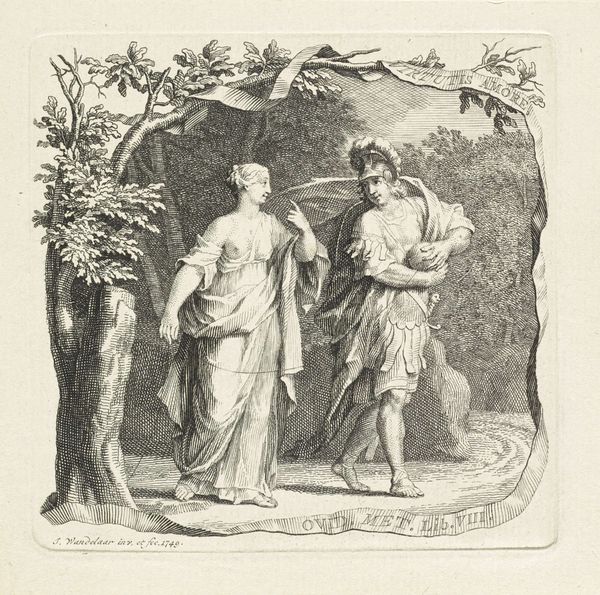
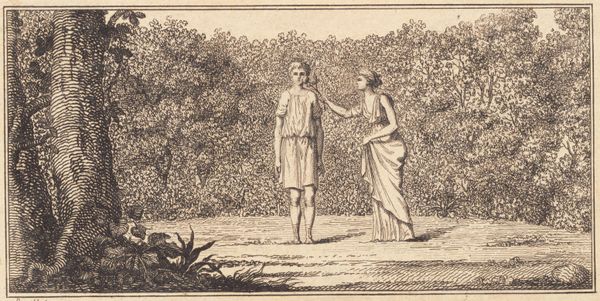
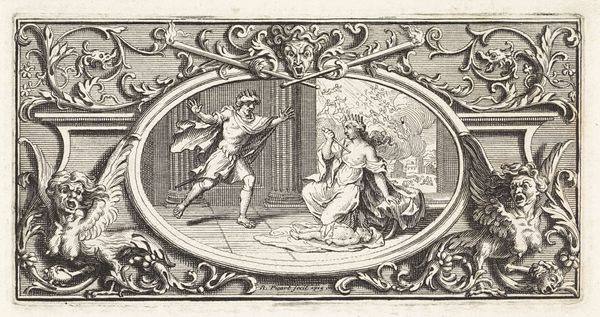
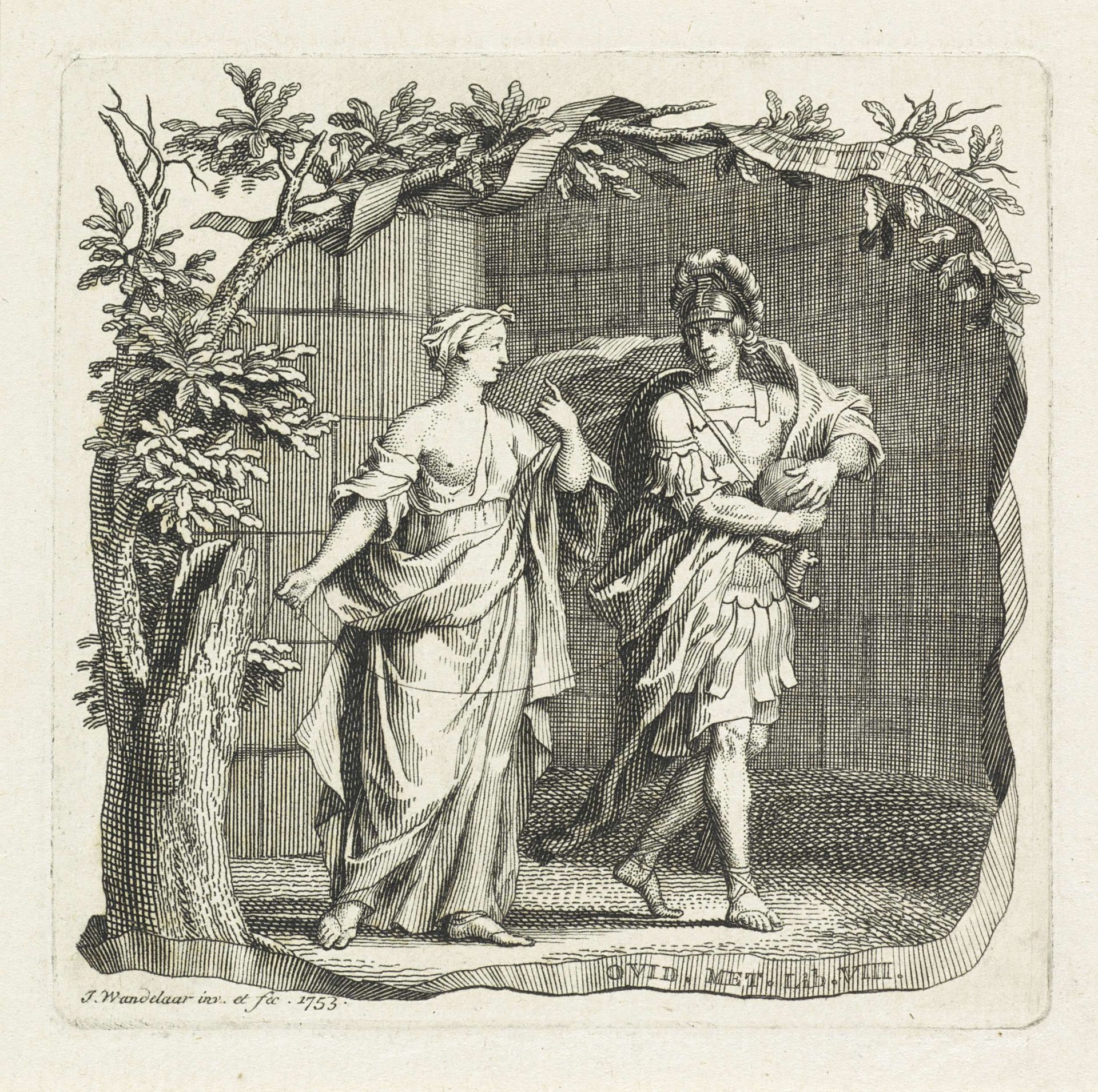
Curator: This engraving, “Vignet met Theseus en Ariadne” created in 1753 by Jan Wandelaar, depicts a pivotal scene from classical mythology. Editor: Immediately, I’m struck by the contrast. Ariadne, with her flowing garments and the single strand of thread, seems so vulnerable next to the armor-clad, self-assured Theseus. Curator: Precisely. Wandelaar masterfully employs line and form to create a dichotomy between feminine ingenuity and masculine strength. The vignette itself acts as a theatrical proscenium arch. Observe how the composition is balanced—the organic forms of the tree mirroring the architectural severity behind the figures. Editor: And that thread, its materiality almost imperceptible! It represents her contribution to his heroic act. Ariadne’s thread is a tool, crafted from mundane fibers, yet it's also instrumental in her potential imprisonment and betrayal. It reveals a lot about her agency within the context of patriarchy and power. Curator: Absolutely, this print illustrates the broader theme: love's ability to navigate the most treacherous paths, albeit with a poignant undertone. The texture achieved through the engraving process mirrors the labyrinthine nature of the myth itself. Look closely at the density of lines, which suggest a deep, shadowed space behind Theseus, symbolizing the Minotaur’s lair. Editor: Beyond symbolism, the economic dimensions are crucial to unpack, here. The etching on paper would allow a broad distribution, and this democratization is interesting, when one reflects on the patron-artist relations of the day and their own relationship to Greek narratives, to art history itself, and even craft traditions! Curator: Indeed. This print encapsulates classical idealism expressed with a distinctly Baroque flavor and hints at socio-economic context. A sophisticated encapsulation that goes beyond simplistic depiction. Editor: Yes, a reminder that objects hold both inherent formal qualities, as well as traces of production and history. Curator: A worthy perspective, I think we can now let the audience spend more time reflecting about the material conditions that make images and artworks possible.

Artwork details
- Medium
- engraving
- Dimensions
- height 89 mm, width 92 mm
- Location
- Rijksmuseum
- Copyright
- Rijks Museum: Open Domain
Tags
allegory
baroque
classical-realism
figuration
history-painting
engraving
Comments
No comments
About this artwork
Curator: This engraving, “Vignet met Theseus en Ariadne” created in 1753 by Jan Wandelaar, depicts a pivotal scene from classical mythology. Editor: Immediately, I’m struck by the contrast. Ariadne, with her flowing garments and the single strand of thread, seems so vulnerable next to the armor-clad, self-assured Theseus. Curator: Precisely. Wandelaar masterfully employs line and form to create a dichotomy between feminine ingenuity and masculine strength. The vignette itself acts as a theatrical proscenium arch. Observe how the composition is balanced—the organic forms of the tree mirroring the architectural severity behind the figures. Editor: And that thread, its materiality almost imperceptible! It represents her contribution to his heroic act. Ariadne’s thread is a tool, crafted from mundane fibers, yet it's also instrumental in her potential imprisonment and betrayal. It reveals a lot about her agency within the context of patriarchy and power. Curator: Absolutely, this print illustrates the broader theme: love's ability to navigate the most treacherous paths, albeit with a poignant undertone. The texture achieved through the engraving process mirrors the labyrinthine nature of the myth itself. Look closely at the density of lines, which suggest a deep, shadowed space behind Theseus, symbolizing the Minotaur’s lair. Editor: Beyond symbolism, the economic dimensions are crucial to unpack, here. The etching on paper would allow a broad distribution, and this democratization is interesting, when one reflects on the patron-artist relations of the day and their own relationship to Greek narratives, to art history itself, and even craft traditions! Curator: Indeed. This print encapsulates classical idealism expressed with a distinctly Baroque flavor and hints at socio-economic context. A sophisticated encapsulation that goes beyond simplistic depiction. Editor: Yes, a reminder that objects hold both inherent formal qualities, as well as traces of production and history. Curator: A worthy perspective, I think we can now let the audience spend more time reflecting about the material conditions that make images and artworks possible.
Comments
No comments