About this artwork
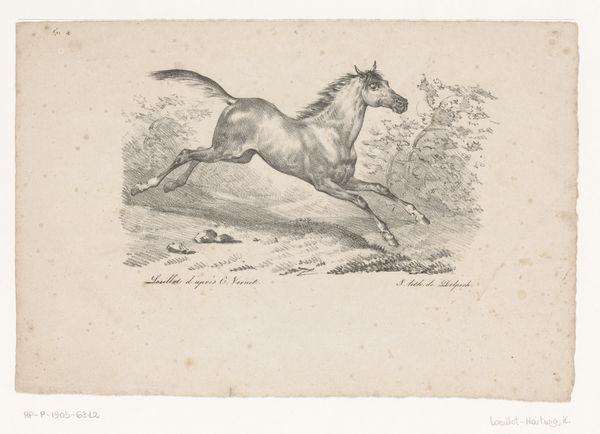
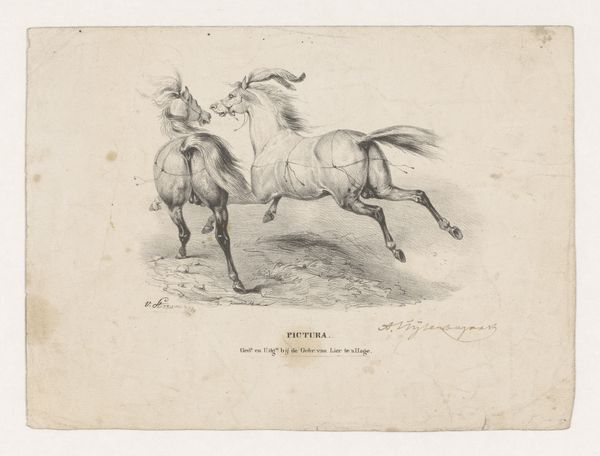
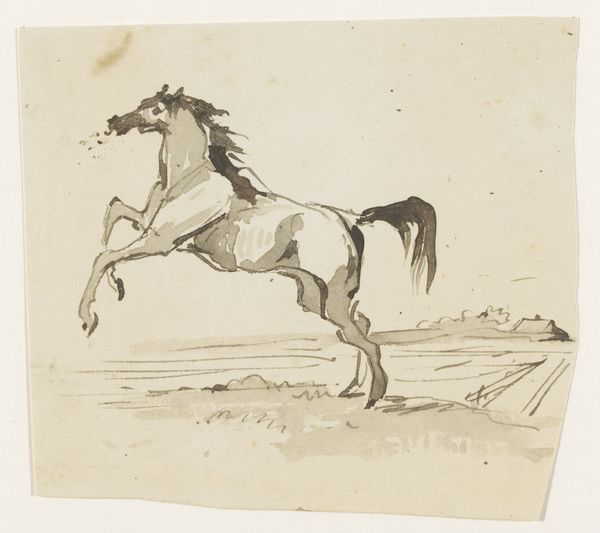
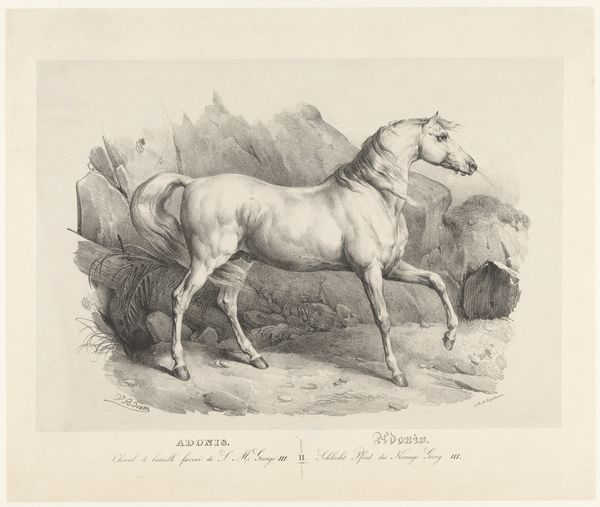
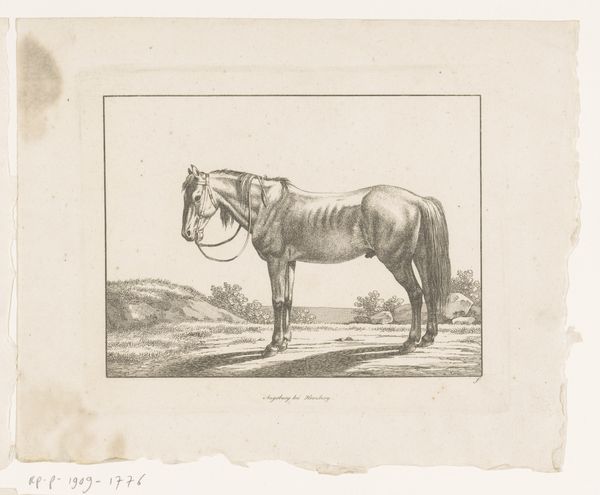
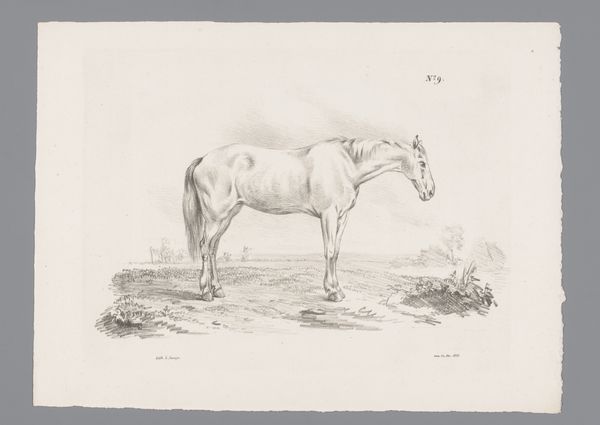
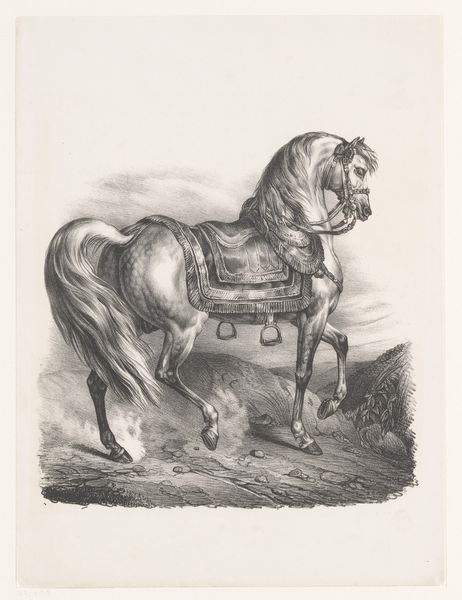
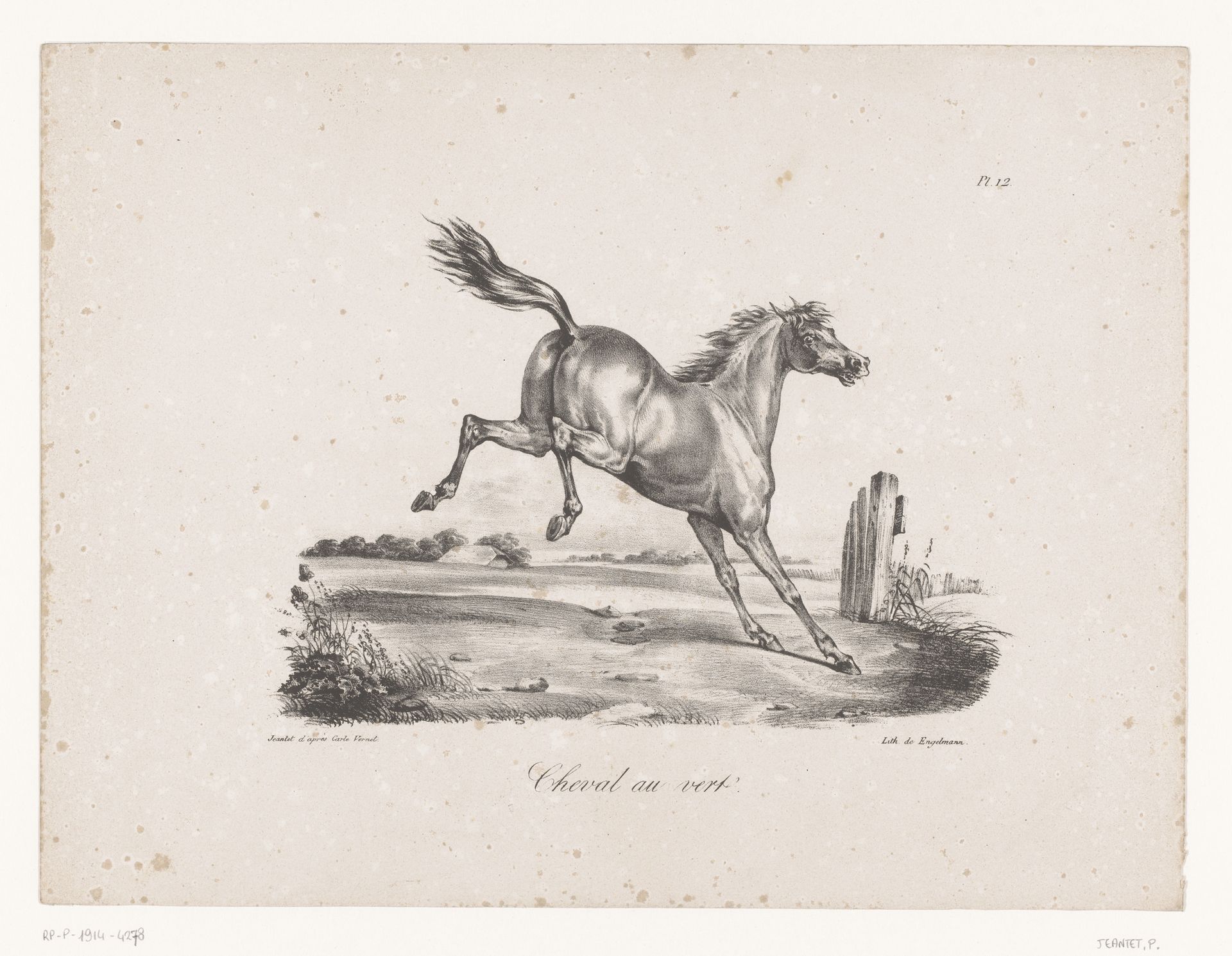
Editor: Here we have Pierre Jeantet’s 1827 engraving, *Achteruitslaand paard in een weiland*—or *Horse Kicking Backwards in a Meadow*. The horse appears very spirited, wild almost! What's your read of this, in terms of how Jeantet captures the animal's nature? Curator: It strikes me as freedom caught in a sketch. See how the horse isn’t simply *standing* in that field, but *leaping*—rearing, defiant, joyous even? It embodies the Romantic era's love affair with nature's untamed spirit. Almost like the horse is the embodiment of the landscape. Ever feel a landscape speaking back at you? Editor: That's beautiful! The landscape mirroring the horse, I hadn’t considered that. I’d initially focused solely on the horse, its individual energy… almost missing the broader conversation. Curator: Exactly! The "meadow" isn't just a backdrop. It’s whispering tales of freedom, space… perhaps even a challenge to the tamed world. That almost frantic energy that Romanticism always seems to embody. Editor: It’s interesting to consider the conversation between animal and landscape; the untamed in dialogue, challenging the more domesticated side of existence, isn’t it? I suppose this could say something more broadly of the 19th century as society became more civilized. Curator: You nailed it. I will say: there's a good splash of the absurd there too! Art isn’t always heavy thinking, right? Editor: A joyful release of energy and thought! That's something to consider for the artwork, beyond the heavy intellectualizing, huh? Thanks!

Artwork details
- Medium
- drawing, engraving
- Dimensions
- height 272 mm, width 361 mm
- Copyright
- Rijks Museum: Open Domain
Tags
Comments
Share your thoughts
About this artwork
Editor: Here we have Pierre Jeantet’s 1827 engraving, *Achteruitslaand paard in een weiland*—or *Horse Kicking Backwards in a Meadow*. The horse appears very spirited, wild almost! What's your read of this, in terms of how Jeantet captures the animal's nature? Curator: It strikes me as freedom caught in a sketch. See how the horse isn’t simply *standing* in that field, but *leaping*—rearing, defiant, joyous even? It embodies the Romantic era's love affair with nature's untamed spirit. Almost like the horse is the embodiment of the landscape. Ever feel a landscape speaking back at you? Editor: That's beautiful! The landscape mirroring the horse, I hadn’t considered that. I’d initially focused solely on the horse, its individual energy… almost missing the broader conversation. Curator: Exactly! The "meadow" isn't just a backdrop. It’s whispering tales of freedom, space… perhaps even a challenge to the tamed world. That almost frantic energy that Romanticism always seems to embody. Editor: It’s interesting to consider the conversation between animal and landscape; the untamed in dialogue, challenging the more domesticated side of existence, isn’t it? I suppose this could say something more broadly of the 19th century as society became more civilized. Curator: You nailed it. I will say: there's a good splash of the absurd there too! Art isn’t always heavy thinking, right? Editor: A joyful release of energy and thought! That's something to consider for the artwork, beyond the heavy intellectualizing, huh? Thanks!
Comments
Share your thoughts