About this artwork
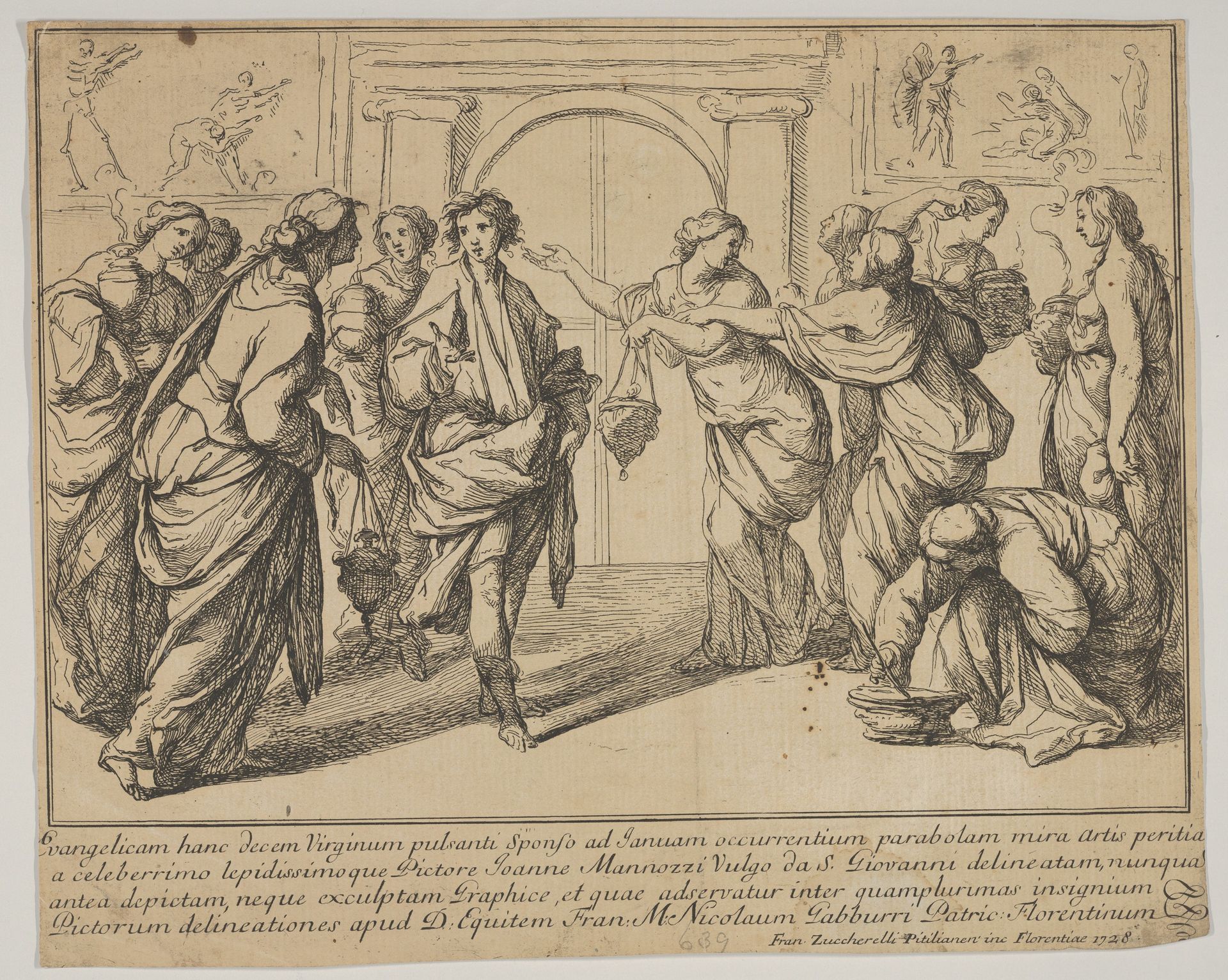
This is an etching of "The Wise and the Foolish Virgins," made in Florence in 1728 by Francesco Zuccarelli. Zuccarelli illustrates a parable from the Gospel of Matthew, a story about the kingdom of heaven. This story raises important questions about institutionalized religion. The Bible was often used to reinforce existing social norms, encouraging people to accept the social roles assigned to them. Zuccarelli uses his etching to reinforce those social norms. The wise virgins are orderly. In contrast, the foolish virgins, on the right, are chaotic and frantic. In the 18th century, the Accademia delle Arti del Disegno in Florence provided instruction in drawing, painting, sculpture, and architecture, and it played a role in promoting particular aesthetic values and social ideals. Zuccarelli was not a member of the Accademia, but this piece shows how widely its cultural values had spread. Further research into the social and religious history of 18th-century Florence would reveal more about how the cultural institutions of the time shaped the production and reception of this image.
The Wise and the Foolish Virgins
1728

Francesco Zuccarelli
1702 - 1788
The Metropolitan Museum of Art
Metropolitan Museum of Art, New York, NYArtwork details
- Medium
- drawing, print, etching
- Dimensions
- image: 8 1/16 x 10 1/8 in. (20.5 x 25.7 cm)
- Location
- Metropolitan Museum of Art, New York, NY
- Copyright
- Public Domain
Tags
drawing
baroque
etching
figuration
history-painting
italian-renaissance
Comments
Be the first to share your thoughts about this work.
About this artwork
This is an etching of "The Wise and the Foolish Virgins," made in Florence in 1728 by Francesco Zuccarelli. Zuccarelli illustrates a parable from the Gospel of Matthew, a story about the kingdom of heaven. This story raises important questions about institutionalized religion. The Bible was often used to reinforce existing social norms, encouraging people to accept the social roles assigned to them. Zuccarelli uses his etching to reinforce those social norms. The wise virgins are orderly. In contrast, the foolish virgins, on the right, are chaotic and frantic. In the 18th century, the Accademia delle Arti del Disegno in Florence provided instruction in drawing, painting, sculpture, and architecture, and it played a role in promoting particular aesthetic values and social ideals. Zuccarelli was not a member of the Accademia, but this piece shows how widely its cultural values had spread. Further research into the social and religious history of 18th-century Florence would reveal more about how the cultural institutions of the time shaped the production and reception of this image.
Comments
Be the first to share your thoughts about this work.