1895
Autumn

Isaac Levitan
1860 - 1900Location
Rostov Regional Museum of Fine Arts, Rostov-on-Don, RussiaListen to curator's interpretation
Curatorial notes
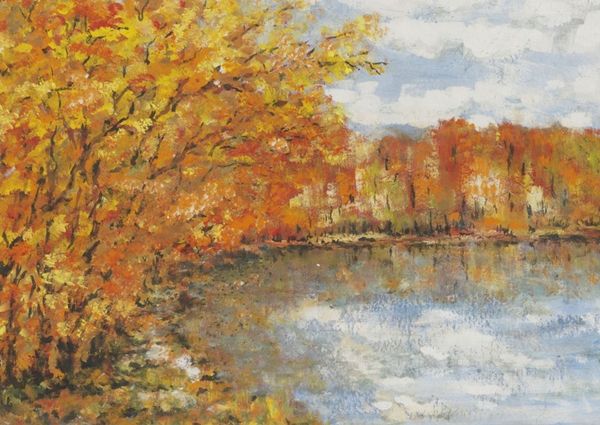
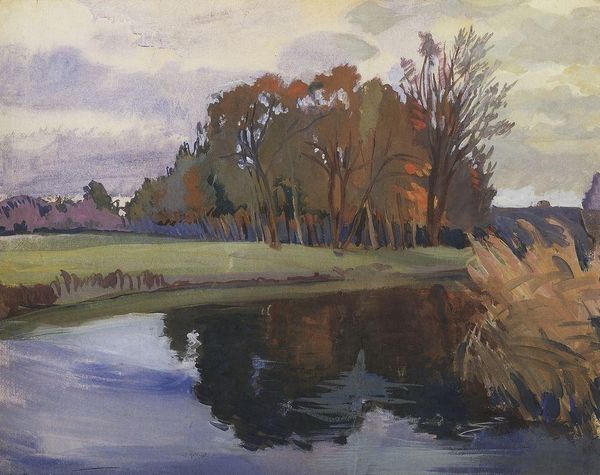
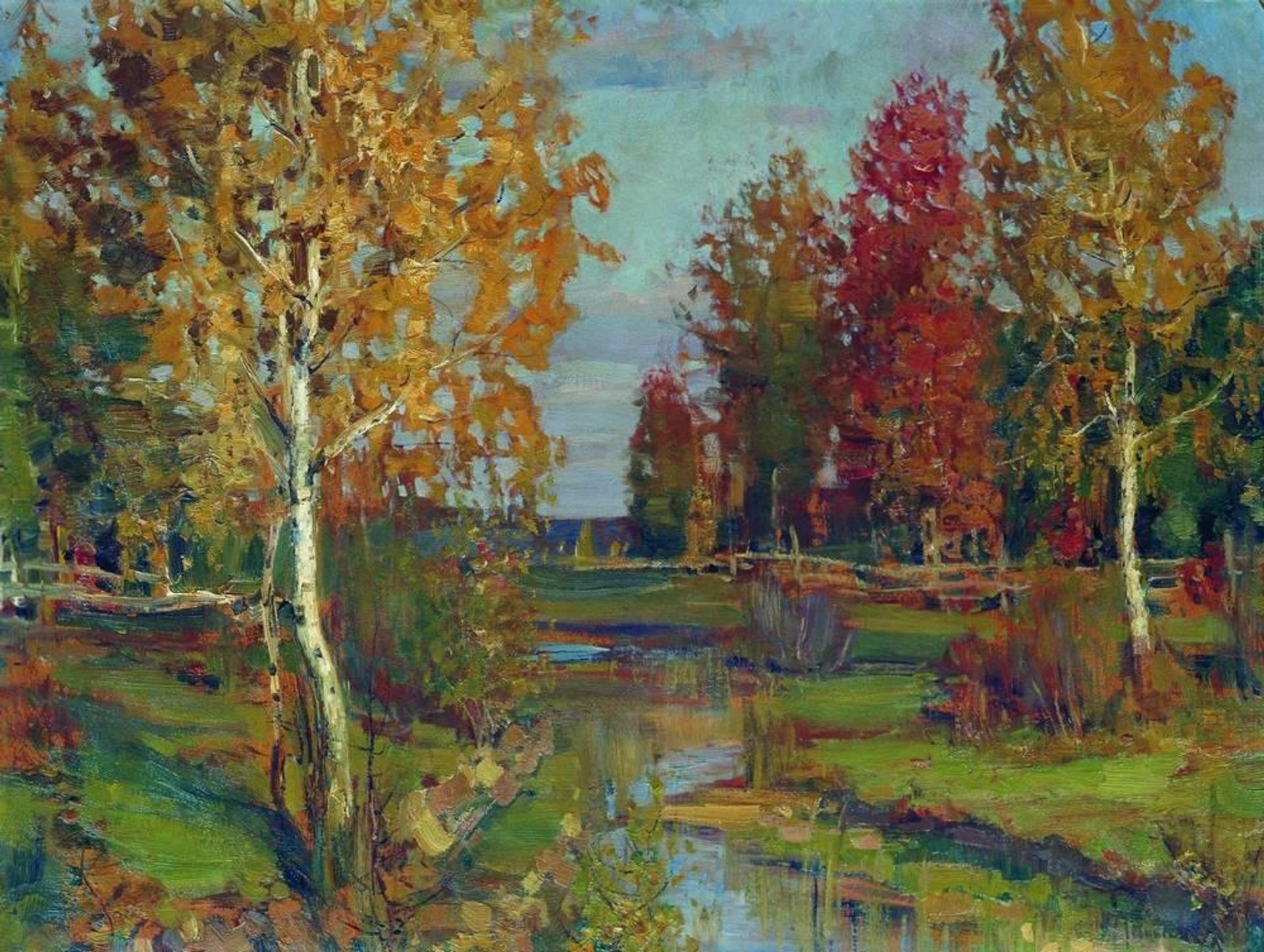
Curator: At first glance, this evokes a powerful sense of melancholy. The muted palette, the stillness of the water...it speaks to a very specific mood. Editor: Indeed. What you're sensing comes to us from Isaac Levitan’s "Autumn," painted in 1895. Levitan was a master of landscape painting, and a pivotal figure in late 19th-century Russian art, often associated with the Peredvizhniki movement which aimed to depict Russian life and landscapes realistically and accessibly. Curator: Realistically, perhaps, but filtered through a very subjective lens. The texture alone tells a story. Notice the broken brushstrokes, particularly in the trees, the leaves rendered as daubs of color. Editor: Precisely. Levitan’s technique, though rooted in impressionism, leans toward post-impressionism here, with an emphasis on emotional expression rather than pure optical accuracy. He was grappling with feelings of isolation and the transience of life, which mirrored a broader societal feeling. Curator: I see it, the painting is heavy on nature. It looks more of a classical Romantic view here, but with new painterly elements as opposed to strict perspective drawing and an earthy-hued color story overall. And these are the forests from old world memories too. It speaks volumes. How was this received at the time? Editor: It’s fascinating; some critics celebrated its emotional depth and sincerity, aligning it with a national sensibility, seeing echoes of Turgenev in its mood. Others dismissed it as overly sentimental. Levitan was a prominent member of the Russian artistic landscape, and had also lectured at Moscow School of Painting, Sculpture and Architecture; yet like his artworks there was an appreciation for technical innovation. Curator: It is an innovation on melancholic atmosphere in paint, which is an extraordinary way to speak to cultural issues or ideas, as Levitan masterfully achieved. Editor: Absolutely, the genius here is palpable; from these seemingly simple brushstrokes springs a gateway into 19th century Russian artistic landscape, with its particular sentiments and the overall artistic talent it held, much to this day.