About this artwork
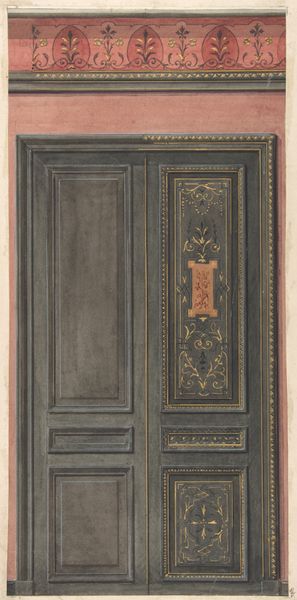
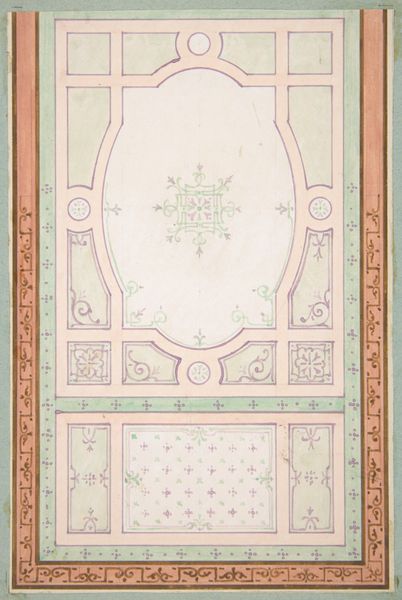
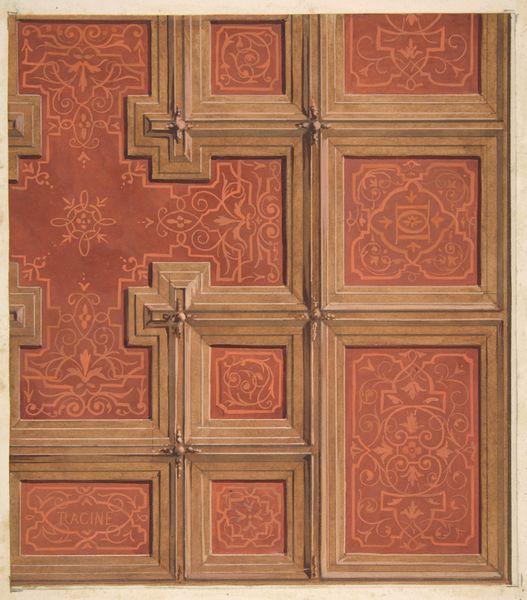
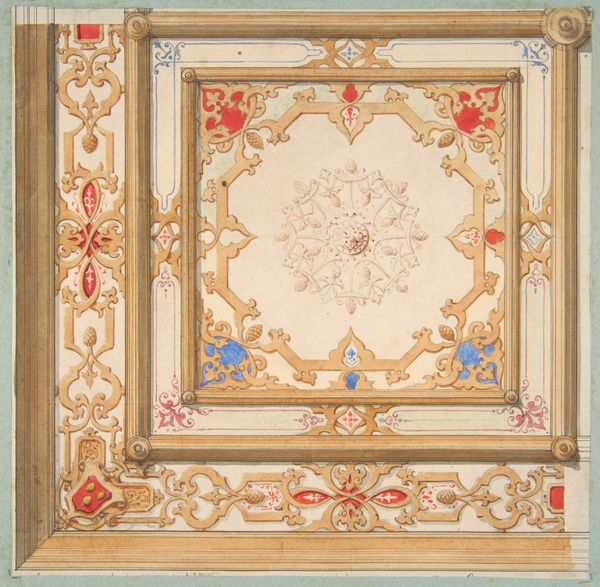
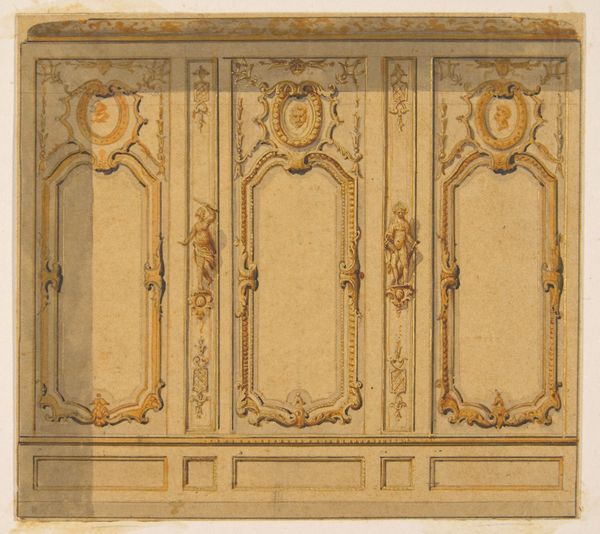
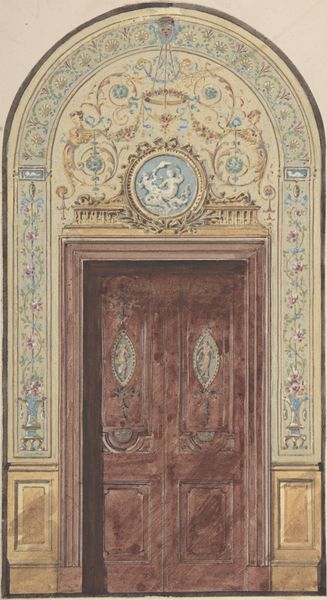
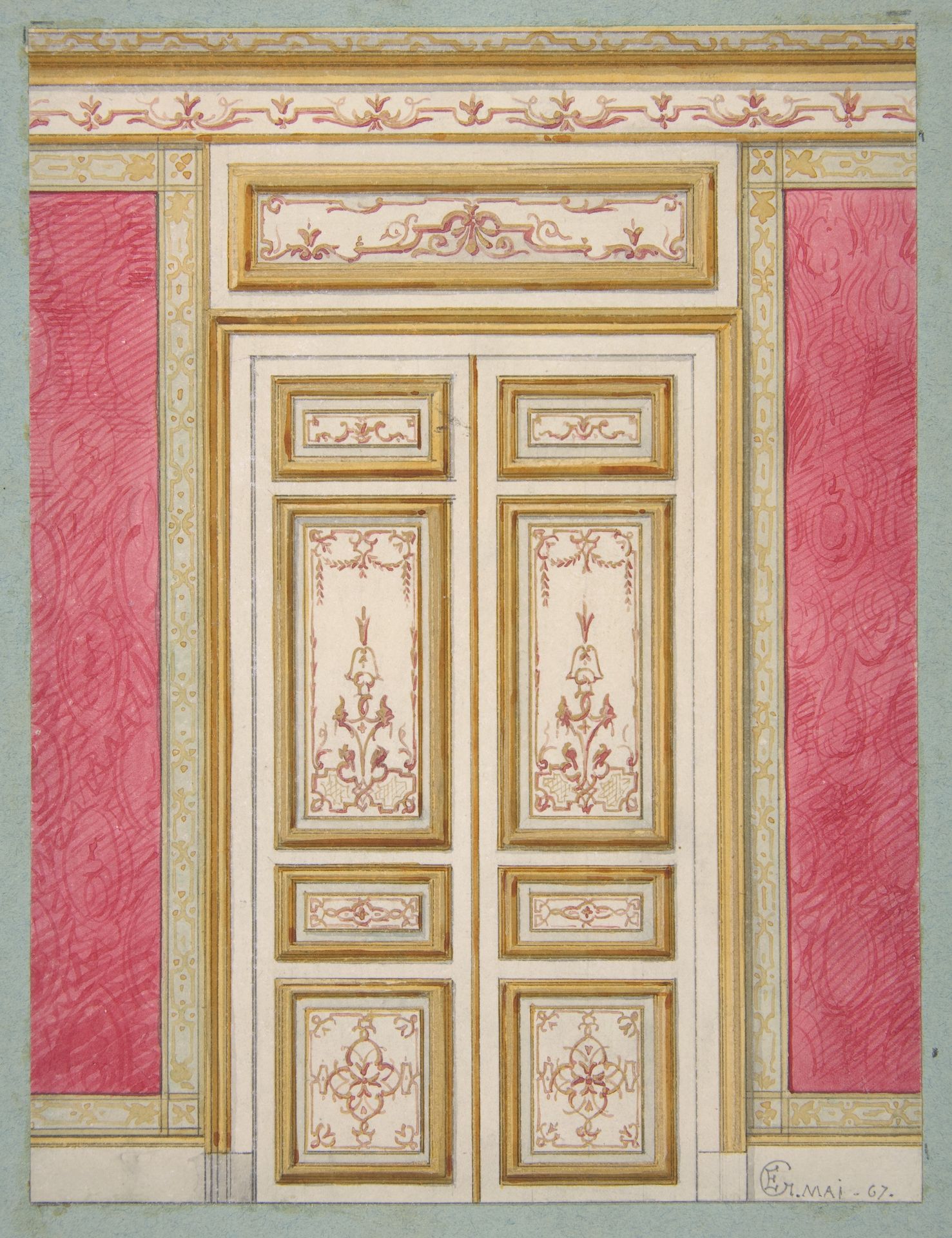
Editor: Here we have Jules-Edmond-Charles Lachaise's "Design for Double Doors Decorated in the Rococo Style," created around 1867. It seems to be a watercolor drawing, very precisely rendered. It evokes a sense of delicate opulence, and the linear quality emphasizes the architectural elements. What stands out to you in terms of its composition? Curator: What strikes me first is the rigorous symmetry at play, even as the Rococo style delights in asymmetry. Note the strategic framing: how the strong verticality of the pink panels containing implied, decorative patterning anchors the central door design. Consider the function of line here; the precise outlines that dictate the ornate details. Observe how line and wash combine to build form. Editor: So, even within the ornate details, there’s still a strict structural foundation? I’m so used to thinking of Rococo as pure ornamentation. Curator: Precisely. Lachaise displays a clear understanding of how underlying structure can support surface decoration. How does the colour contribute? Editor: The limited palette, mostly pink, cream and gold, it creates a sense of refined luxury, while staying delicate. It's luxurious, but not overwhelming. I'm curious about why Lachaise chose this particular arrangement of panels and decorative motifs; is it based on some system? Curator: One can dissect it using semiotics. The panels could be viewed as modules, and the motifs as units within a system, which, as a whole, conveys a specific message regarding hierarchy and order. However, to say this would have a clear textual meaning seems, ultimately, limiting. Is the visual experience reduced when described in terms of system and semiotic code? Editor: It is interesting to see how a design for a functional object becomes, on paper, something to analyze on its formal properties. Curator: Exactly. A piece like this pushes us to look closely at the construction of beauty through purely formal decisions. It prompts us to move past questions of function.
Design for double doors decorated in the rococco style 1867

Jules-Edmond-Charles Lachaise
1897
The Metropolitan Museum of Art
Metropolitan Museum of Art, New York, NYArtwork details
- Dimensions
- Overall: 14 3/4 x 10 3/8 in. (37.4 x 26.4 cm) image: 5 7/8 in. (14.9 cm)
- Location
- Metropolitan Museum of Art, New York, NY
- Copyright
- Public Domain
Comments
No comments
About this artwork
Editor: Here we have Jules-Edmond-Charles Lachaise's "Design for Double Doors Decorated in the Rococo Style," created around 1867. It seems to be a watercolor drawing, very precisely rendered. It evokes a sense of delicate opulence, and the linear quality emphasizes the architectural elements. What stands out to you in terms of its composition? Curator: What strikes me first is the rigorous symmetry at play, even as the Rococo style delights in asymmetry. Note the strategic framing: how the strong verticality of the pink panels containing implied, decorative patterning anchors the central door design. Consider the function of line here; the precise outlines that dictate the ornate details. Observe how line and wash combine to build form. Editor: So, even within the ornate details, there’s still a strict structural foundation? I’m so used to thinking of Rococo as pure ornamentation. Curator: Precisely. Lachaise displays a clear understanding of how underlying structure can support surface decoration. How does the colour contribute? Editor: The limited palette, mostly pink, cream and gold, it creates a sense of refined luxury, while staying delicate. It's luxurious, but not overwhelming. I'm curious about why Lachaise chose this particular arrangement of panels and decorative motifs; is it based on some system? Curator: One can dissect it using semiotics. The panels could be viewed as modules, and the motifs as units within a system, which, as a whole, conveys a specific message regarding hierarchy and order. However, to say this would have a clear textual meaning seems, ultimately, limiting. Is the visual experience reduced when described in terms of system and semiotic code? Editor: It is interesting to see how a design for a functional object becomes, on paper, something to analyze on its formal properties. Curator: Exactly. A piece like this pushes us to look closely at the construction of beauty through purely formal decisions. It prompts us to move past questions of function.
Comments
No comments