About this artwork
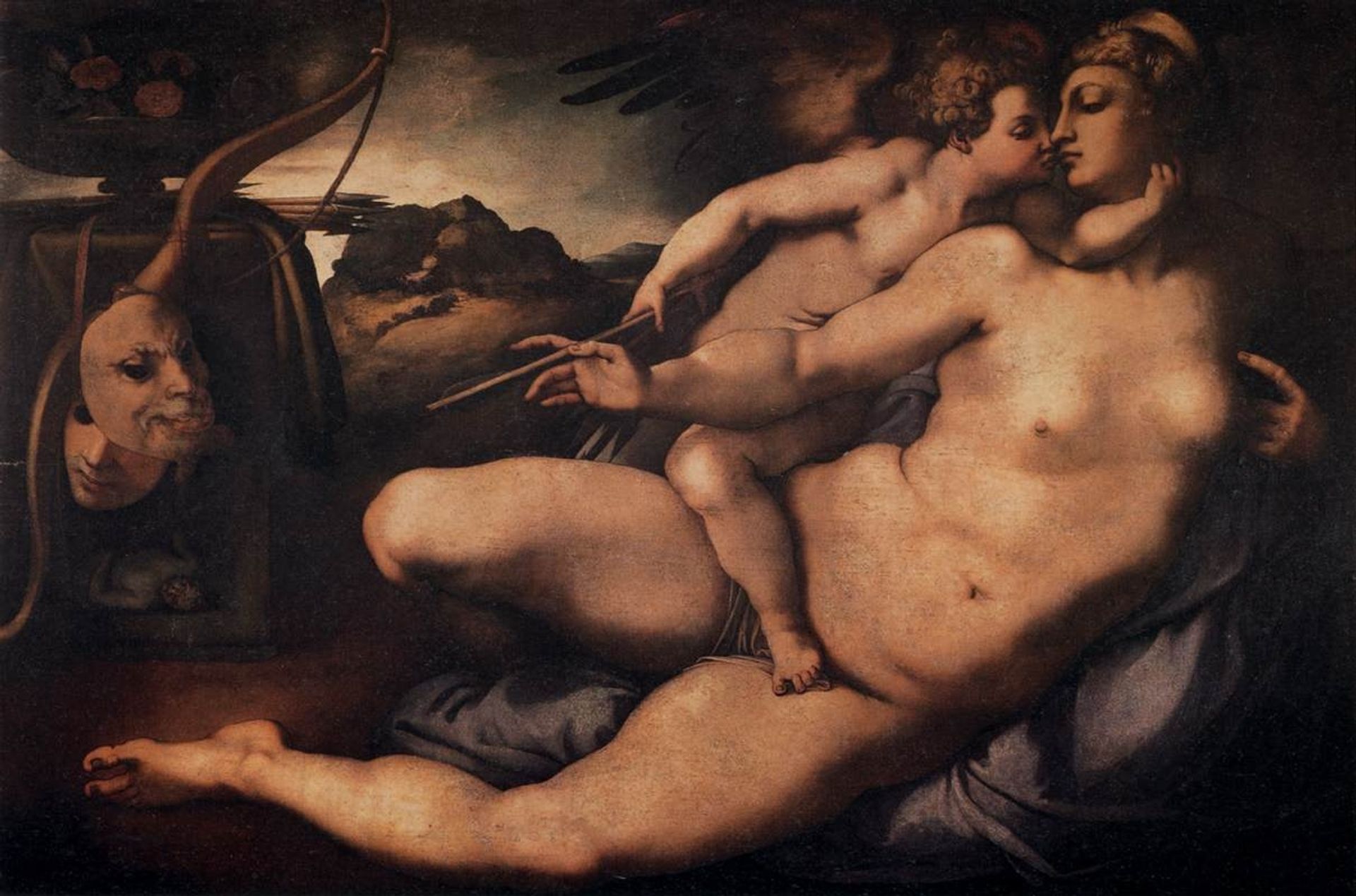
Jacopo Pontormo, around 1534, painted in oil on wood the scene of Venus and Cupid. Note how Pontormo populates the image with ancient symbols of beauty and love: Venus, Cupid, and theatrical masks. These masks, symbols of comedy and tragedy, were of great importance in antiquity, often associated with Dionysus, the god of wine and theater. Here, they are silent witnesses to the scene of love, but their fixed expressions remind us of the complex play of emotions inherent in love, the alternating dance between joy and suffering. But Cupid's gesture of kissing his mother has echoes in other contexts. In some Renaissance paintings, it is the Virgin Mary who is kissed by Jesus. This motif, charged with tenderness, echoes in the collective memory, evolving through history, shifting in meaning, and resurfacing in different artistic languages. The painting engages viewers on a deep, subconscious level with the powerful force of love. This affection has resurfaced, evolved, and taken on new meanings in different historical contexts.
Venus and Cupid 1533

Jacopo Pontormo
1494 - 1557Location
Galleria dell'Accademia di Firenze, Florence, ItalyArtwork details
- Medium
- oil-paint
- Dimensions
- 12.8 x 19.7 cm
- Location
- Galleria dell'Accademia di Firenze, Florence, Italy
- Copyright
- Public domain
Tags
portrait
allegory
oil-paint
mannerism
oil painting
mythology
italian-renaissance
nude
Comments
No comments
About this artwork
Jacopo Pontormo, around 1534, painted in oil on wood the scene of Venus and Cupid. Note how Pontormo populates the image with ancient symbols of beauty and love: Venus, Cupid, and theatrical masks. These masks, symbols of comedy and tragedy, were of great importance in antiquity, often associated with Dionysus, the god of wine and theater. Here, they are silent witnesses to the scene of love, but their fixed expressions remind us of the complex play of emotions inherent in love, the alternating dance between joy and suffering. But Cupid's gesture of kissing his mother has echoes in other contexts. In some Renaissance paintings, it is the Virgin Mary who is kissed by Jesus. This motif, charged with tenderness, echoes in the collective memory, evolving through history, shifting in meaning, and resurfacing in different artistic languages. The painting engages viewers on a deep, subconscious level with the powerful force of love. This affection has resurfaced, evolved, and taken on new meanings in different historical contexts.
Comments
No comments