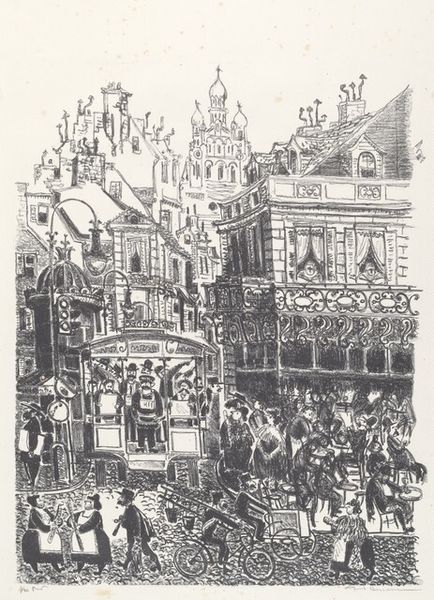
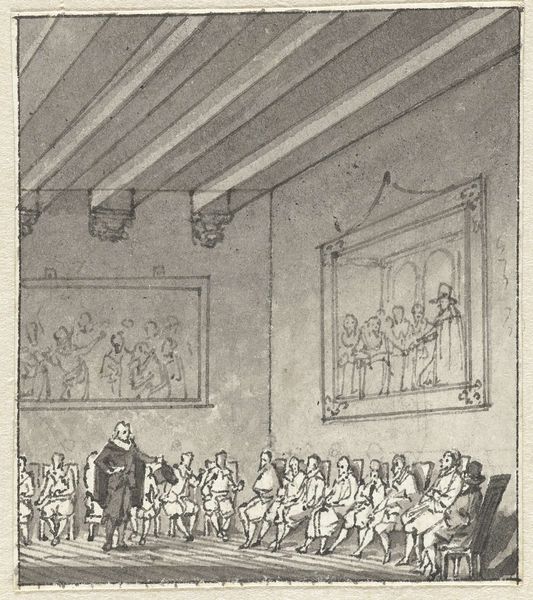
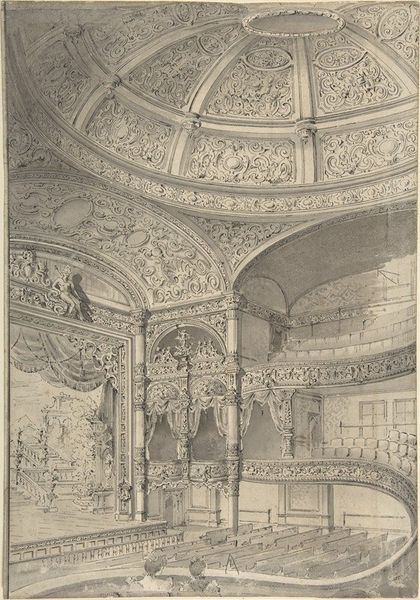
Großer Musikvereinssaal, Wien (Great Concert Hall, Vienna) c. 1920
0:00
0:00


drawing, print, ink
#
pen and ink
#
drawing
#
ink drawing
#
pen drawing
# print
#
pen illustration
#
pen sketch
#
ink
#
cityscape
Dimensions: image: 33.34 × 29.53 cm (13 1/8 × 11 5/8 in.) sheet: 37.62 × 33.02 cm (14 13/16 × 13 in.)
Copyright: National Gallery of Art: CC0 1.0
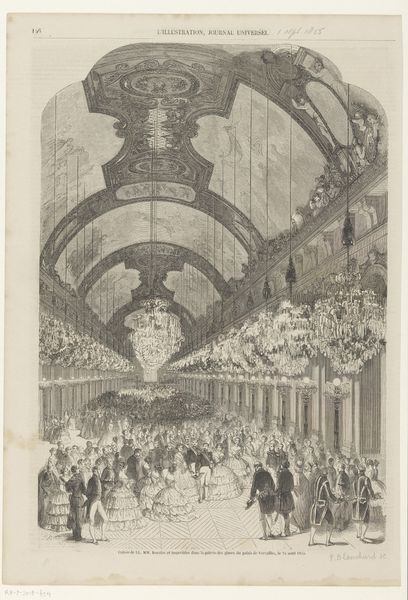
Curator: This is Emma Bormann’s "Großer Musikvereinssaal, Wien," or "Great Concert Hall, Vienna," created around 1920. Bormann captured it using pen and ink. Editor: It feels intensely alive, doesn’t it? Even though it's monochrome and relatively small, the energy of the concert hall practically vibrates off the paper. I see class and high society, literally and figuratively. Curator: Indeed. Bormann was active in artistic circles during a turbulent period in Vienna. Her work often depicted urban life and architectural spaces. This print offers insight into the cultural priorities of the city at that time. Editor: The detail is impressive; the chandeliers sparkle even in the grayscale. There's almost a frenetic quality to all the strokes, like Bormann was trying to capture not just the image but also the very sound of the music itself. Curator: I find the choice of medium interesting too. Pen and ink allowed for detailed work and for creating many prints from the line block. This would make the art more affordable. Bormann made cityscapes and prints available for the everyday Viennese to have on their walls. Editor: And it brings up interesting questions about access to culture and the democratizing role of art. Who was actually able to attend concerts here, and who got to see them only through Bormann's lens? Curator: Precisely. Consider the cultural significance of the Musikvereinssaal. It remains one of the world’s most highly regarded concert halls and has shaped Vienna's identity as a capital of music. Editor: Bormann's work acts as a historical document of place, but it prompts broader consideration. We need to examine it within the framework of the city’s artistic ecosystem and class stratification. Curator: I agree. It's about understanding Vienna's social fabric and how artists were participating in both celebrating and potentially critiquing the status quo. Editor: Yes, so much can be uncovered through images like these that go beyond their immediate subject matter. Bormann delivers all that complexity within those inks and lines. Curator: I see it as an insight into the layers of Viennese culture, at once both accessible and hinting at deeper social questions.
Comments
No comments
Be the first to comment and join the conversation on the ultimate creative platform.
 Collect
 React
React Comment
More like this