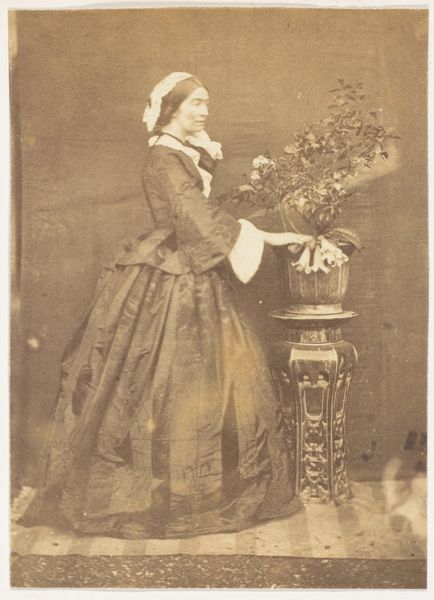
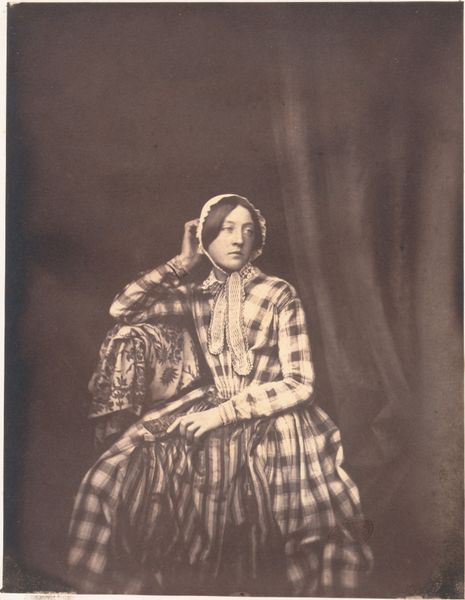
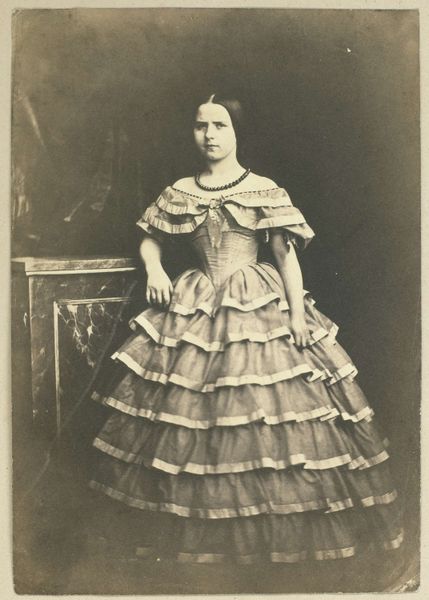
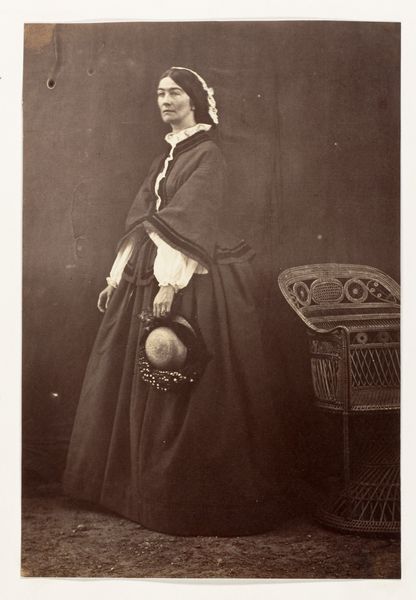
Autre nièce du propriétaire du no. 7 1854 - 1856
0:00
0:00


photography, albumen-print
#
portrait
#
photography
#
albumen-print
#
realism
Dimensions: Image: 9 5/16 × 7 1/2 in. (23.7 × 19.1 cm) Sheet: 13 3/8 × 18 1/8 in. (34 × 46 cm)
Copyright: Public Domain
Curator: This albumen print, entitled "Autre nièce du propriétaire du no. 7," or "Another Niece of the Landlord of no. 7," was captured sometime between 1854 and 1856 by Louis-Pierre-Théophile Dubois de Nehaut. It currently resides at the Metropolitan Museum of Art. Editor: There's a certain subdued melancholy radiating from this image. The heavy drapery, the subdued light—it almost feels like a still from an early film adaptation of a Gothic novel. Curator: Note how Dubois de Nehaut meticulously presents his subject within the formal confines of 19th-century portraiture. The lace bonnet she wears—a delicate shield of propriety—acts as both an adornment and a subtle marker of her societal position. Lace itself, of course, signifies laborious handiwork, demanding considerable skill and time to produce. Editor: Right, and look at how the dress itself is rendered – it’s clearly quite opulent, the silk reflecting the light with a heavy sheen. I am particularly interested in the evidence of its construction. These portraits served, on one level, as catalogs of textile prowess and fashionable design, demonstrating what skilled dressmakers could produce and what prosperous clients could afford. Consider the very human labor captured in this material, from the weavers to the seamstresses. Curator: The sitter's gaze draws us into her interior world. While we don't know her story, her presence here, immortalized through the burgeoning technology of photography, suggests a yearning for recognition and remembrance, speaking to broader themes of identity and preservation in a rapidly changing world. Editor: Precisely. And this burgeoning medium... albumem prints weren't exactly easy. Each print involved coating paper with egg whites to create a smooth surface, which really demonstrates an investment in the final presentation. And for whom? Was this for family, friends, or something grander, some act of preservation against the shifting sands of time? Curator: A photograph serves as more than just a record; it captures aspirations and the dreams of those hoping to leave an indelible mark. Editor: It really makes you wonder about the aspirations of this particular landlord's niece and the labor inherent to her portrait.
Comments
No comments
Be the first to comment and join the conversation on the ultimate creative platform.
 Collect
 React
React Comment
More like this