![Untitled [seated nude with her left hand touching her face] by Richard Diebenkorn](https://d2w8kbdekdi1gv.cloudfront.net/eyJidWNrZXQiOiAiYXJ0ZXJhLWltYWdlcy1idWNrZXQiLCAia2V5IjogImFydHdvcmtzLzlhMTdhODNlLTkxZjctNDA5Ni04ZTI2LWEzZmM3M2FlNWEzYi85YTE3YTgzZS05MWY3LTQwOTYtOGUyNi1hM2ZjNzNhZTVhM2JfZnVsbC5qcGciLCAiZWRpdHMiOiB7InJlc2l6ZSI6IHsid2lkdGgiOiAxOTIwLCAiaGVpZ2h0IjogMTkyMCwgImZpdCI6ICJpbnNpZGUifX19)
About this artwork
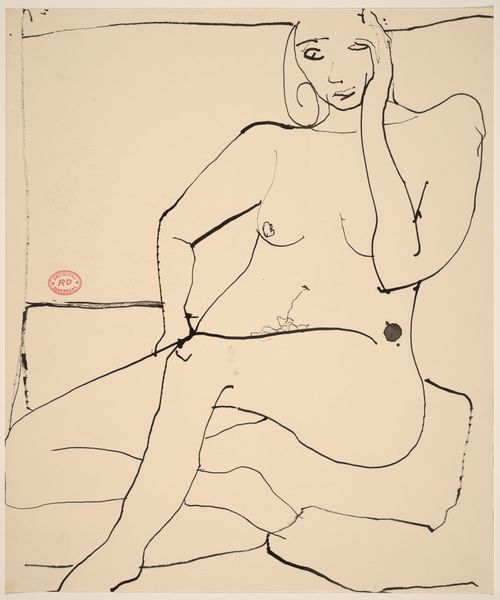
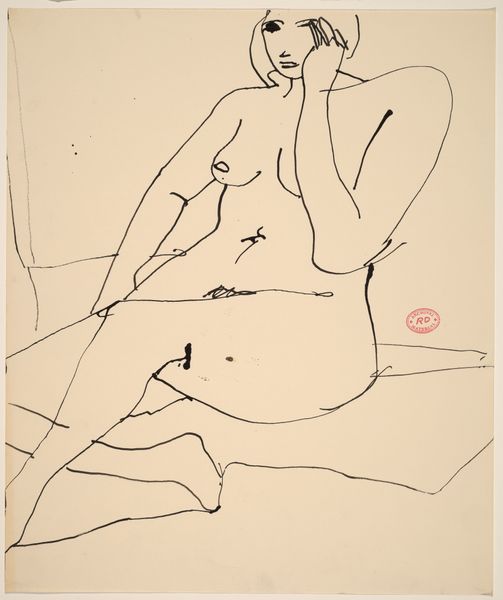
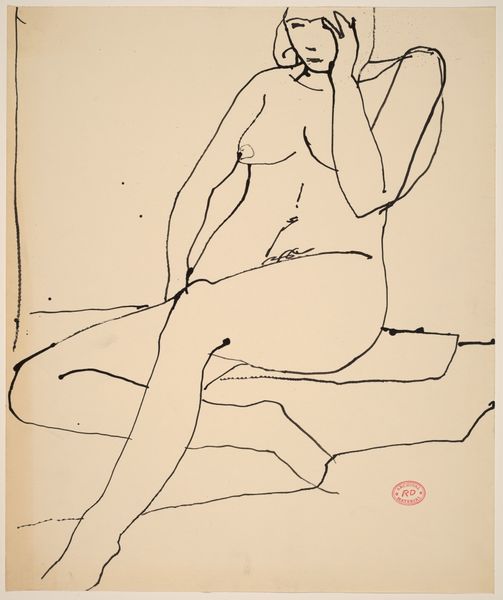
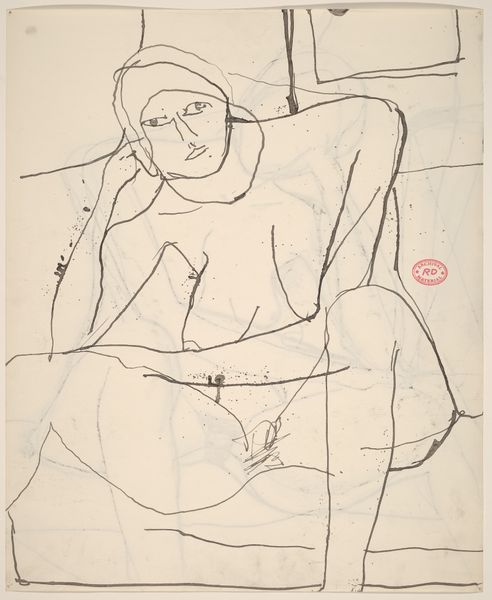
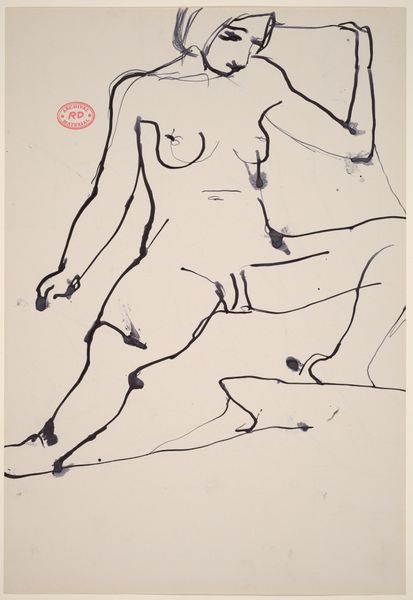
Curator: Here we have an ink drawing, created sometime between 1955 and 1967, titled "Untitled [seated nude with her left hand touching her face]" by Richard Diebenkorn. Editor: Wow, it feels incredibly immediate, almost like we’re looking at a fleeting impression captured in ink. The stark simplicity and those expressive, confident lines...there's something haunting about it. Curator: Indeed. The use of line is quite striking. Think about how a simple outline can still convey volume, emotion. Diebenkorn manages to suggest a whole inner world with the sparest of means. And what do you make of the pose itself, the woman’s hand obscuring part of her face? Editor: It’s intriguing, isn't it? Maybe a gesture of vulnerability, or perhaps self-reflection. The covering of the face evokes feelings of introspection. It feels deeply human. Almost melancholic, like she is wrestling with a question or a memory. The lines at the base strike me like the feeling one gets when they forget the punchline to a joke. They hint at something almost completed and the feeling is lingering like a phantom pain. Curator: The “Untitled” is quite apt, leaving space for us to insert our own interpretations. The crossed-out element on the lower right feels also charged. But there's also a timeless quality, an echo of classical depictions of the female form. A real sense of a continued study of the body. Editor: Absolutely! Even with this modern approach, it ties into an ancient visual dialogue. The sketchiness contributes to a unique charm, as if you interrupted a meditation. One I feel comfortable lingering in. Curator: It invites you in. This particular piece highlights Diebenkorn’s ability to synthesize tradition with a distinctly modern sensibility. The lines feel raw, direct. A window into the artist's mind in conversation with his subject. Editor: And perhaps our minds, too, as we observe. Art, always reflecting back. Thank you for illuminating the sketch.
Untitled [seated nude with her left hand touching her face] 1955 - 1967


Artwork details
- Medium
- drawing, ink
- Dimensions
- overall: 45.4 x 38.1 cm (17 7/8 x 15 in.)
- Copyright
- National Gallery of Art: CC0 1.0
Tags
portrait
drawing
ink drawing
etching
figuration
bay-area-figurative-movement
ink
pen-ink sketch
portrait drawing
nude
Comments
No comments
About this artwork
Curator: Here we have an ink drawing, created sometime between 1955 and 1967, titled "Untitled [seated nude with her left hand touching her face]" by Richard Diebenkorn. Editor: Wow, it feels incredibly immediate, almost like we’re looking at a fleeting impression captured in ink. The stark simplicity and those expressive, confident lines...there's something haunting about it. Curator: Indeed. The use of line is quite striking. Think about how a simple outline can still convey volume, emotion. Diebenkorn manages to suggest a whole inner world with the sparest of means. And what do you make of the pose itself, the woman’s hand obscuring part of her face? Editor: It’s intriguing, isn't it? Maybe a gesture of vulnerability, or perhaps self-reflection. The covering of the face evokes feelings of introspection. It feels deeply human. Almost melancholic, like she is wrestling with a question or a memory. The lines at the base strike me like the feeling one gets when they forget the punchline to a joke. They hint at something almost completed and the feeling is lingering like a phantom pain. Curator: The “Untitled” is quite apt, leaving space for us to insert our own interpretations. The crossed-out element on the lower right feels also charged. But there's also a timeless quality, an echo of classical depictions of the female form. A real sense of a continued study of the body. Editor: Absolutely! Even with this modern approach, it ties into an ancient visual dialogue. The sketchiness contributes to a unique charm, as if you interrupted a meditation. One I feel comfortable lingering in. Curator: It invites you in. This particular piece highlights Diebenkorn’s ability to synthesize tradition with a distinctly modern sensibility. The lines feel raw, direct. A window into the artist's mind in conversation with his subject. Editor: And perhaps our minds, too, as we observe. Art, always reflecting back. Thank you for illuminating the sketch.
Comments
No comments