About this artwork
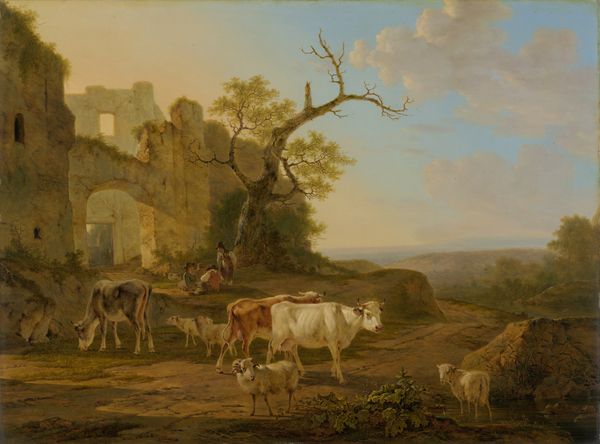
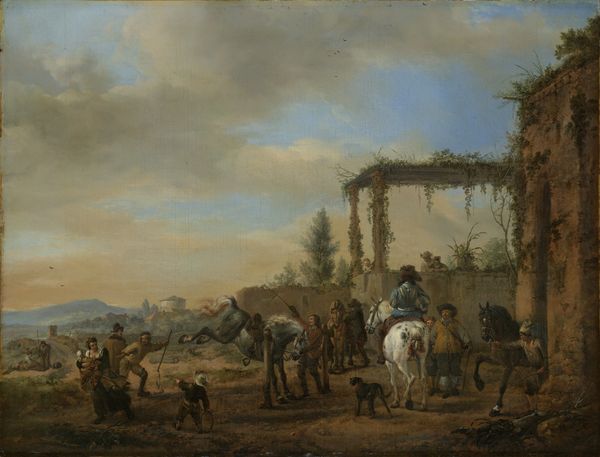
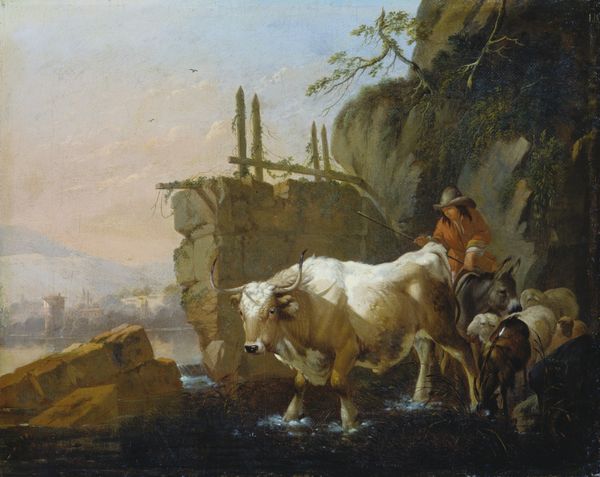
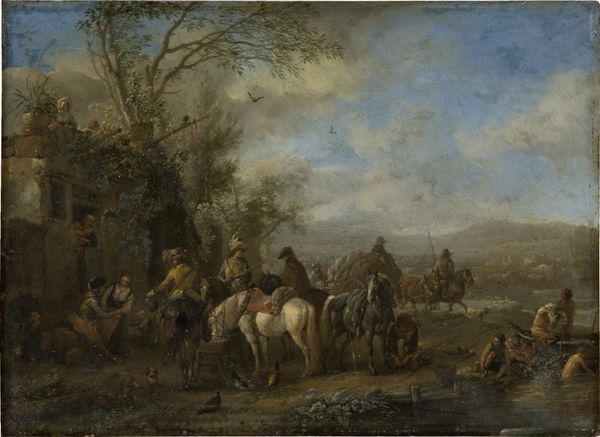
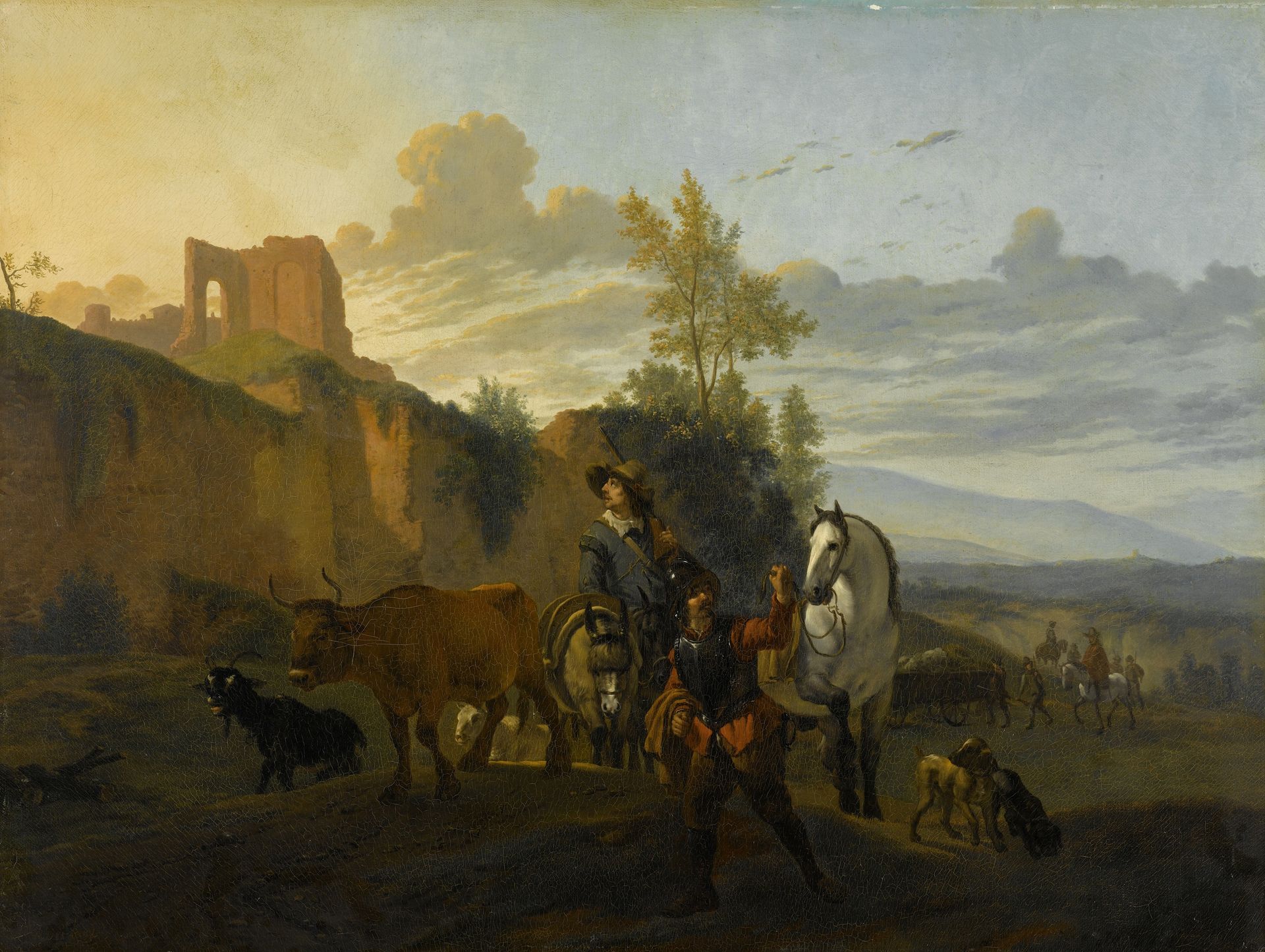
Editor: This is "Italian Landscape with Soldiers," an oil painting attributed to Karel du Jardin, sometime between 1652 and 1700. The crumbling ruin in the background gives it this feeling of past glory and faded empire. How do you read this scene? Curator: Well, immediately I think about the intersection of power and representation in landscape art. Here, the pastoral scene isn't just a pretty backdrop; it’s a site loaded with social and political meaning. Notice how the soldiers aren't engaged in heroic battle, but seem more like guards overseeing a working landscape. Editor: So, you're suggesting that the painting isn’t just a peaceful scene, but also says something about control? Curator: Precisely. And who are they controlling? The animals, yes, but also, implicitly, the land and its resources. This kind of scene served to naturalize and legitimize a certain power dynamic. Consider the visual hierarchy: The ruins of Roman power in the distance, the military figures in the midground and in the immediate foreground. Editor: It's interesting how it frames the Italian landscape through the lens of military presence, instead of celebrating its natural beauty. Curator: It really invites us to question what this idealization of nature obscures, perhaps social inequalities or even exploitation of natural resources. Du Jardin doesn’t offer us pure beauty, but a carefully constructed image, one embedded with implicit social commentary. Editor: So much more to landscape painting than initially meets the eye. I'll never look at another landscape the same way again! Curator: That's exactly the point—to look beyond the surface and ask, "Whose story is being told, and whose is being left out?".

Artwork details
- Medium
- oil-paint
- Dimensions
- height 46 cm, width 62 cm, depth 9.5 cm
- Location
- Rijksmuseum
- Copyright
- Rijks Museum: Open Domain
Tags
baroque
oil-paint
landscape
figuration
oil painting
genre-painting
Comments
Be the first to share your thoughts about this work.
About this artwork
Editor: This is "Italian Landscape with Soldiers," an oil painting attributed to Karel du Jardin, sometime between 1652 and 1700. The crumbling ruin in the background gives it this feeling of past glory and faded empire. How do you read this scene? Curator: Well, immediately I think about the intersection of power and representation in landscape art. Here, the pastoral scene isn't just a pretty backdrop; it’s a site loaded with social and political meaning. Notice how the soldiers aren't engaged in heroic battle, but seem more like guards overseeing a working landscape. Editor: So, you're suggesting that the painting isn’t just a peaceful scene, but also says something about control? Curator: Precisely. And who are they controlling? The animals, yes, but also, implicitly, the land and its resources. This kind of scene served to naturalize and legitimize a certain power dynamic. Consider the visual hierarchy: The ruins of Roman power in the distance, the military figures in the midground and in the immediate foreground. Editor: It's interesting how it frames the Italian landscape through the lens of military presence, instead of celebrating its natural beauty. Curator: It really invites us to question what this idealization of nature obscures, perhaps social inequalities or even exploitation of natural resources. Du Jardin doesn’t offer us pure beauty, but a carefully constructed image, one embedded with implicit social commentary. Editor: So much more to landscape painting than initially meets the eye. I'll never look at another landscape the same way again! Curator: That's exactly the point—to look beyond the surface and ask, "Whose story is being told, and whose is being left out?".
Comments
Be the first to share your thoughts about this work.