About this artwork
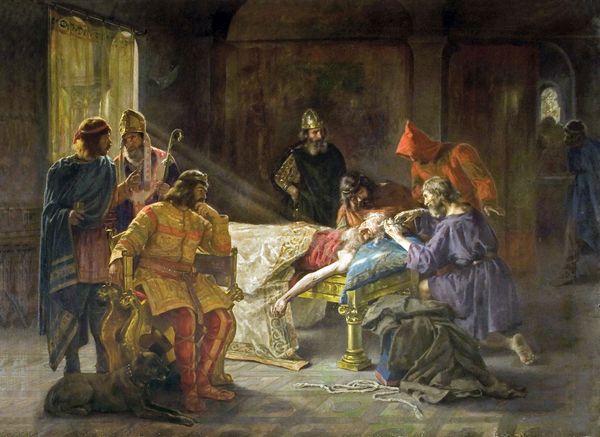
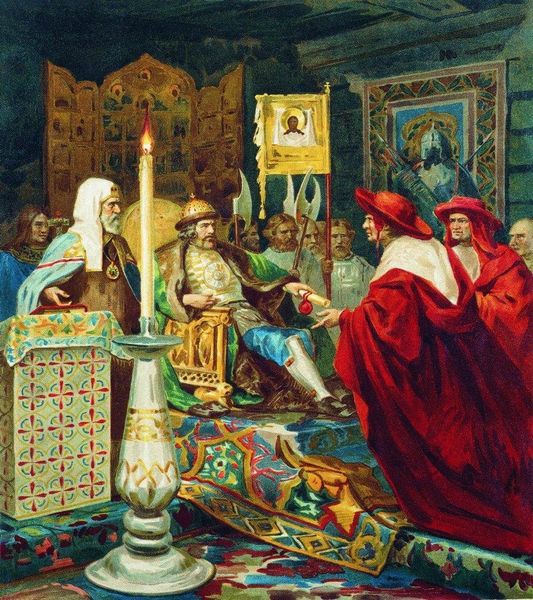
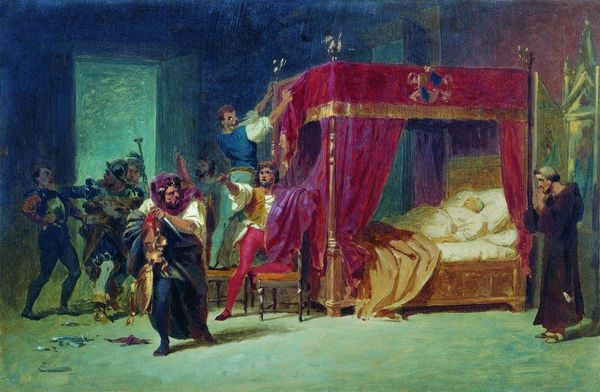
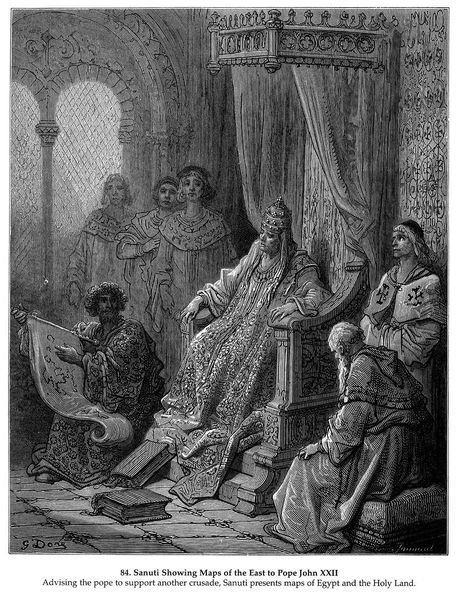
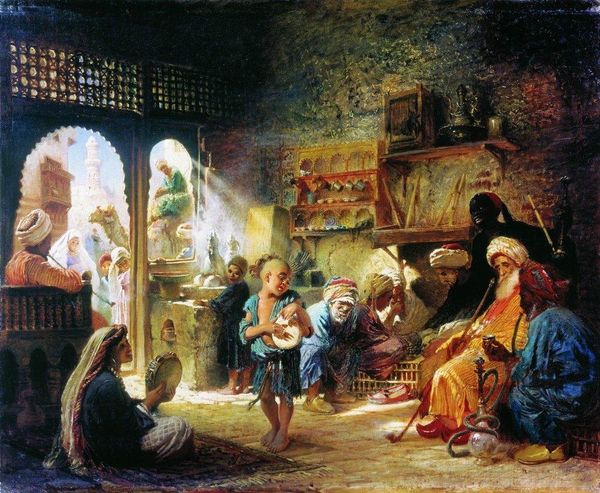
Curator: I find the composition quite moving. The somber atmosphere is thick with grief and reverence. It truly encapsulates loss, don’t you think? Editor: Indeed. We're looking at Henryk Siemiradzki’s "The Death of Alexander Nevsky," a history painting rendered in oil. It belongs, somewhat awkwardly, to both the Romanticism and Russian Avant-Garde movements and the Academic Art style. It really begs the question of how socio-political influences were perceived and interpreted. Curator: Yes! Especially in relation to the representation of Alexander Nevsky as a symbol. How much does the painting celebrate a figure versus utilize him as a tool? It feels rooted in constructing narratives around Russian identity. How does the construction impact national identity, especially through the lens of death and mourning? Editor: Exactly. Siemiradzki clearly depicts a powerful, symbolic moment. The artist likely considered the political and public perception of figures like Nevsky to contribute a kind of legitimization. Did this idealized image serve a larger national narrative and bolster certain powers or factions within society? Curator: Absolutely. I find myself questioning the depiction of these grieving figures surrounding him too. Their presence – or even lack thereof – speaks to gendered roles and societal expectations. How did class impact visibility, or lack thereof, in this moment of national mourning? Editor: An astute observation. What purpose did the visual construction of a historical death scene serve for contemporary audiences? Perhaps, constructing a unifying symbol during times of social division and political transition. It's hard to separate the symbolic death of a "hero" from those larger socio-political and national contexts. Curator: Reflecting on this piece, I am drawn to consider who really has agency and who benefits in the production of collective memory through art like this? Whose story gets privileged? Editor: Right, because analyzing art isn’t just about the individual genius of the artist, but considering how the socio-political forces contextualize, shape, and allow a piece like this to find its viewers. It reveals the public's relationship to both art and the power dynamics of the era.

Artwork details
- Medium
- painting, oil-paint
- Copyright
- Public domain
Tags
portrait
medieval
narrative-art
painting
death
oil-paint
oil painting
famous-people
romanticism
russian-avant-garde
genre-painting
history-painting
academic-art
Comments
No comments
About this artwork
Curator: I find the composition quite moving. The somber atmosphere is thick with grief and reverence. It truly encapsulates loss, don’t you think? Editor: Indeed. We're looking at Henryk Siemiradzki’s "The Death of Alexander Nevsky," a history painting rendered in oil. It belongs, somewhat awkwardly, to both the Romanticism and Russian Avant-Garde movements and the Academic Art style. It really begs the question of how socio-political influences were perceived and interpreted. Curator: Yes! Especially in relation to the representation of Alexander Nevsky as a symbol. How much does the painting celebrate a figure versus utilize him as a tool? It feels rooted in constructing narratives around Russian identity. How does the construction impact national identity, especially through the lens of death and mourning? Editor: Exactly. Siemiradzki clearly depicts a powerful, symbolic moment. The artist likely considered the political and public perception of figures like Nevsky to contribute a kind of legitimization. Did this idealized image serve a larger national narrative and bolster certain powers or factions within society? Curator: Absolutely. I find myself questioning the depiction of these grieving figures surrounding him too. Their presence – or even lack thereof – speaks to gendered roles and societal expectations. How did class impact visibility, or lack thereof, in this moment of national mourning? Editor: An astute observation. What purpose did the visual construction of a historical death scene serve for contemporary audiences? Perhaps, constructing a unifying symbol during times of social division and political transition. It's hard to separate the symbolic death of a "hero" from those larger socio-political and national contexts. Curator: Reflecting on this piece, I am drawn to consider who really has agency and who benefits in the production of collective memory through art like this? Whose story gets privileged? Editor: Right, because analyzing art isn’t just about the individual genius of the artist, but considering how the socio-political forces contextualize, shape, and allow a piece like this to find its viewers. It reveals the public's relationship to both art and the power dynamics of the era.
Comments
No comments