About this artwork
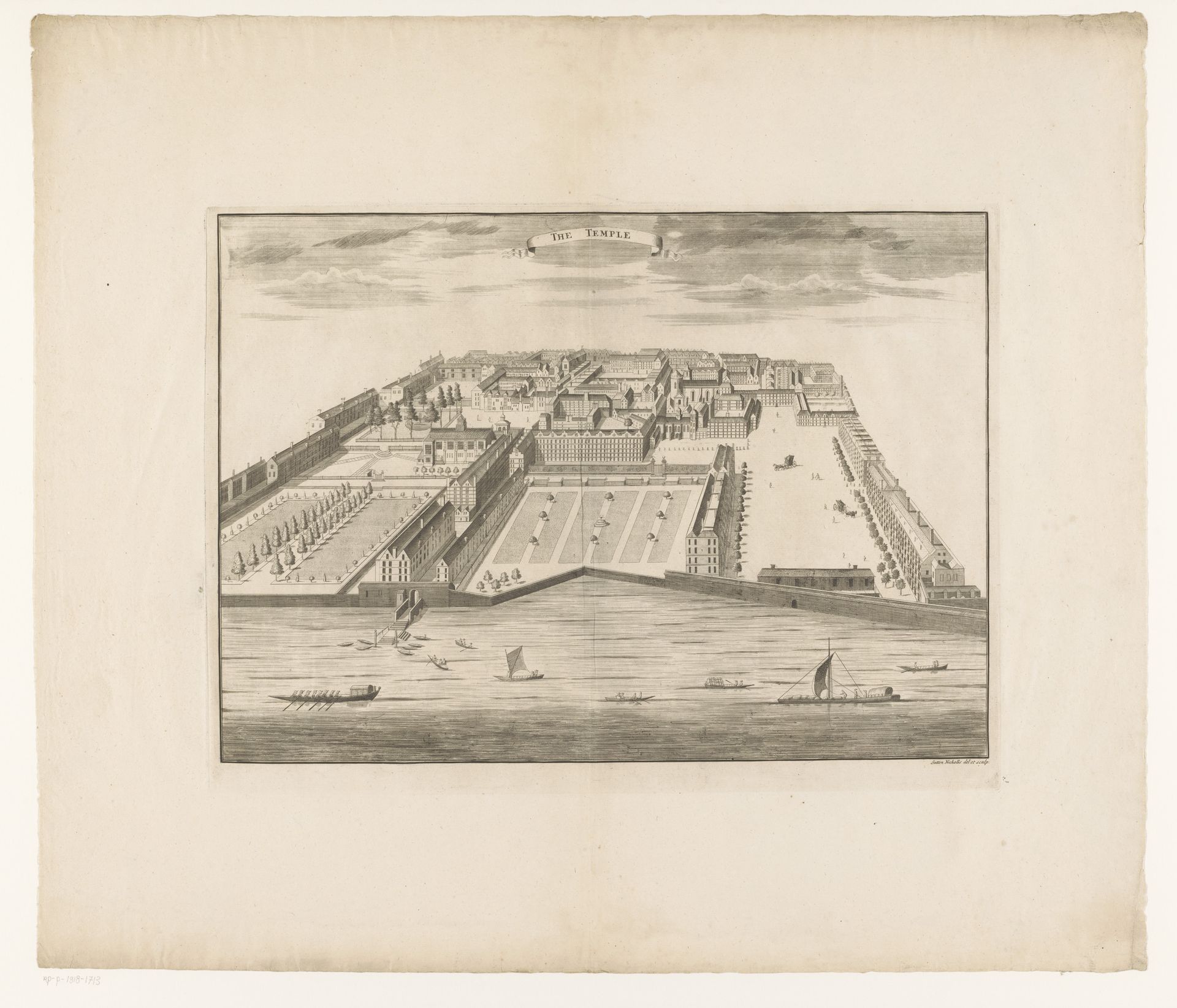
Curator: This is Sutton Nicholls' "Gezicht op Temple, het gerechtelijk district in Londen," created between 1720 and 1731. The Rijksmuseum holds this remarkable ink drawing and engraving on paper. What strikes you first about it? Editor: It's like a meticulously planned ant farm for barristers! The geometry is almost oppressive, yet there's a certain beauty in the obsessive detail, right? I mean, look at those regimented little trees. Curator: Absolutely. Nicholls’ work, falling within the late Baroque period, provides invaluable insight into the visual culture and urban planning of the time. Note how it depicts the Temple as almost a self-contained world, physically separated from the rest of London by the river. Editor: I see it! And the river’s so busy with little boats – a constant reminder that this "world" is actually hyper-connected. It’s a power center visualized, but drained of all warmth. Do you get a "Big Brother" vibe, or is that just me? Curator: Perhaps it's less about surveillance and more about asserting control through visual representation. Cityscapes like this served a political function, projecting an image of order and prosperity under a specific regime. The Baroque was often about spectacle. Editor: Spectacle… yeah, a very *organized* spectacle. I am amused how seriously people took themselves then; everything had to look important! But isn't that the function of legal structures, at the end? Create order and make things “serious”. Curator: Indeed. And notice the technique itself. The precise engraving enhances that sense of order and permanence that rulers were looking to portray in this new and prosperous age for London. Editor: Well, after that enlightening journey into history, I confess: I’ll never look at perfectly trimmed hedges quite the same way again! Now I feel the power! Curator: And I suppose, after all, it’s interesting how Nicholls uses these rigid forms to highlight something more dynamic than perhaps meets the eye at first: London as an early center of trade and power.
Gezicht op Temple, het gerechtelijk district in Londen
1720 - 1731

Sutton Nicholls
1668 - 1729Location
RijksmuseumArtwork details
- Medium
- drawing, print, paper, ink, engraving
- Dimensions
- height 345 mm, width 466 mm
- Location
- Rijksmuseum
- Copyright
- Rijks Museum: Open Domain
Tags
Comments
Share your thoughts
About this artwork
Curator: This is Sutton Nicholls' "Gezicht op Temple, het gerechtelijk district in Londen," created between 1720 and 1731. The Rijksmuseum holds this remarkable ink drawing and engraving on paper. What strikes you first about it? Editor: It's like a meticulously planned ant farm for barristers! The geometry is almost oppressive, yet there's a certain beauty in the obsessive detail, right? I mean, look at those regimented little trees. Curator: Absolutely. Nicholls’ work, falling within the late Baroque period, provides invaluable insight into the visual culture and urban planning of the time. Note how it depicts the Temple as almost a self-contained world, physically separated from the rest of London by the river. Editor: I see it! And the river’s so busy with little boats – a constant reminder that this "world" is actually hyper-connected. It’s a power center visualized, but drained of all warmth. Do you get a "Big Brother" vibe, or is that just me? Curator: Perhaps it's less about surveillance and more about asserting control through visual representation. Cityscapes like this served a political function, projecting an image of order and prosperity under a specific regime. The Baroque was often about spectacle. Editor: Spectacle… yeah, a very *organized* spectacle. I am amused how seriously people took themselves then; everything had to look important! But isn't that the function of legal structures, at the end? Create order and make things “serious”. Curator: Indeed. And notice the technique itself. The precise engraving enhances that sense of order and permanence that rulers were looking to portray in this new and prosperous age for London. Editor: Well, after that enlightening journey into history, I confess: I’ll never look at perfectly trimmed hedges quite the same way again! Now I feel the power! Curator: And I suppose, after all, it’s interesting how Nicholls uses these rigid forms to highlight something more dynamic than perhaps meets the eye at first: London as an early center of trade and power.
Comments
Share your thoughts