Dimensions: 14 5/16 × 9 7/16 in. (36.3 × 24 cm) (image)23 × 19 × 1 1/2 in. (58.42 × 48.26 × 3.81 cm) (outer frame)
Copyright: No Copyright - United States
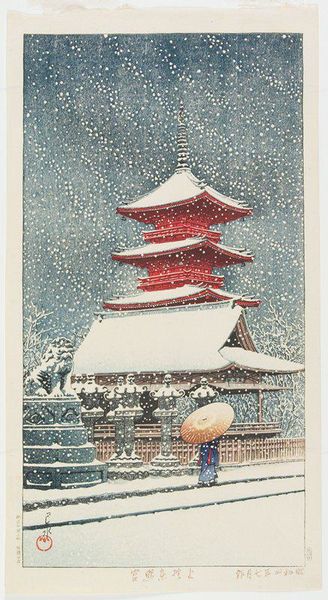
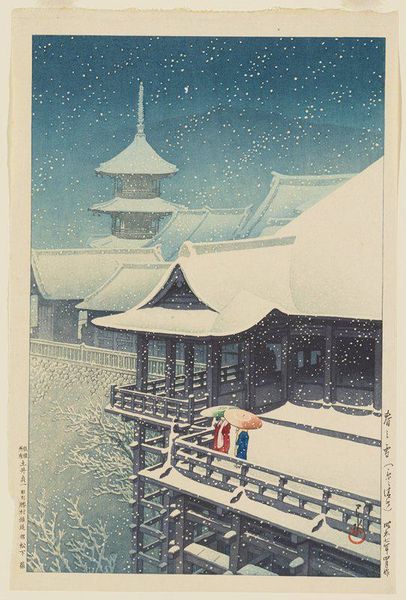
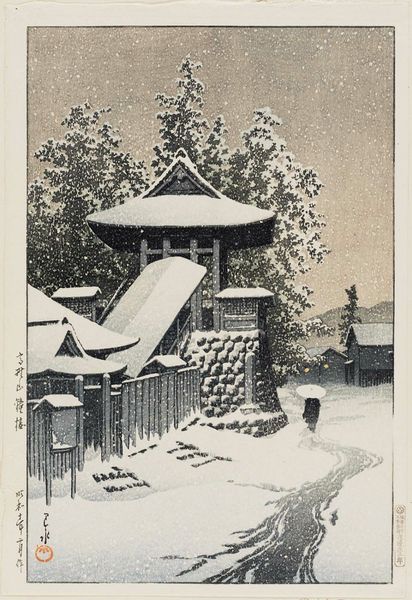
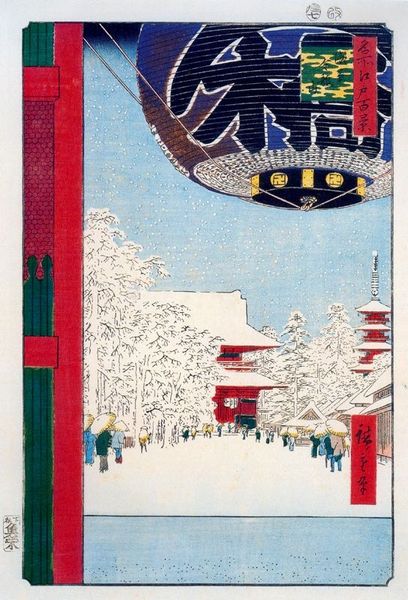
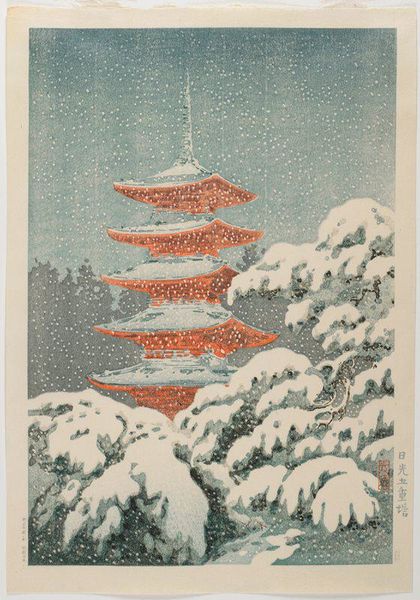
Editor: Here we have Hasui Kawase's "Snow at Kiyomizu Hall in Ueno," a woodblock print from the 1930s. The overwhelming impression is one of quiet solitude; the bright blue of the umbrella carried by a solitary figure stands out starkly against the red and white. What strikes you about this piece? Curator: What grabs me immediately is how Kawase's print allows us to think about the shifting relationship between tradition, modernity, and cultural identity. "Snow at Kiyomizu Hall" seems to invite us to unpack the ways in which Japanese identity was being negotiated during a period of intense social and political change, leading up to World War II. What’s your sense of how the Ukiyo-e tradition figures into that negotiation? Editor: It feels like a bridge between the old and the new. There's a clear lineage in terms of style, but the focus feels less on fleeting pleasures and more on a specific place and its atmosphere. Curator: Precisely! Kawase and other Shin-Hanga artists were consciously modernizing the Ukiyo-e tradition, negotiating with both Western art movements and a desire to capture authentic "Japanese" experiences. This print, with its realistic depiction of a snow-covered temple and its lone female figure, can be seen as an exploration of the female experience in relation to spirituality and cultural identity during this time. Do you think the artist is idealizing something about Japanese identity? Or complicating it? Editor: Perhaps both? The idealized snow scene evokes a sense of purity, but the single figure hints at isolation, a counter-narrative to collective identity. Curator: I think you're on to something. And isn't it telling that this moment of apparent serenity was created on the cusp of intense disruption. We should never underestimate the role of art as a safe space to meditate on cultural resilience and the complicated nature of belonging. Editor: Absolutely. I now see it as much more than just a pretty picture, it really prompts important questions about a period of transformation. Thanks for this perspective.
Comments
No comments
Be the first to comment and join the conversation on the ultimate creative platform.
 Collect
 React
React Comment
More like this