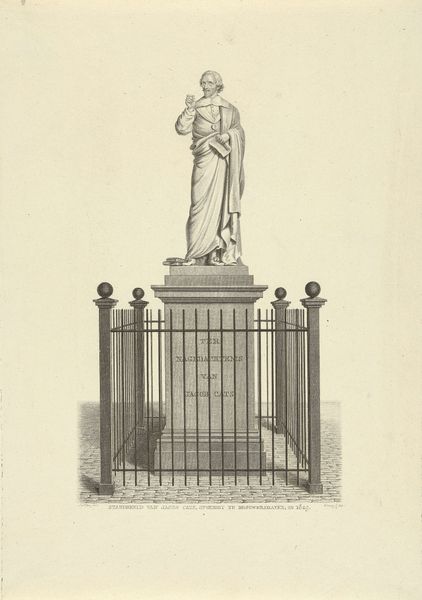
Laurens Koster, uitvinder der boekdrukkunst in den jare 1421, te Haarlem / Leurent Koster, inventeur de l'imprimerie l'an 1421, a Haarlem 1800 - 1833
0:00
0:00

alexandercranendoncq
Rijksmuseum
print, engraving
#
portrait
#
neoclacissism
#
statue
# print
#
historical fashion
#
sketchbook drawing
#
watercolour illustration
#
history-painting
#
academic-art
#
engraving
Dimensions: height 415 mm, width 327 mm
Copyright: Rijks Museum: Open Domain
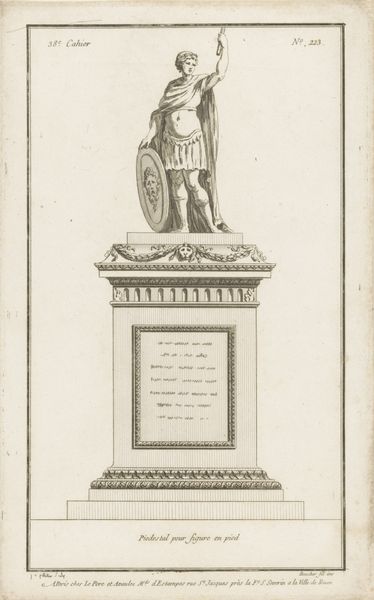
Curator: I find this print so wonderfully… optimistic. There’s a buoyant, forward-looking feel to it, wouldn’t you agree? Editor: That's an interesting way to put it. Before us we have "Laurens Koster, uitvinder der boekdrukkunst in den jare 1421, te Haarlem," which translates to "Laurens Koster, inventor of printing in the year 1421, in Haarlem." This engraving, dating from around 1800-1833, depicts the statue of Koster enclosed in a cage. Curator: Caged? That's it! The cage gives it that playful, just-unveiled feeling—like the statue might leap into action at any moment! And the colors—the soft blues and yellows, the almost salmon-pink of his toga—it’s quite a confection. Editor: I see the bars not as a celebration, but as a visual representation of the constraints placed upon historical narratives. The image serves as a reminder of who gets remembered, and how those memories are controlled and presented. Curator: But consider the pose—that confident stance, the book in hand, the suggestion of knowledge and progress radiating from him. This wasn't a time of easily disseminated information. Imagine what an invention like this must have felt like—suddenly, the world's stories are unbound. Editor: Absolutely, that element is present, but there are also deeper undercurrents to consider. In Dutch and European history, national identity has often been closely intertwined with technological advancement and this image attempts to solidify a sense of cultural pride. Curator: Fair enough. It’s hard to look at a piece from this era and not see the weight of that ambition—that impulse toward national mythmaking. But to focus entirely on that political aspect…it almost robs the print of its visual impact. The hatching, the light playing across the statue’s face. It is an object of artistic skill, yes? Editor: Yes, and that tension between the image's aesthetic qualities and its embedded historical context makes it compelling. How do we contend with the celebration of innovation when access and power dynamics still leave many people behind? Curator: I suppose this print, like any object from the past, presents us with more questions than answers. Editor: Precisely. Perhaps engaging with it isn't just about viewing history, but understanding our present.
Comments
No comments
Be the first to comment and join the conversation on the ultimate creative platform.
 Collect
 React
React Comment
More like this