About this artwork
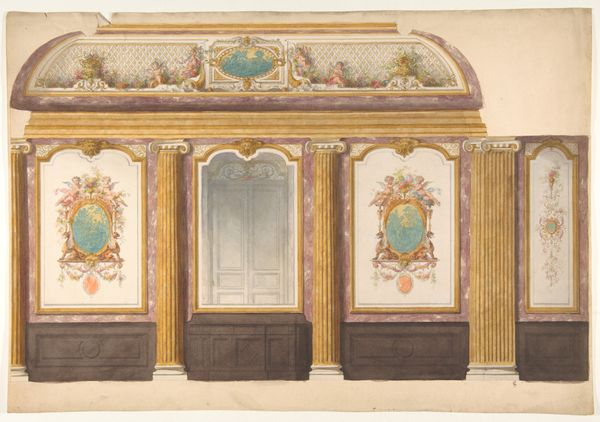
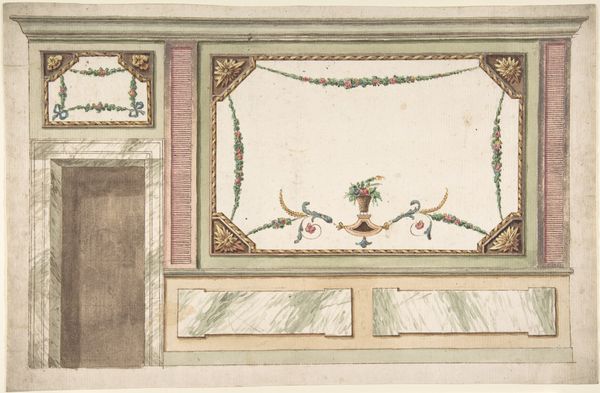
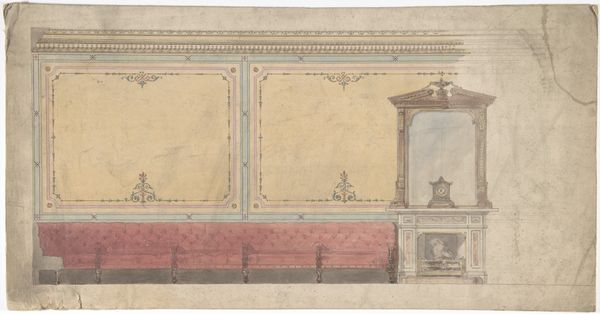
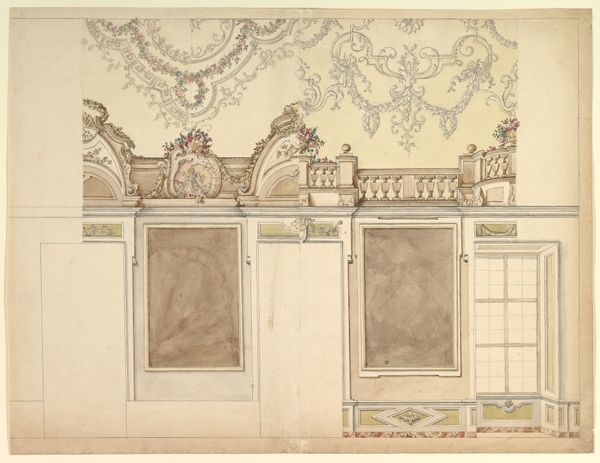
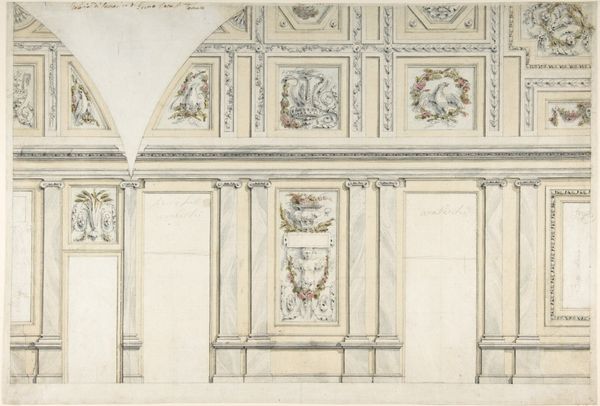
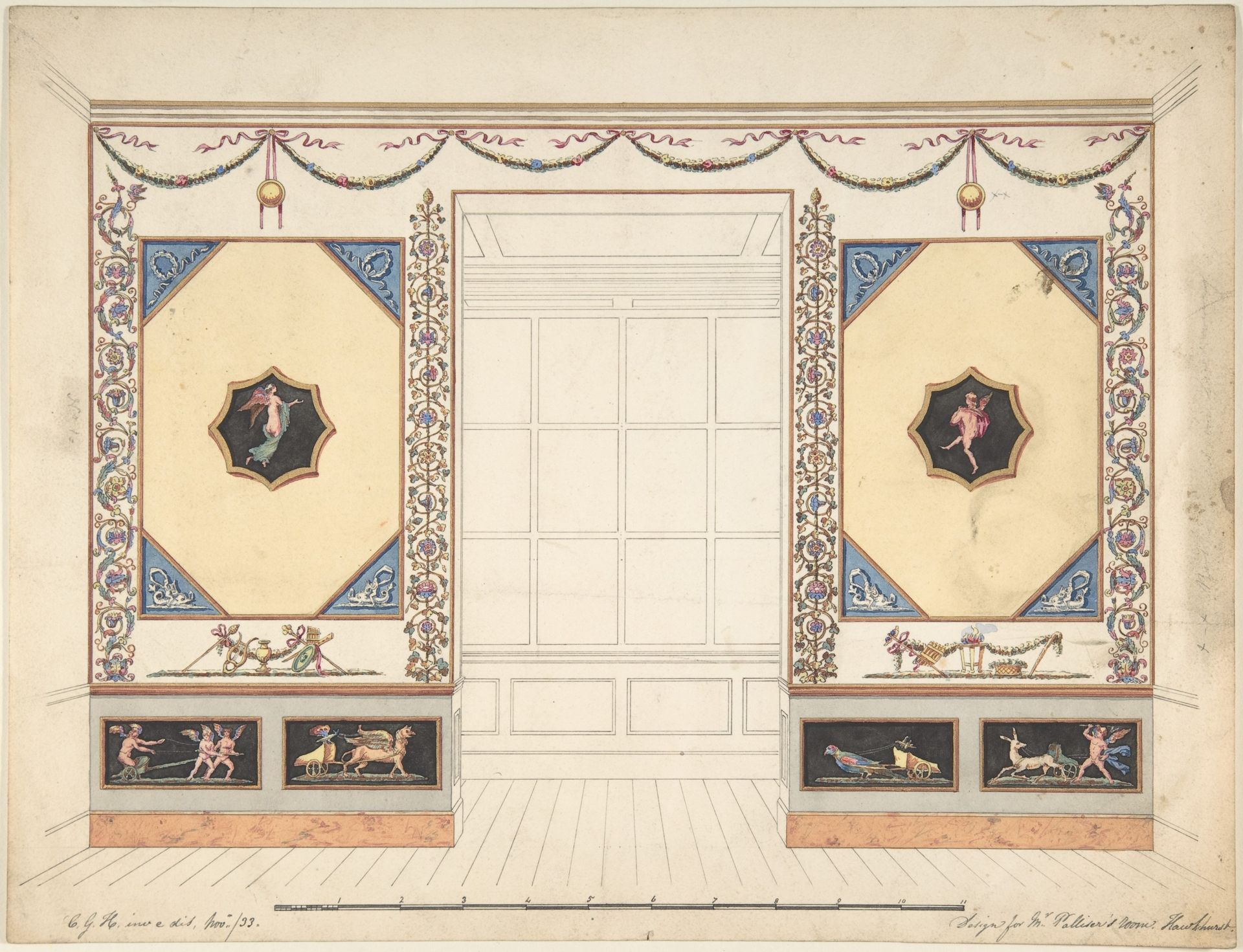
This watercolor design for a room in the Etruscan or Pompeian style, by C. G. Hawkhurst, is rich with classical motifs. Swags of garlands evoke celebratory feasts, while winged figures floating in octagonal frames recall ancient frescoes, meant to transport one back to an idyllic, classical past. Look closer: do you see the friezes populated with mythological creatures and scenes? These aren't mere decoration. Consider how similar figures appear on Greek vases, Roman reliefs, and Renaissance paintings. These images are cultural touchstones that connect us to the deep wellspring of human history. Take, for instance, the image of the winged figure. We see it re-emerge time and again in different contexts, from the gods of antiquity to the angels of Christianity. This enduring motif speaks to our collective yearning for transcendence, echoing through centuries. Such symbols remind us that history isn't a linear progression, but a cyclical return. Images never truly die; they are reborn, carrying within them the echoes of past ages.
Design for a Room in the Etruscan or Pompeian style (Elevation)
1833


Artwork details
- Medium
- drawing, print, architecture
- Dimensions
- sheet: 9 1/2 x 12 3/8 in. (24.1 x 31.4 cm)
- Location
- Metropolitan Museum of Art, New York, NY
- Copyright
- Public Domain
Tags
Comments
Share your thoughts
About this artwork
This watercolor design for a room in the Etruscan or Pompeian style, by C. G. Hawkhurst, is rich with classical motifs. Swags of garlands evoke celebratory feasts, while winged figures floating in octagonal frames recall ancient frescoes, meant to transport one back to an idyllic, classical past. Look closer: do you see the friezes populated with mythological creatures and scenes? These aren't mere decoration. Consider how similar figures appear on Greek vases, Roman reliefs, and Renaissance paintings. These images are cultural touchstones that connect us to the deep wellspring of human history. Take, for instance, the image of the winged figure. We see it re-emerge time and again in different contexts, from the gods of antiquity to the angels of Christianity. This enduring motif speaks to our collective yearning for transcendence, echoing through centuries. Such symbols remind us that history isn't a linear progression, but a cyclical return. Images never truly die; they are reborn, carrying within them the echoes of past ages.
Comments
Share your thoughts