About this artwork
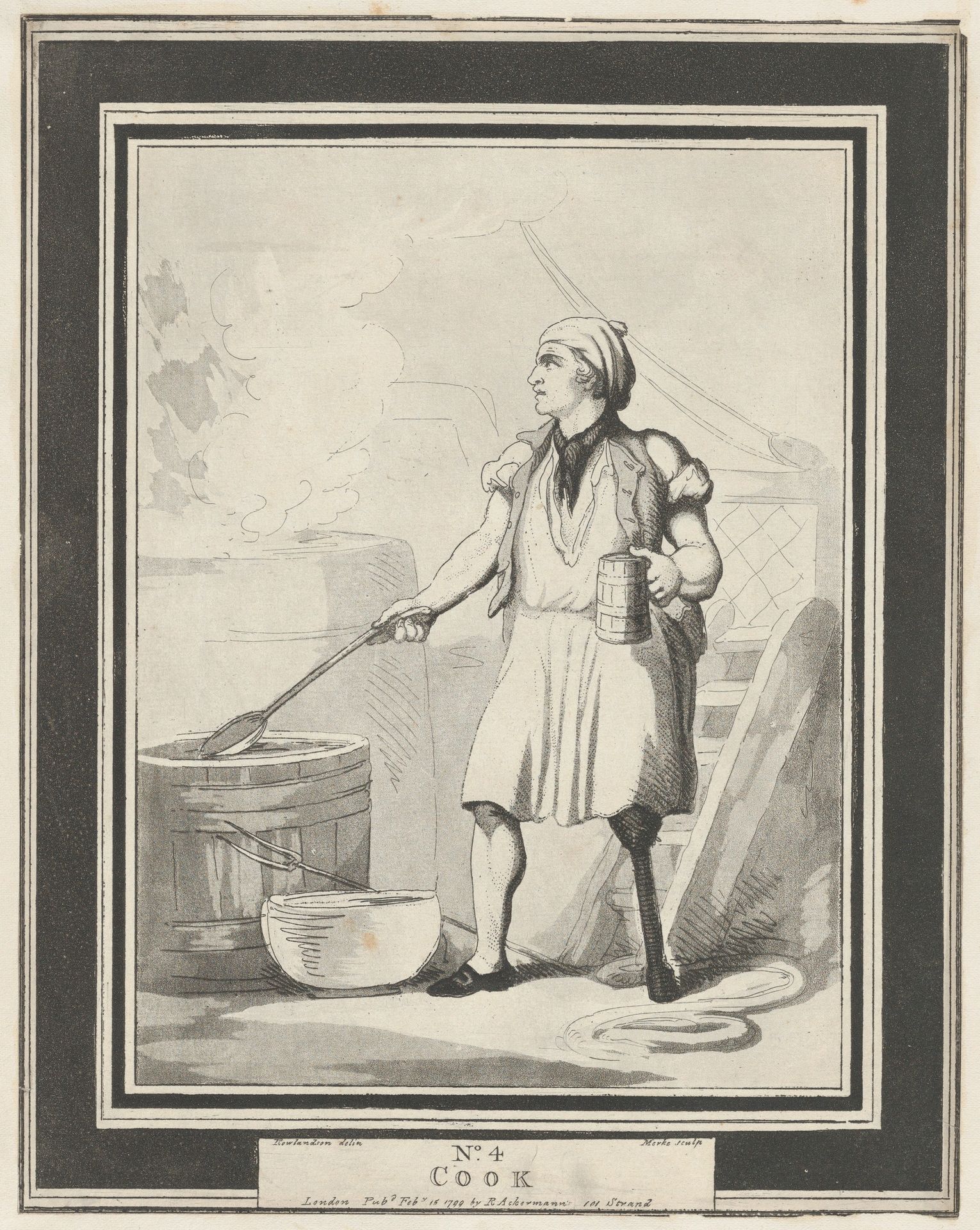
Editor: This is "No. 4: Cook," a print and drawing made in 1799 by Henri Merke, currently housed at the Metropolitan Museum of Art. The figure feels like a stage character—something from a play. What jumps out at you? Curator: It’s fascinating to consider the image as a form of social commentary. Prints like these were often circulated widely, shaping public perception of various trades and social classes. Notice how the cook's wooden leg is emphasized; how might that resonate with viewers in 1799, a period of revolution and naval conflict? Editor: That's interesting. It hadn’t occurred to me to read into the cook's disability. Does it serve to elicit sympathy, or is there a satirical edge at play? Curator: It's likely both. Caricatures in this era often employed exaggeration, and disability could be used to evoke both pity and ridicule. Consider the audience for this print; it would have been consumed within a specific political and cultural context. Also, prints had a didactic purpose for people unable to view the artwork physically, and who consume this image in different spaces? How does the consumption inform the meaning? Editor: So, it’s not just about the individual cook depicted, but also the social narratives and power dynamics surrounding labor and disability in late 18th-century London. The piece asks who gets to consume art and how this consumption impacts cultural significance? Curator: Precisely. The print serves as a portal into a specific moment, revealing how identities were constructed and negotiated in the public sphere. Editor: I now appreciate the role of social history and political context in interpreting seemingly simple genre scenes. It really opens up a whole new avenue for understanding the work. Curator: Absolutely, and it underscores how museums actively shape our understanding of the past. Examining that relationship is critical.
No. 4: Cook
1799


Artwork details
- Medium
- drawing, print
- Dimensions
- Sheet (trimmed and inset): 10 1/4 × 8 1/16 in. (26.1 × 20.4 cm)
- Location
- Metropolitan Museum of Art, New York, NY
- Copyright
- Public Domain
Tags
Comments
Share your thoughts
About this artwork
Editor: This is "No. 4: Cook," a print and drawing made in 1799 by Henri Merke, currently housed at the Metropolitan Museum of Art. The figure feels like a stage character—something from a play. What jumps out at you? Curator: It’s fascinating to consider the image as a form of social commentary. Prints like these were often circulated widely, shaping public perception of various trades and social classes. Notice how the cook's wooden leg is emphasized; how might that resonate with viewers in 1799, a period of revolution and naval conflict? Editor: That's interesting. It hadn’t occurred to me to read into the cook's disability. Does it serve to elicit sympathy, or is there a satirical edge at play? Curator: It's likely both. Caricatures in this era often employed exaggeration, and disability could be used to evoke both pity and ridicule. Consider the audience for this print; it would have been consumed within a specific political and cultural context. Also, prints had a didactic purpose for people unable to view the artwork physically, and who consume this image in different spaces? How does the consumption inform the meaning? Editor: So, it’s not just about the individual cook depicted, but also the social narratives and power dynamics surrounding labor and disability in late 18th-century London. The piece asks who gets to consume art and how this consumption impacts cultural significance? Curator: Precisely. The print serves as a portal into a specific moment, revealing how identities were constructed and negotiated in the public sphere. Editor: I now appreciate the role of social history and political context in interpreting seemingly simple genre scenes. It really opens up a whole new avenue for understanding the work. Curator: Absolutely, and it underscores how museums actively shape our understanding of the past. Examining that relationship is critical.
Comments
Share your thoughts