About this artwork
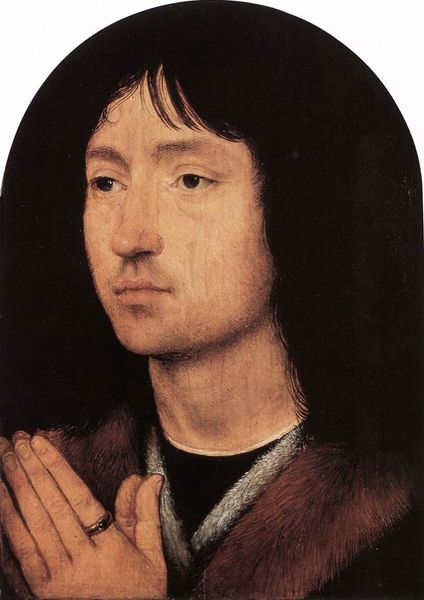
Editor: This is Hans Memling’s "Young Man at Prayer," painted around 1475. It’s currently housed at the National Gallery in London. It strikes me as incredibly intimate; a very personal devotional scene. What can you tell me about the socio-historical context that shaped such an image? Curator: This small oil on panel provides insight into the changing roles of patronage and religious devotion during the Italian Renaissance. Previously, religious imagery primarily existed in grand altarpieces or public spaces, reinforcing communal faith and the Church's power. However, as wealth grew amongst the merchant class, smaller, more portable, and personal devotional images became fashionable. Do you notice anything about the composition suggesting wealth? Editor: The rings on his fingers and the quality of his garments point to status. And the very fact that he can commission a portrait of himself praying suggests a level of privilege. Curator: Exactly. And that column behind him. While seemingly innocuous, classically-inspired architectural details began appearing in portraits during the Renaissance to display one's connection to classical learning and the humanist movement, thereby legitimizing their status and intellectual aspirations. So, Memling crafts not just a devotional image, but a declaration of social standing and alignment with burgeoning cultural values. Do you find this undermines the perceived intimacy of the piece? Editor: That’s a good question! It does add a layer of complexity, maybe even performativity, to the image. Perhaps he isn’t simply a “young man at prayer,” but rather, a young man *presenting* himself at prayer for a specific audience and societal impact. Curator: Precisely. Thinking about it as a carefully constructed image shifts our perspective entirely. I find that exploration of intention fascinating. Editor: I completely agree. Thinking about the performative aspects adds new dimensions. Thanks!
Young Man at Prayer 1475


Artwork details
- Medium
- painting, oil-paint
- Dimensions
- 39 x 25.4 cm
- Location
- National Gallery, London, UK
- Copyright
- Public domain
Tags
portrait
painting
oil-paint
geometric
italian-renaissance
Comments
No comments
About this artwork
Editor: This is Hans Memling’s "Young Man at Prayer," painted around 1475. It’s currently housed at the National Gallery in London. It strikes me as incredibly intimate; a very personal devotional scene. What can you tell me about the socio-historical context that shaped such an image? Curator: This small oil on panel provides insight into the changing roles of patronage and religious devotion during the Italian Renaissance. Previously, religious imagery primarily existed in grand altarpieces or public spaces, reinforcing communal faith and the Church's power. However, as wealth grew amongst the merchant class, smaller, more portable, and personal devotional images became fashionable. Do you notice anything about the composition suggesting wealth? Editor: The rings on his fingers and the quality of his garments point to status. And the very fact that he can commission a portrait of himself praying suggests a level of privilege. Curator: Exactly. And that column behind him. While seemingly innocuous, classically-inspired architectural details began appearing in portraits during the Renaissance to display one's connection to classical learning and the humanist movement, thereby legitimizing their status and intellectual aspirations. So, Memling crafts not just a devotional image, but a declaration of social standing and alignment with burgeoning cultural values. Do you find this undermines the perceived intimacy of the piece? Editor: That’s a good question! It does add a layer of complexity, maybe even performativity, to the image. Perhaps he isn’t simply a “young man at prayer,” but rather, a young man *presenting* himself at prayer for a specific audience and societal impact. Curator: Precisely. Thinking about it as a carefully constructed image shifts our perspective entirely. I find that exploration of intention fascinating. Editor: I completely agree. Thinking about the performative aspects adds new dimensions. Thanks!
Comments
No comments