About this artwork
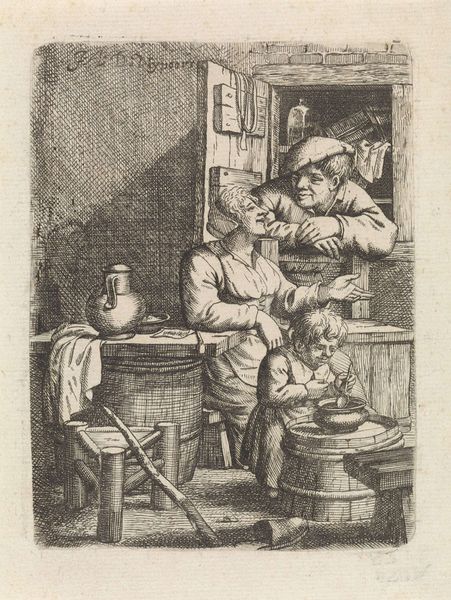
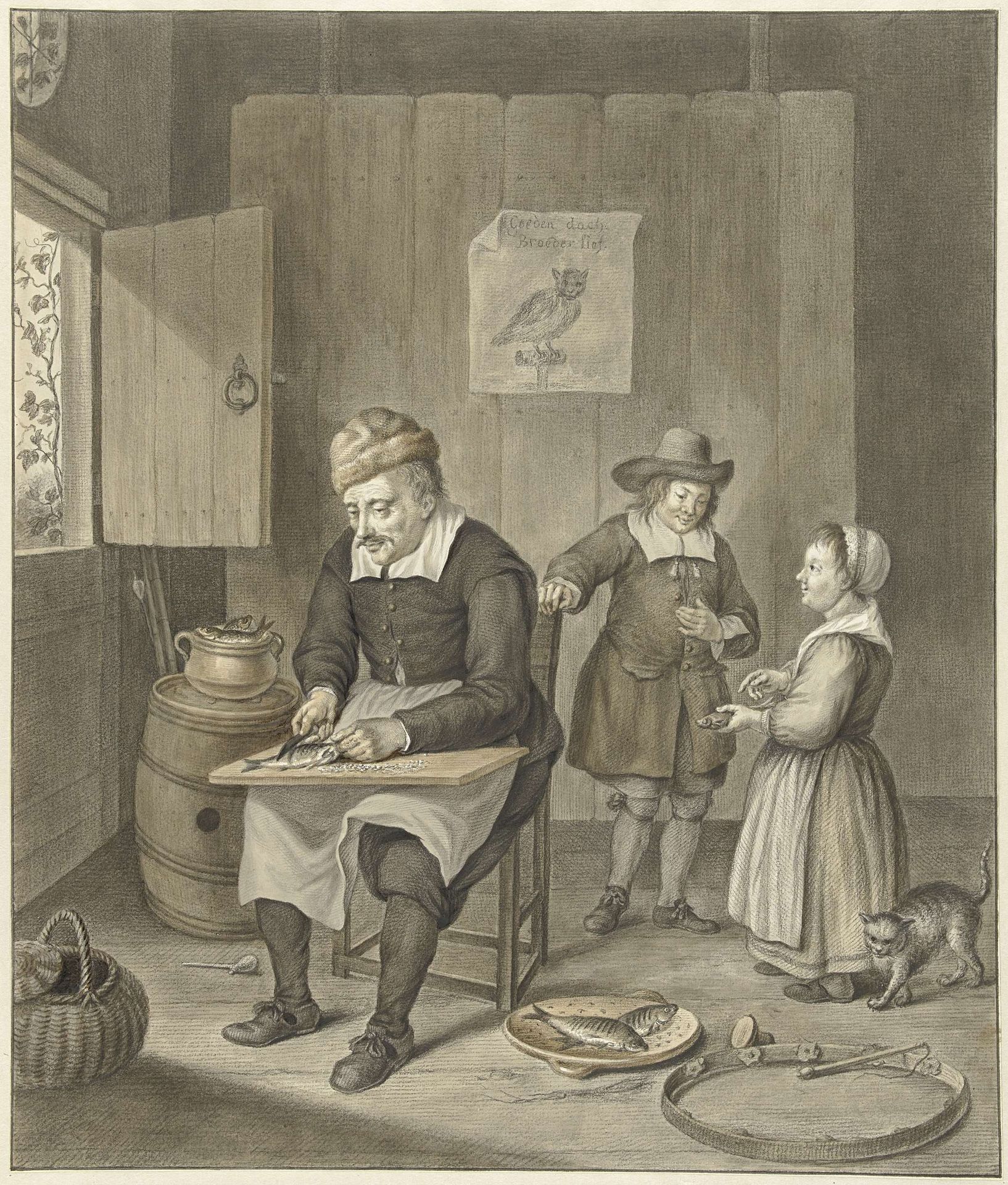
Abraham Delfos created this engraving, "Interior with a Man Cleaning Fish and Two Children," capturing a domestic scene rich with symbolic undertones. Dominating the backdrop is an image of an owl, an animal that has long carried dual meanings of wisdom and foolishness. The owl, often a symbol of knowledge and watchfulness, also embodies darkness and ignorance, a motif found even in ancient Greek traditions. Its appearance here, within a seemingly mundane domestic setting, invites us to consider these contradictory meanings. In this context, the owl is perched above a man performing a menial task, perhaps suggesting a commentary on the nature of labor and knowledge. This duality echoes through time, appearing in various guises across cultures and artistic movements. As symbols evolve, their meanings are layered with new interpretations, influenced by the collective memory and the subconscious drives of humanity. Delfos's composition subtly engages these forces, prompting us to reflect on the complex interplay between knowledge, labor, and our own subconscious projections.
Interieur met man die vissen schoon maakt en twee kinderen
1741 - 1820

Abraham Delfos
1731 - 1820Location
RijksmuseumArtwork details
- Medium
- drawing, print, etching, intaglio
- Dimensions
- height 405 mm, width 345 mm
- Location
- Rijksmuseum
- Copyright
- Rijks Museum: Open Domain
Tags
portrait
drawing
narrative-art
dutch-golden-age
etching
intaglio
charcoal drawing
figuration
pencil drawing
genre-painting
Comments
Be the first to share your thoughts about this work.
About this artwork
Abraham Delfos created this engraving, "Interior with a Man Cleaning Fish and Two Children," capturing a domestic scene rich with symbolic undertones. Dominating the backdrop is an image of an owl, an animal that has long carried dual meanings of wisdom and foolishness. The owl, often a symbol of knowledge and watchfulness, also embodies darkness and ignorance, a motif found even in ancient Greek traditions. Its appearance here, within a seemingly mundane domestic setting, invites us to consider these contradictory meanings. In this context, the owl is perched above a man performing a menial task, perhaps suggesting a commentary on the nature of labor and knowledge. This duality echoes through time, appearing in various guises across cultures and artistic movements. As symbols evolve, their meanings are layered with new interpretations, influenced by the collective memory and the subconscious drives of humanity. Delfos's composition subtly engages these forces, prompting us to reflect on the complex interplay between knowledge, labor, and our own subconscious projections.
Comments
Be the first to share your thoughts about this work.