About this artwork
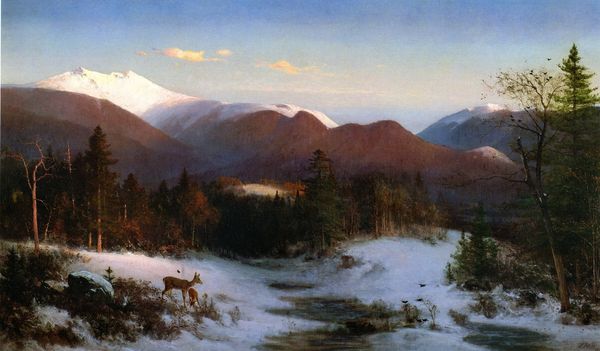
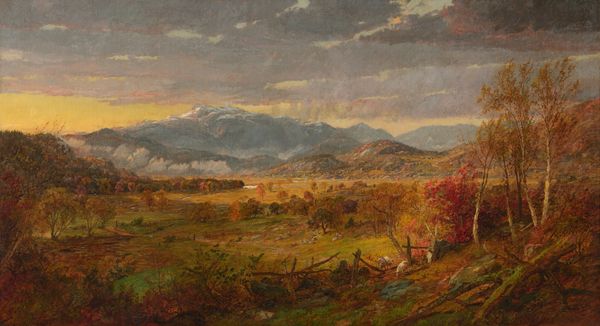
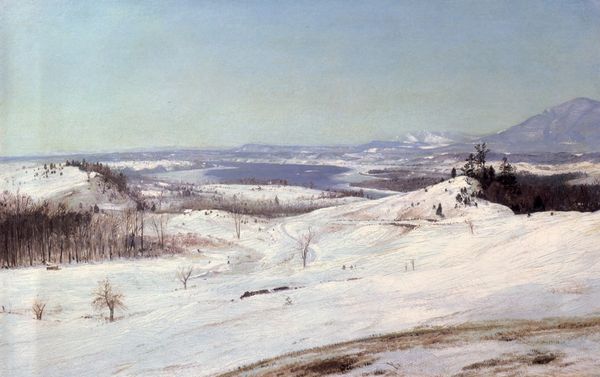
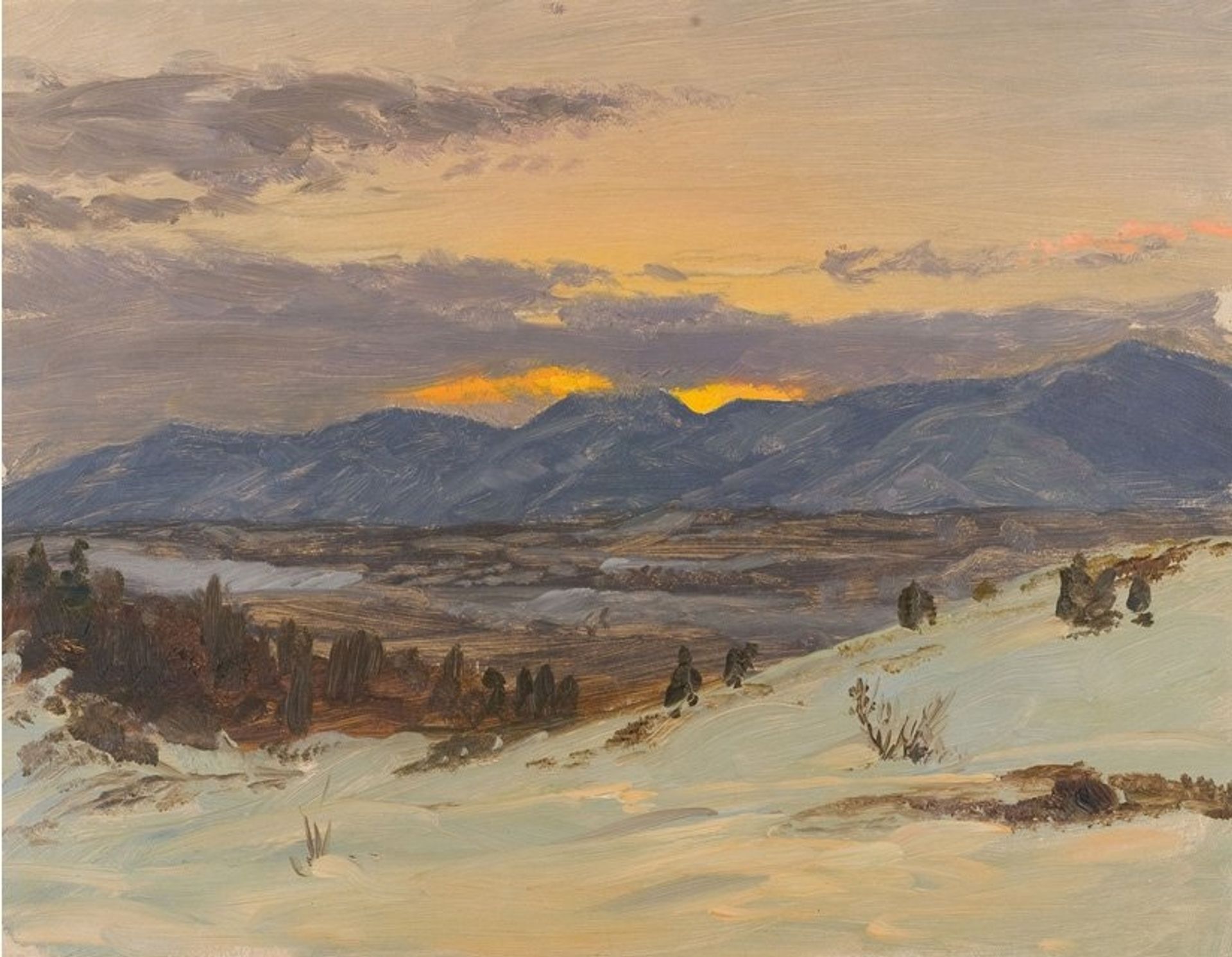
Editor: This is Frederic Edwin Church's "Winter Twilight from Olana," painted in 1871 using oil paint. It's just… striking. The golden light against those imposing mountains really grabs your attention. How do you interpret this work? Curator: Indeed. Notice how Church masterfully employs aerial perspective. The gradations in color and tone create a sense of depth, drawing the eye from the immediate foreground, with its textural brushstrokes suggesting snow, towards the distant mountains and finally, the luminous sky. How do these elements interact, would you say? Editor: I think the color palette really directs our focus. The warm sunset is a distinct focal point, juxtaposed against the cool blues and greys of the snow-covered landscape and distant mountains. The texture almost seems secondary to the coloring itself. Is this the appeal of Romanticism that it seems to represent? Curator: A worthwhile point. Focus on the arrangement of forms, for example. Observe the compositional structure and how Church utilizes horizontal lines to create a sense of stability. And where does your eye go with respect to all of this organization? Editor: It still finds itself pulled to the mountain’s center, where the colors contrast each other strongly and pull all of that tonal and shape tension. Curator: Precisely. It exemplifies the ability to utilize the basic components of visual language to create engagement. Has considering the work in this manner affected your impression? Editor: It has! Focusing on the structural elements gives me a clearer idea of Church's technical skill in orchestrating such a visually arresting landscape. Curator: Agreed, by analyzing the painting’s formal qualities, we gain a deeper understanding of Church’s artistic choices and the aesthetic impact they create.
Winter Twilight from Olana
1871

Frederic Edwin Church
1826 - 1900Location
Olana State Historic Site, Greenport, NY, USArtwork details
- Location
- Olana State Historic Site, Greenport, NY, US
- Copyright
- Public domain
Comments
Share your thoughts
About this artwork
Editor: This is Frederic Edwin Church's "Winter Twilight from Olana," painted in 1871 using oil paint. It's just… striking. The golden light against those imposing mountains really grabs your attention. How do you interpret this work? Curator: Indeed. Notice how Church masterfully employs aerial perspective. The gradations in color and tone create a sense of depth, drawing the eye from the immediate foreground, with its textural brushstrokes suggesting snow, towards the distant mountains and finally, the luminous sky. How do these elements interact, would you say? Editor: I think the color palette really directs our focus. The warm sunset is a distinct focal point, juxtaposed against the cool blues and greys of the snow-covered landscape and distant mountains. The texture almost seems secondary to the coloring itself. Is this the appeal of Romanticism that it seems to represent? Curator: A worthwhile point. Focus on the arrangement of forms, for example. Observe the compositional structure and how Church utilizes horizontal lines to create a sense of stability. And where does your eye go with respect to all of this organization? Editor: It still finds itself pulled to the mountain’s center, where the colors contrast each other strongly and pull all of that tonal and shape tension. Curator: Precisely. It exemplifies the ability to utilize the basic components of visual language to create engagement. Has considering the work in this manner affected your impression? Editor: It has! Focusing on the structural elements gives me a clearer idea of Church's technical skill in orchestrating such a visually arresting landscape. Curator: Agreed, by analyzing the painting’s formal qualities, we gain a deeper understanding of Church’s artistic choices and the aesthetic impact they create.
Comments
Share your thoughts