About this artwork
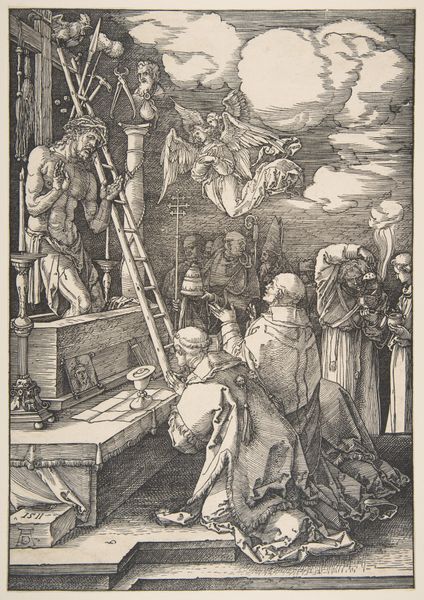
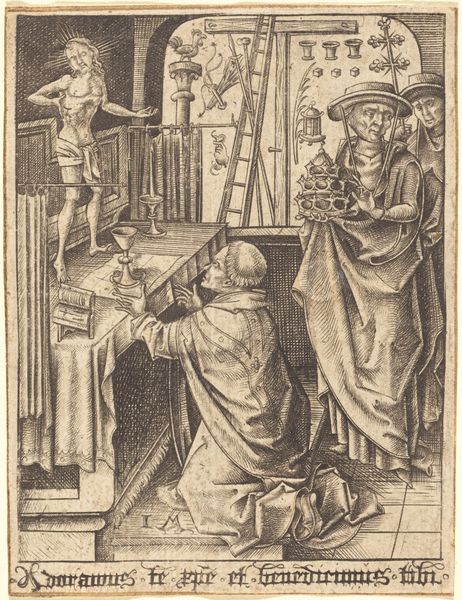
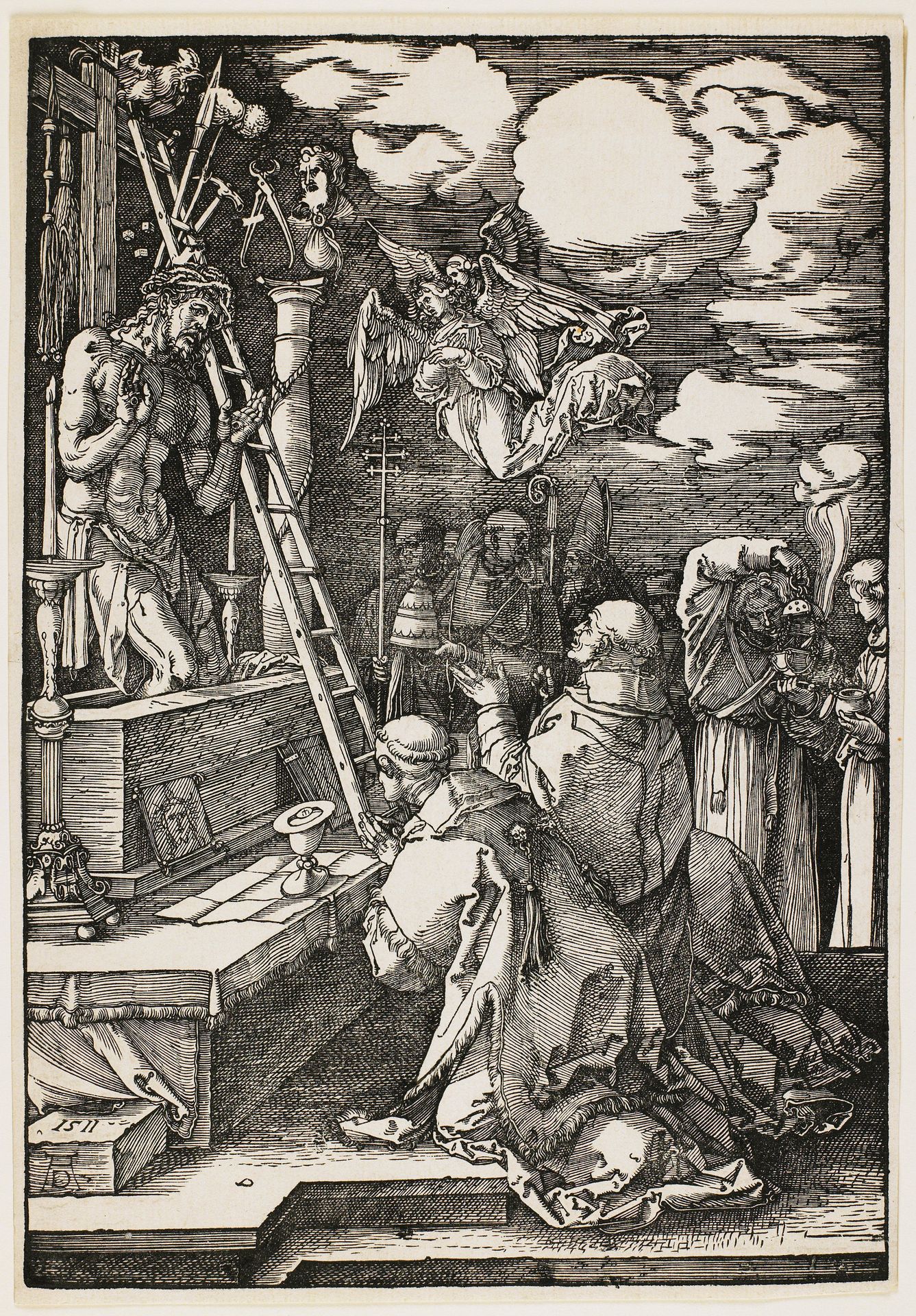
Curator: Dürer’s "The Mass of Saint Gregory," created as a woodcut in 1511, immerses us in a complex scene, currently housed here at the Minneapolis Institute of Art. Editor: My first impression is dominated by contrasts: the stark black lines against the white ground create a dramatic intensity. It’s so textural, especially when you consider its graphic simplicity! Curator: Absolutely, the materiality heightens its visual impact. Beyond that, consider the context. Dürer made this print during a period of religious and social upheaval in Europe, capturing the essence of late medieval piety in Germany amidst rising calls for reform. The image visualizes a miracle from the life of St. Gregory the Great. Editor: The composition is intriguing, isn’t it? A ladder reaches toward a tortured Christ, surrounded by instruments of his Passion. Yet, below, the orderly arrangement of figures at prayer, a geometric tabletop. These arrangements establish very firm tonal differentiations across the picture plane. Curator: The visual tension resonates with a wider historical reading. Gregory's vision, appearing during the Mass, symbolizes the redemptive power of Christ's sacrifice. Dürer connects the divine directly to the earthly, imbuing ritual with transformative potential, a sentiment of real comfort at a time when faith was in crisis. Editor: Notice also Dürer’s meticulous rendering of details – the folds of fabric, the texture of skin. Observe, too, the symbolism embedded within – each instrument of Christ's passion speaks volumes and they draw your eye around. And the precision of the woodcut technique only enhances its didactic quality. Curator: Looking closely, the details echo themes of social equity, the promise of direct communication between the faithful and the divine regardless of social standing. The image implies a deeply personal spiritual relationship facilitated by genuine, heart-felt repentance— a view championed by reformers and reflective of the time's anxieties. Editor: Yes, in the end, "The Mass of Saint Gregory" provides us with multiple levels of interpretation through composition, materiality, and texture. Curator: Indeed, viewing it through this lens grants us insight into the sociopolitical complexities of its time and Dürer’s reflections on those issues.
The Mass of Saint Gregory
1511


Artwork details
- Medium
- print, woodcut
- Dimensions
- 11 3/4 x 8 1/8 in. (29.85 x 20.64 cm) (image)
- Location
- Minneapolis Institute of Art
- Copyright
- Public Domain
Tags
Comments

While celebrating Mass in Rome, Pope Gregory the Great reportedly saw Christ miraculously rise above a sarcophagus, accompanied by symbols of the Passion. This legend gave birth to the Gregorian Man of Sorrows. With an eye to naturalism, Albrecht Dürer leaned a small devotional picture against the altar, perhaps to model for the viewer how contemplation can lead to visualization.
About this artwork
Curator: Dürer’s "The Mass of Saint Gregory," created as a woodcut in 1511, immerses us in a complex scene, currently housed here at the Minneapolis Institute of Art. Editor: My first impression is dominated by contrasts: the stark black lines against the white ground create a dramatic intensity. It’s so textural, especially when you consider its graphic simplicity! Curator: Absolutely, the materiality heightens its visual impact. Beyond that, consider the context. Dürer made this print during a period of religious and social upheaval in Europe, capturing the essence of late medieval piety in Germany amidst rising calls for reform. The image visualizes a miracle from the life of St. Gregory the Great. Editor: The composition is intriguing, isn’t it? A ladder reaches toward a tortured Christ, surrounded by instruments of his Passion. Yet, below, the orderly arrangement of figures at prayer, a geometric tabletop. These arrangements establish very firm tonal differentiations across the picture plane. Curator: The visual tension resonates with a wider historical reading. Gregory's vision, appearing during the Mass, symbolizes the redemptive power of Christ's sacrifice. Dürer connects the divine directly to the earthly, imbuing ritual with transformative potential, a sentiment of real comfort at a time when faith was in crisis. Editor: Notice also Dürer’s meticulous rendering of details – the folds of fabric, the texture of skin. Observe, too, the symbolism embedded within – each instrument of Christ's passion speaks volumes and they draw your eye around. And the precision of the woodcut technique only enhances its didactic quality. Curator: Looking closely, the details echo themes of social equity, the promise of direct communication between the faithful and the divine regardless of social standing. The image implies a deeply personal spiritual relationship facilitated by genuine, heart-felt repentance— a view championed by reformers and reflective of the time's anxieties. Editor: Yes, in the end, "The Mass of Saint Gregory" provides us with multiple levels of interpretation through composition, materiality, and texture. Curator: Indeed, viewing it through this lens grants us insight into the sociopolitical complexities of its time and Dürer’s reflections on those issues.
Comments
While celebrating Mass in Rome, Pope Gregory the Great reportedly saw Christ miraculously rise above a sarcophagus, accompanied by symbols of the Passion. This legend gave birth to the Gregorian Man of Sorrows. With an eye to naturalism, Albrecht Dürer leaned a small devotional picture against the altar, perhaps to model for the viewer how contemplation can lead to visualization.