About this artwork
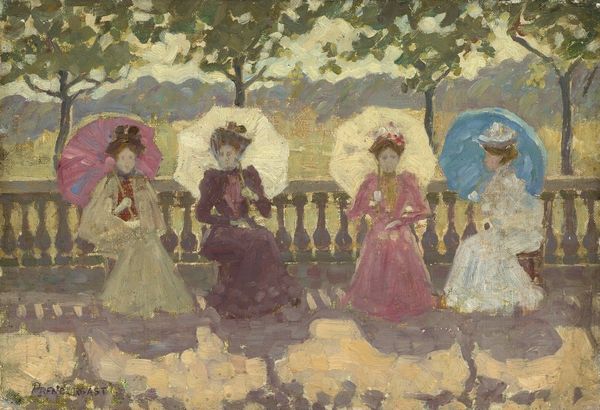
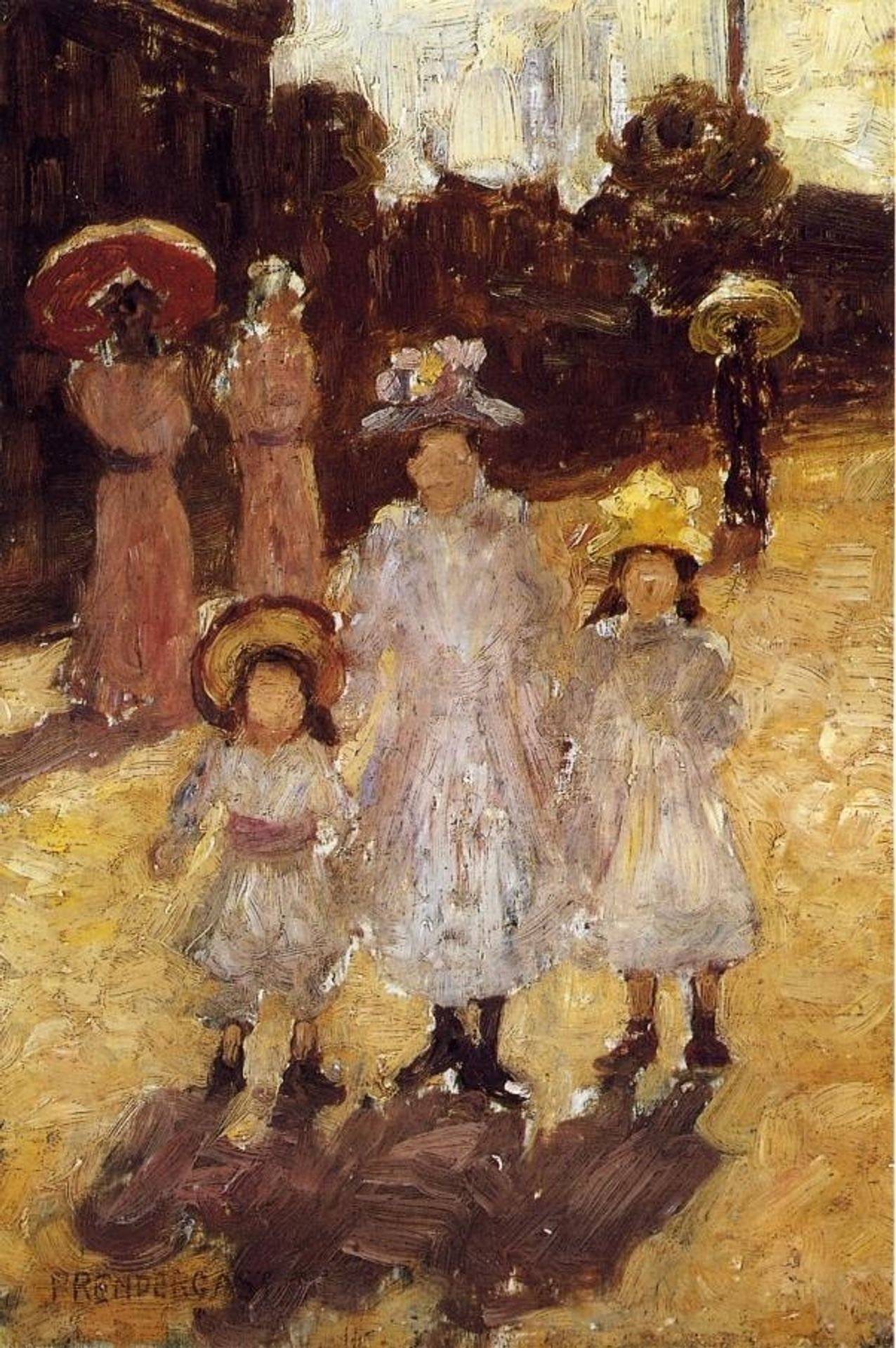
Curator: Ah, this painting has a beautiful, breezy quality. The piece is entitled *Sunday Morning, Paris*, executed by Maurice Prendergast in 1894, using oil on canvas. Editor: My immediate response is of dappled sunlight and the relaxed atmosphere of a leisurely day. The artist's rendering almost dissolves into a hazy dream. Curator: Absolutely, the overall chromatic register verges towards a subtle array of pinks and ochres, creating a rather harmonious surface. The figures' forms, while discernible, melt back into the canvas via Prendergast's pointillist-like technique. Editor: I’m intrigued by these figures. Their fashionable attire indicates a certain social class enjoying a Sunday promenade, possibly near a park. Prendergast was depicting modernity – its burgeoning middle class and their newfound leisure activities. Curator: Note too the careful arrangement of the figures – some flattened, almost hieratic. Their spatial arrangement is decidedly modernist. It deviates drastically from traditional academic painting; here, formal elements outweigh representational accuracy. Editor: Considering it's a late 19th-century work, the emphasis on portraying contemporary life certainly highlights its significance. Impressionism paved the way for capturing fleeting moments within broader social transformations. Curator: The energetic brushstrokes function not only descriptively, suggesting fabric or foliage, but as self-referential elements acknowledging the material conditions of painting itself. This insistence on the materiality is what characterizes high Modernism. Editor: Prendergast spent considerable time in Paris. And as we consider the period's attitude toward public spaces and burgeoning urban experience, Prendergast gives us a specific vision. This painting encapsulates that transformative era, capturing everyday leisure. Curator: Indeed, analyzing this, I'm particularly taken by its flattened plane and how color and composition prioritize texture, more so than perspective, reflecting Prendergast’s radical vision. Editor: And for me, its true accomplishment is documenting a shift – witnessing the evolution of public life and societal attitudes within that particular era. It's fascinating how Prendergast immortalized it.

Artwork details
- Dimensions
- 23.81 x 15.56 cm
- Location
- Private Collection
- Copyright
- Public domain
Comments
No comments
About this artwork
Curator: Ah, this painting has a beautiful, breezy quality. The piece is entitled *Sunday Morning, Paris*, executed by Maurice Prendergast in 1894, using oil on canvas. Editor: My immediate response is of dappled sunlight and the relaxed atmosphere of a leisurely day. The artist's rendering almost dissolves into a hazy dream. Curator: Absolutely, the overall chromatic register verges towards a subtle array of pinks and ochres, creating a rather harmonious surface. The figures' forms, while discernible, melt back into the canvas via Prendergast's pointillist-like technique. Editor: I’m intrigued by these figures. Their fashionable attire indicates a certain social class enjoying a Sunday promenade, possibly near a park. Prendergast was depicting modernity – its burgeoning middle class and their newfound leisure activities. Curator: Note too the careful arrangement of the figures – some flattened, almost hieratic. Their spatial arrangement is decidedly modernist. It deviates drastically from traditional academic painting; here, formal elements outweigh representational accuracy. Editor: Considering it's a late 19th-century work, the emphasis on portraying contemporary life certainly highlights its significance. Impressionism paved the way for capturing fleeting moments within broader social transformations. Curator: The energetic brushstrokes function not only descriptively, suggesting fabric or foliage, but as self-referential elements acknowledging the material conditions of painting itself. This insistence on the materiality is what characterizes high Modernism. Editor: Prendergast spent considerable time in Paris. And as we consider the period's attitude toward public spaces and burgeoning urban experience, Prendergast gives us a specific vision. This painting encapsulates that transformative era, capturing everyday leisure. Curator: Indeed, analyzing this, I'm particularly taken by its flattened plane and how color and composition prioritize texture, more so than perspective, reflecting Prendergast’s radical vision. Editor: And for me, its true accomplishment is documenting a shift – witnessing the evolution of public life and societal attitudes within that particular era. It's fascinating how Prendergast immortalized it.
Comments
No comments