About this artwork
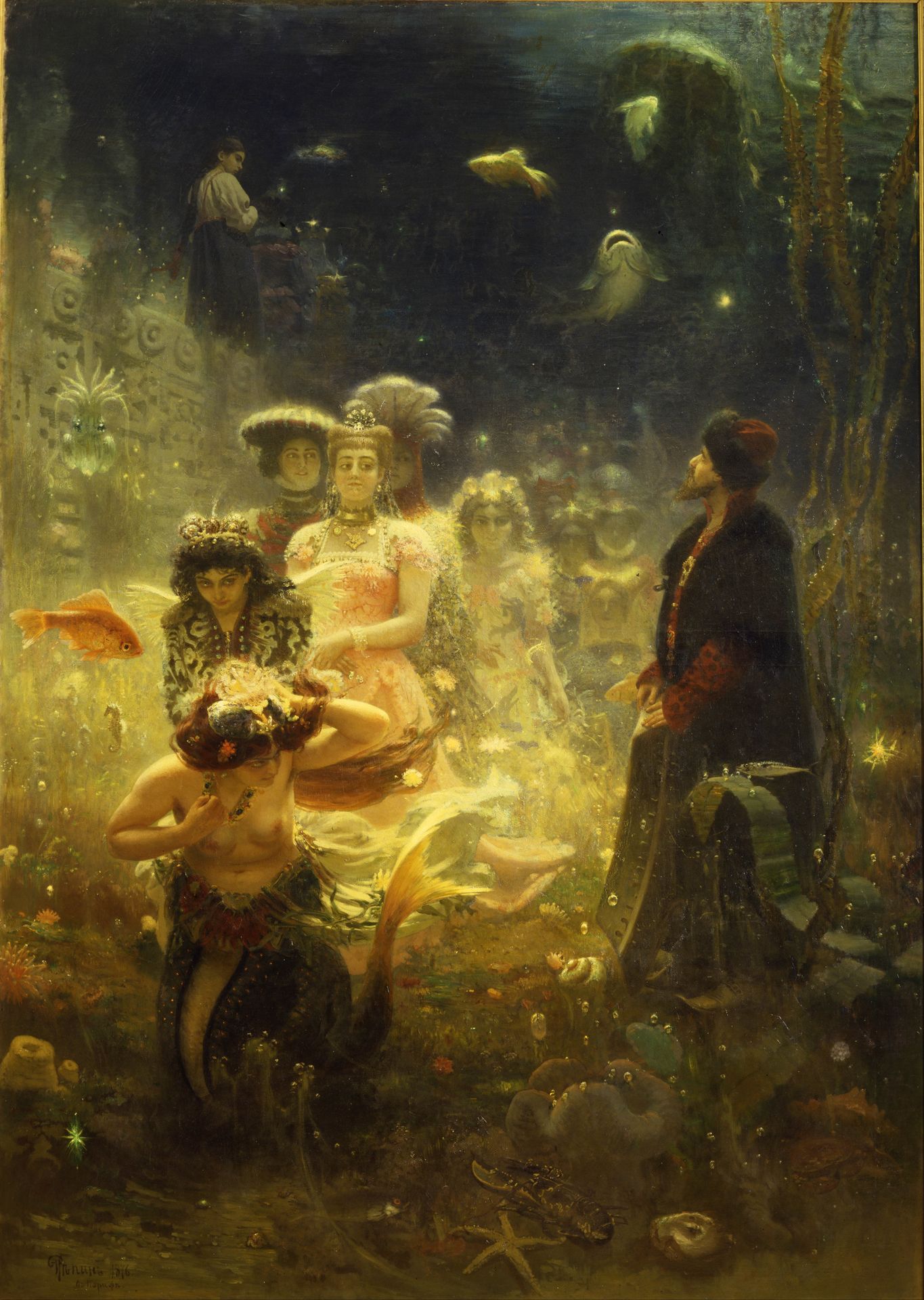
Editor: Here we have Ilya Repin's *Sadko*, painted in 1876. It's quite a captivating scene – an underwater tableau shimmering with ethereal light. The texture seems so fluid; it’s like the paint itself is water. How would you approach an interpretation of this work? Curator: Consider Repin's process. The underpainting, likely quickly executed, establishes the watery atmosphere, yet over that are lavish costumes and carefully rendered faces. What tensions might this suggest? Editor: Well, the immediate contrast is between the wealth of the mermaids and Sadko versus their surroundings. It seems almost deliberately… artificial? Curator: Exactly! Look at the stark juxtaposition: supposedly 'natural' beings adorned in jewels, the mermaid queen's dress. Where do these materials originate? How does this fantastical image reinforce social hierarchies and power dynamics, even within a supposedly imaginary world? What does luxury signify in this underwater kingdom? Editor: It is difficult to miss. I didn't initially consider the implication of luxury in this dreamscape; the production involved in creating it. Are you suggesting it's less of an escape and more of a reflection of terrestrial social concerns? Curator: Precisely. Repin isn’t simply depicting a fairy tale. He’s constructing a vision of labor, class, and value – submerged, perhaps, but still present. These pearls and jewels—mined and manufactured no doubt. They don’t naturally appear on mermaids in this perfect condition. It suggests consumption is a form of violence imposed even on this undersea world. Editor: That makes so much sense! I hadn't considered the implications of material wealth and production within the context of the painting's fantasy setting. Curator: Seeing beyond the surface allows us to challenge preconceived notions of beauty, fantasy, and the labor behind them.
Sadko 1876


Artwork details
- Dimensions
- 323 x 230 cm
- Location
- Russian Museum, Saint Petersburg, Russia
- Copyright
- Public domain
Tags
impressionistic
fantasy art
possibly oil pastel
fluid art
world underwater
underpainting
painting painterly
watercolour illustration
watercolor
environment sketch
Comments
No comments
About this artwork
Editor: Here we have Ilya Repin's *Sadko*, painted in 1876. It's quite a captivating scene – an underwater tableau shimmering with ethereal light. The texture seems so fluid; it’s like the paint itself is water. How would you approach an interpretation of this work? Curator: Consider Repin's process. The underpainting, likely quickly executed, establishes the watery atmosphere, yet over that are lavish costumes and carefully rendered faces. What tensions might this suggest? Editor: Well, the immediate contrast is between the wealth of the mermaids and Sadko versus their surroundings. It seems almost deliberately… artificial? Curator: Exactly! Look at the stark juxtaposition: supposedly 'natural' beings adorned in jewels, the mermaid queen's dress. Where do these materials originate? How does this fantastical image reinforce social hierarchies and power dynamics, even within a supposedly imaginary world? What does luxury signify in this underwater kingdom? Editor: It is difficult to miss. I didn't initially consider the implication of luxury in this dreamscape; the production involved in creating it. Are you suggesting it's less of an escape and more of a reflection of terrestrial social concerns? Curator: Precisely. Repin isn’t simply depicting a fairy tale. He’s constructing a vision of labor, class, and value – submerged, perhaps, but still present. These pearls and jewels—mined and manufactured no doubt. They don’t naturally appear on mermaids in this perfect condition. It suggests consumption is a form of violence imposed even on this undersea world. Editor: That makes so much sense! I hadn't considered the implications of material wealth and production within the context of the painting's fantasy setting. Curator: Seeing beyond the surface allows us to challenge preconceived notions of beauty, fantasy, and the labor behind them.
Comments
No comments