About this artwork
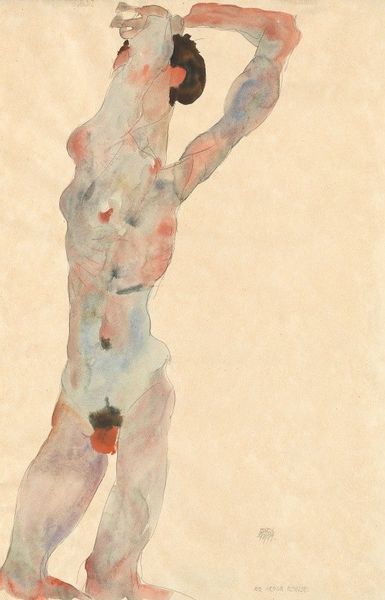
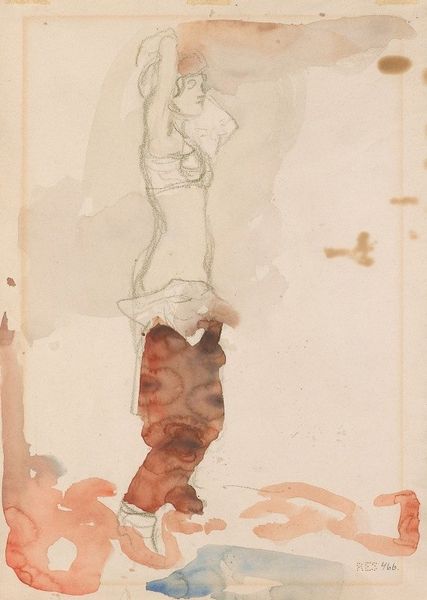
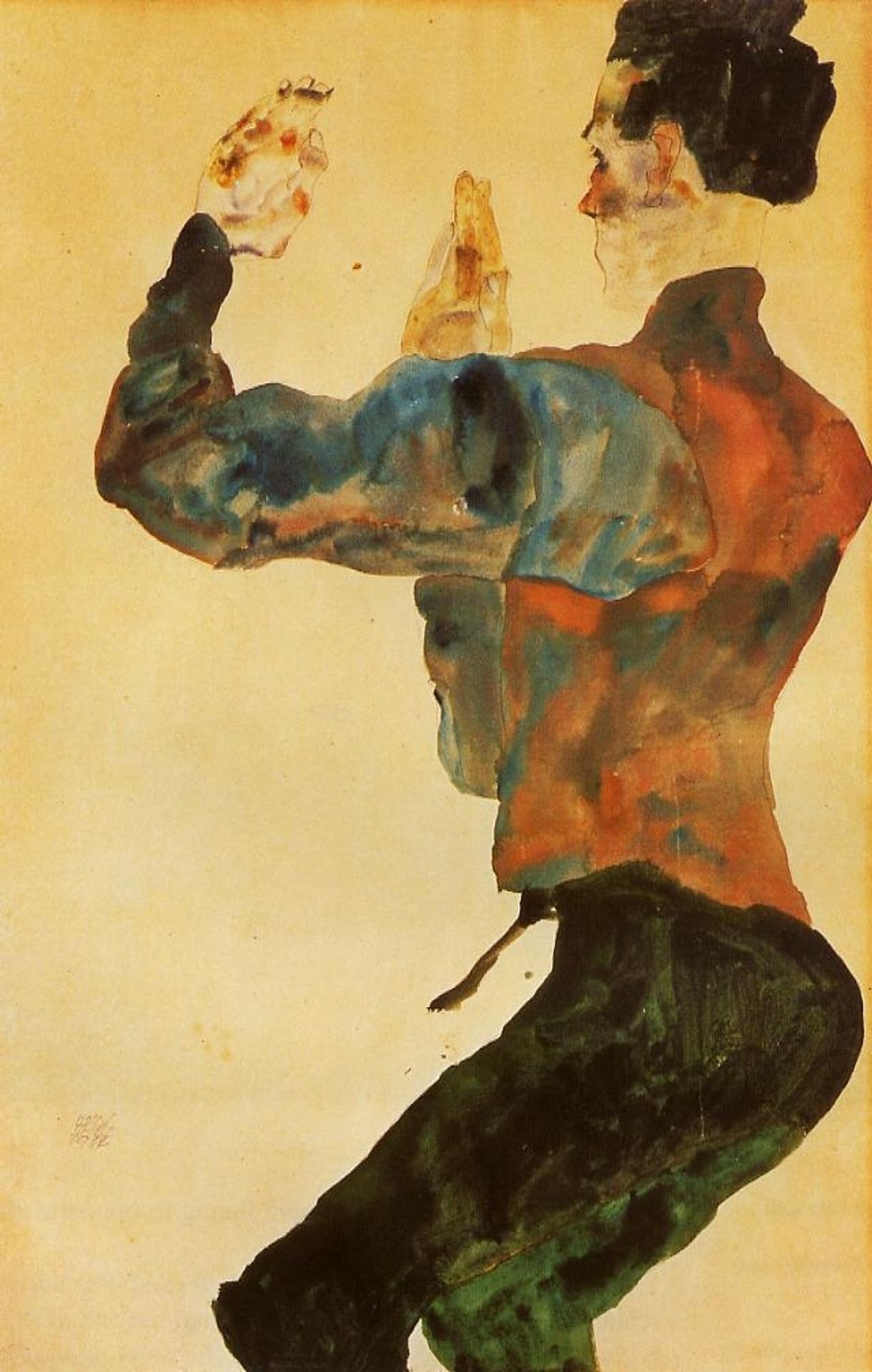
Editor: This is Egon Schiele’s "Self Portrait with Raised Arms, Back View," from 1912, in watercolor and oil. The figure is turned away, vulnerable somehow. What do you see in this piece that I might be missing? Curator: The raised arms immediately bring to mind gestures of supplication or surrender, a universal language transcending time. But the fact that we see the back, the most unprotected part of the body, speaks volumes about vulnerability. What do raised arms, coupled with the obscured face, say to you? Editor: Perhaps an offering of the self? Like, "Here I am," but without revealing all? It's intimate and distancing at the same time. Curator: Precisely! The back, historically, has symbolized secrets, the unseen, the burdens we carry. By presenting his back, Schiele engages with this symbolic weight, suggesting inner turmoil, hidden truths he’s grappling with and inviting us to ponder ours. Notice how the stark lighting emphasizes the musculature—an almost Christ-like agony in the garden pose? Editor: I hadn't considered that connection. So, it's more than just a physical portrait, it's a... psychological landscape? Curator: Indeed. Schiele uses his own image as a vessel for exploring universal themes: anxiety, isolation, the search for identity. The hands especially resonate-- almost claw-like, beseeching. The palette echoes the angst—earth tones and blues suggest a burdened soul. Editor: So the visual language works to deepen the themes beyond just showing a back and raised hands. Curator: Exactly. The emotional and cultural significance here rests in that interplay, how it speaks across time and culture. I think looking at this work has really clarified how symbolic the body can be. Editor: I completely agree. Thinking about the history and psychology embedded in this image gives it such resonance.
Self Portrait with Raised Arms, Back View
1912

Egon Schiele
1890 - 1918Location
Private CollectionArtwork details
- Medium
- painting, watercolor
- Location
- Private Collection
- Copyright
- Public domain
Tags
portrait
self-portrait
painting
oil painting
watercolor
famous-people
male-portraits
expressionism
watercolour illustration
nude
modernism
erotic-art
Comments
Be the first to share your thoughts about this work.
About this artwork
Editor: This is Egon Schiele’s "Self Portrait with Raised Arms, Back View," from 1912, in watercolor and oil. The figure is turned away, vulnerable somehow. What do you see in this piece that I might be missing? Curator: The raised arms immediately bring to mind gestures of supplication or surrender, a universal language transcending time. But the fact that we see the back, the most unprotected part of the body, speaks volumes about vulnerability. What do raised arms, coupled with the obscured face, say to you? Editor: Perhaps an offering of the self? Like, "Here I am," but without revealing all? It's intimate and distancing at the same time. Curator: Precisely! The back, historically, has symbolized secrets, the unseen, the burdens we carry. By presenting his back, Schiele engages with this symbolic weight, suggesting inner turmoil, hidden truths he’s grappling with and inviting us to ponder ours. Notice how the stark lighting emphasizes the musculature—an almost Christ-like agony in the garden pose? Editor: I hadn't considered that connection. So, it's more than just a physical portrait, it's a... psychological landscape? Curator: Indeed. Schiele uses his own image as a vessel for exploring universal themes: anxiety, isolation, the search for identity. The hands especially resonate-- almost claw-like, beseeching. The palette echoes the angst—earth tones and blues suggest a burdened soul. Editor: So the visual language works to deepen the themes beyond just showing a back and raised hands. Curator: Exactly. The emotional and cultural significance here rests in that interplay, how it speaks across time and culture. I think looking at this work has really clarified how symbolic the body can be. Editor: I completely agree. Thinking about the history and psychology embedded in this image gives it such resonance.
Comments
Be the first to share your thoughts about this work.