About this artwork
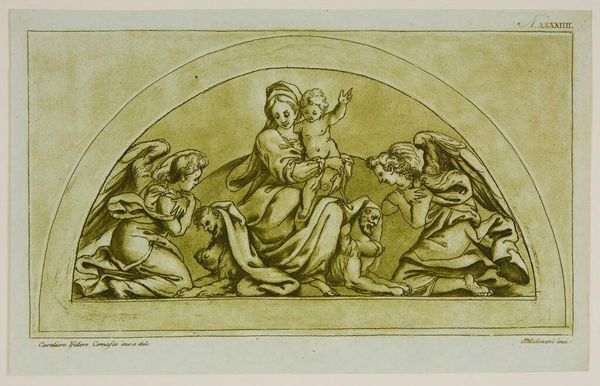
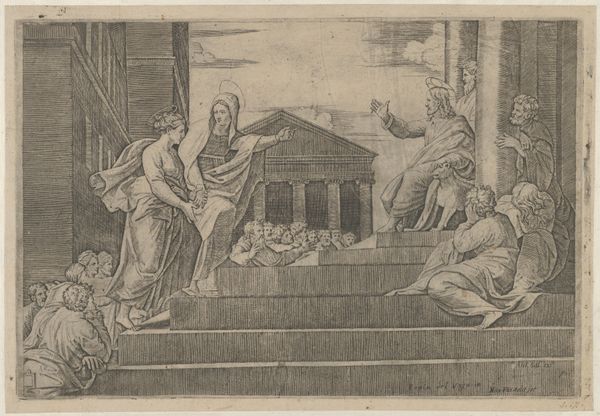
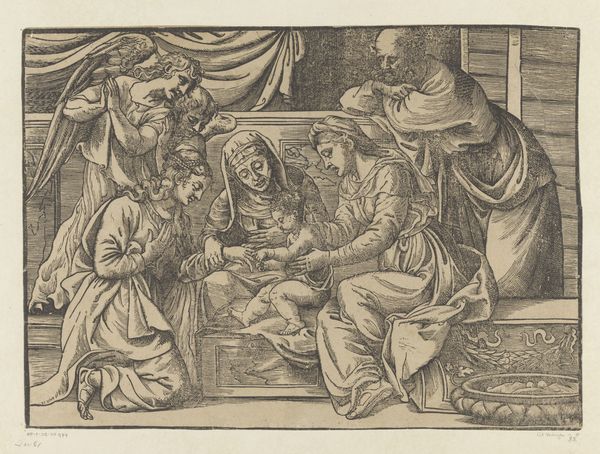
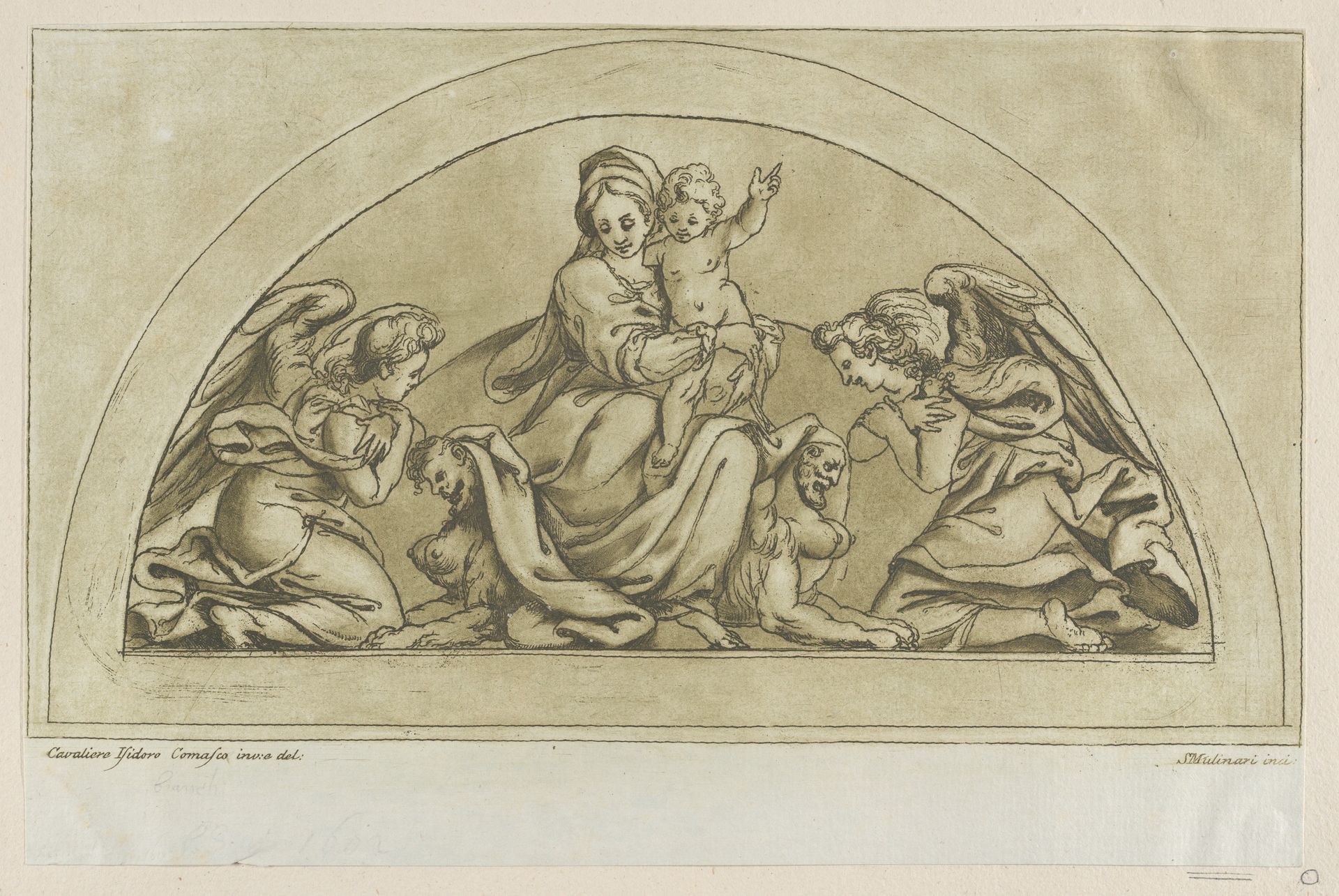
Stefano Mulinari made this print, Virgin and Child flanked by Angels, sometime in the late 18th century. Look closely, and you can see it’s made entirely of lines – a reminder that printmaking, at its heart, is a linear medium. Mulinari employed an etching technique, using acid to bite into a metal plate, which was then inked and printed onto paper. The quality of the line is paramount. Its fineness allows for great detail, but also subtle tonal variation. Mulinari would have manipulated the amount of time the plate spent in the acid bath to achieve different depths of line, and therefore different intensities of ink when printed. The proliferation of prints in the 1700s had a democratizing effect, making art accessible to a wider audience. But it also relied on a division of labor: the artist created the image, and then skilled printers brought it into being. Considering the material qualities of this print reminds us of the complex social and economic systems that underwrite all artistic production.
Virgin and child flanked by angels
1736 - 1790


Artwork details
- Dimensions
- Sheet (Trimmed): 7 7/16 × 11 5/16 in. (18.9 × 28.7 cm)
- Location
- Metropolitan Museum of Art, New York, NY
- Copyright
- Public Domain
Comments
Share your thoughts
About this artwork
Stefano Mulinari made this print, Virgin and Child flanked by Angels, sometime in the late 18th century. Look closely, and you can see it’s made entirely of lines – a reminder that printmaking, at its heart, is a linear medium. Mulinari employed an etching technique, using acid to bite into a metal plate, which was then inked and printed onto paper. The quality of the line is paramount. Its fineness allows for great detail, but also subtle tonal variation. Mulinari would have manipulated the amount of time the plate spent in the acid bath to achieve different depths of line, and therefore different intensities of ink when printed. The proliferation of prints in the 1700s had a democratizing effect, making art accessible to a wider audience. But it also relied on a division of labor: the artist created the image, and then skilled printers brought it into being. Considering the material qualities of this print reminds us of the complex social and economic systems that underwrite all artistic production.
Comments
Share your thoughts