About this artwork
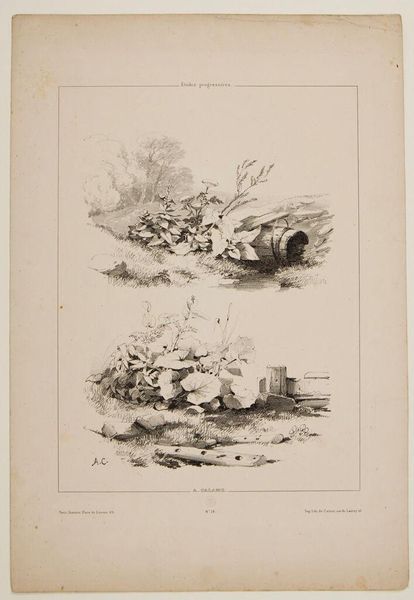
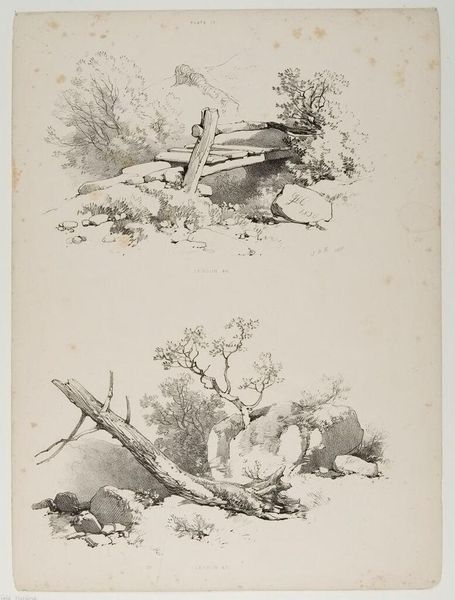
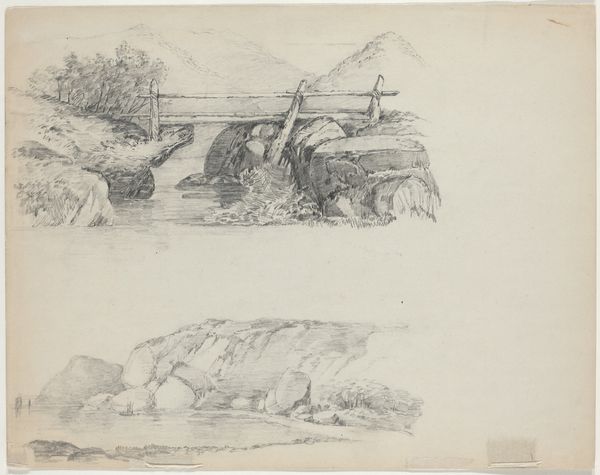
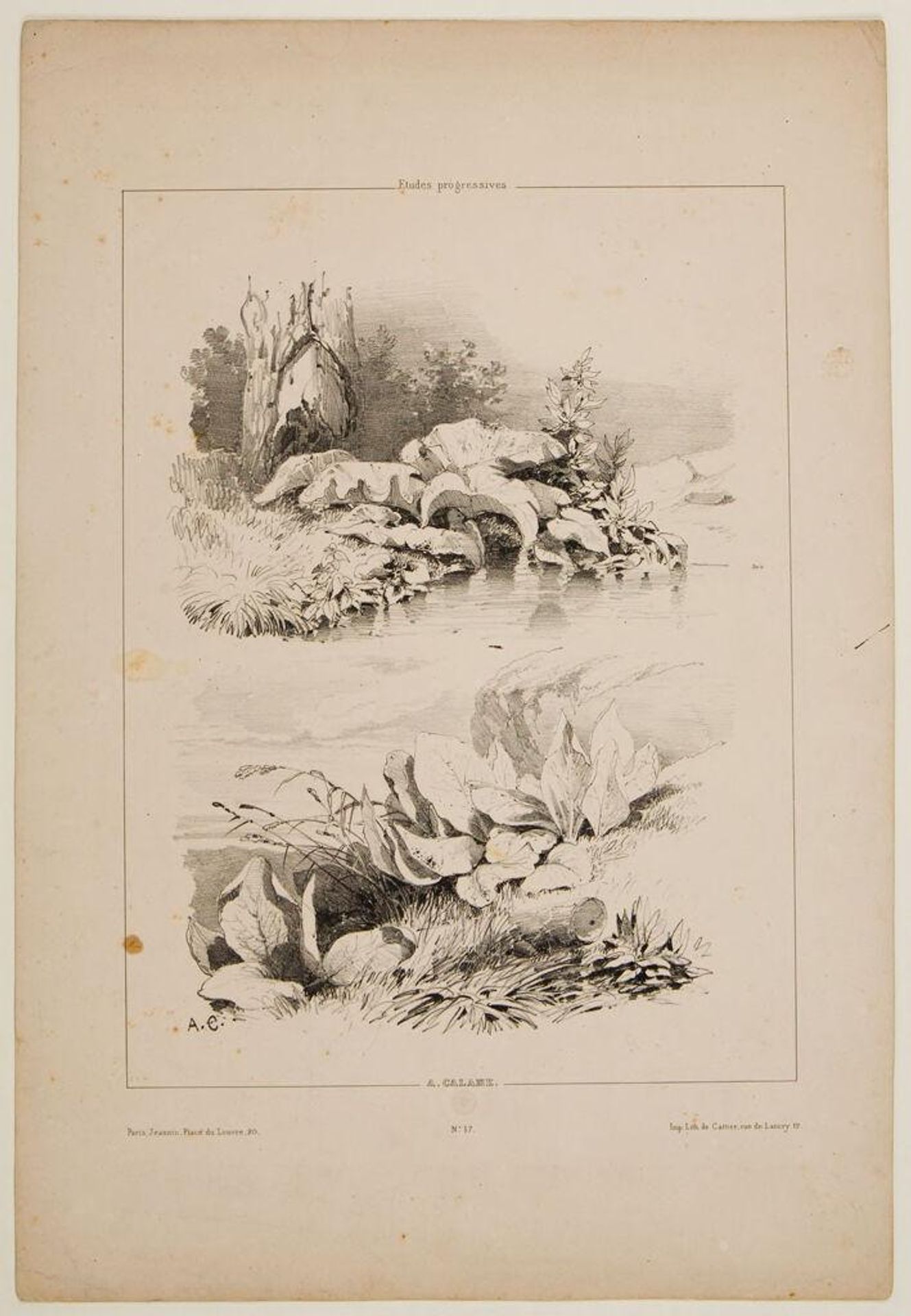
Editor: This is Alexandre Calame’s "Two Sketches of Waterside Large-Leaved Undergrowth." The monochromatic print is quite lovely. What draws me in are the contrast between the delicate foliage and rugged rocks. How do you see it? Curator: These sketches offer a glimpse into 19th-century Romanticism's complex relationship with nature. How might Calame's choice to focus on undergrowth, the often overlooked, reflect a changing social consciousness and a shift in artistic focus towards the marginalized aspects of the natural world? Editor: That’s an interesting point. I hadn't considered the focus on the undergrowth as a deliberate choice with broader implications. Curator: Exactly! Consider how these sketches, seemingly simple, could be interpreted as a subtle commentary on power dynamics and the aesthetic value assigned to different aspects of the environment. Editor: I see, so it's not just a pretty picture, but a reflection of social and political ideas about nature. Thanks! Curator: Indeed. It’s a lens through which we can examine our own relationship with the environment and the values we project onto it.
Two Sketches of Waterside Large-Leaved Undergrowth c. 19th century


Artwork details
- Location
- Harvard Art Museums
- Copyright
- CC0 1.0
Comments
No comments
About this artwork
Editor: This is Alexandre Calame’s "Two Sketches of Waterside Large-Leaved Undergrowth." The monochromatic print is quite lovely. What draws me in are the contrast between the delicate foliage and rugged rocks. How do you see it? Curator: These sketches offer a glimpse into 19th-century Romanticism's complex relationship with nature. How might Calame's choice to focus on undergrowth, the often overlooked, reflect a changing social consciousness and a shift in artistic focus towards the marginalized aspects of the natural world? Editor: That’s an interesting point. I hadn't considered the focus on the undergrowth as a deliberate choice with broader implications. Curator: Exactly! Consider how these sketches, seemingly simple, could be interpreted as a subtle commentary on power dynamics and the aesthetic value assigned to different aspects of the environment. Editor: I see, so it's not just a pretty picture, but a reflection of social and political ideas about nature. Thanks! Curator: Indeed. It’s a lens through which we can examine our own relationship with the environment and the values we project onto it.
Comments
No comments