drawing, ink, pen
#
drawing
#
baroque
#
pen sketch
#
landscape
#
ink
#
pen
#
genre-painting
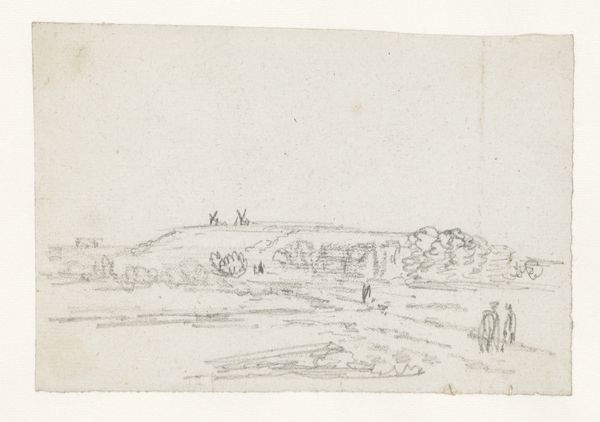
Dimensions: height 82 mm, width 136 mm
Copyright: Rijks Museum: Open Domain
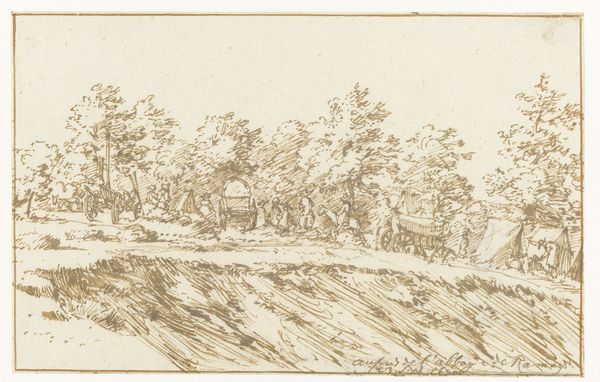
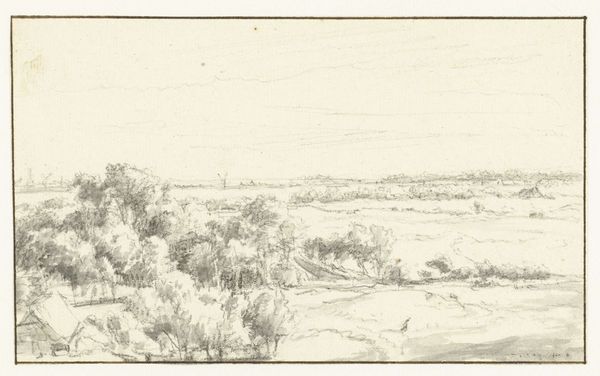
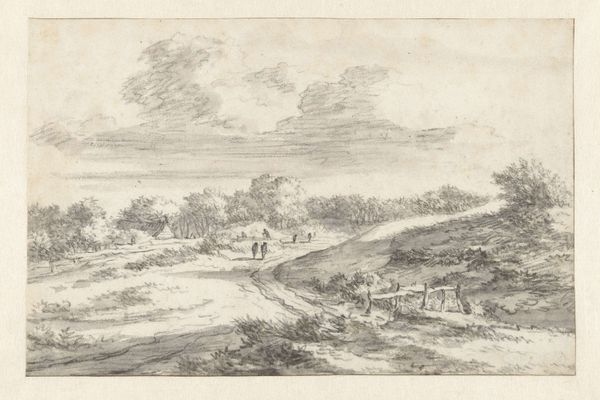
Editor: So, here we have "View of the Army Encampment at Nivelles, Walloon Brabant," likely from 1674-1678, rendered in pen and ink by Barend Klotz. It’s… sparse, almost like a memory fading at the edges. What do you see in it? Curator: Immediately, the visual symbols speak volumes about impermanence and transition. The encampment itself, rendered with such delicate lines, is not a monument to lasting power, but rather to a fleeting presence. Think about what an army represents, beyond mere physical force: upheaval, cultural exchange, and the potential for both creation and destruction. Editor: Creation? I mostly see disruption in that imagery. Curator: Ah, but consider: new trade routes often followed armies, ideas were exchanged, and sometimes, entirely new social structures emerged from the ashes of old ones. Even the tents themselves, as depicted here, they carry the symbol of both the temporary and the portable – the capacity to transplant “civilization”, or a version of it, anywhere. Editor: That's interesting. It makes me wonder, is Klotz celebrating or critiquing that “portability?" Curator: A crucial question! Notice the detached observation in the drawing. The figures seem almost indifferent to the military presence. Perhaps Klotz isn’t delivering a judgment so much as presenting a moment of cultural reckoning. This isn’t propaganda, but a witness account etched in ink, and he leaves it to us to question this transferability. It makes one wonder about the long history of cultural impact that's carried through migration, colonialism and even war. Editor: I hadn’t considered that angle before. I guess I was so focused on the tents and the military aspect, I missed the bigger picture about symbols of broader cultural shifts. Curator: Exactly. It also emphasizes that symbols themselves carry multiple meanings simultaneously; understanding the tensions *between* those meanings is essential to appreciating art history.
Comments
No comments
Be the first to comment and join the conversation on the ultimate creative platform.
 Collect
 React
React Comment
More like this