About this artwork
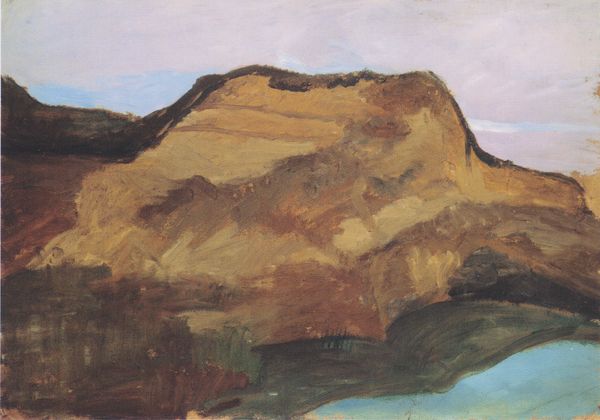
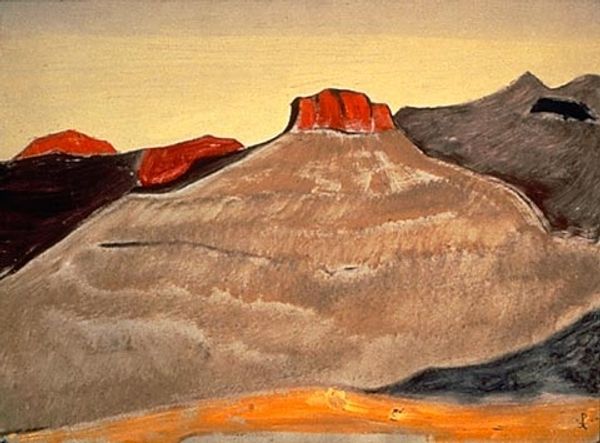
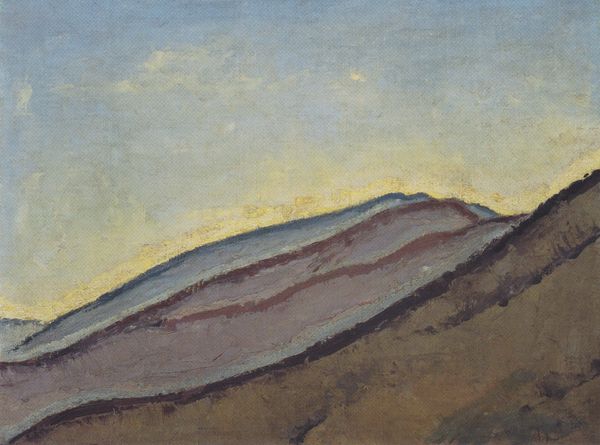
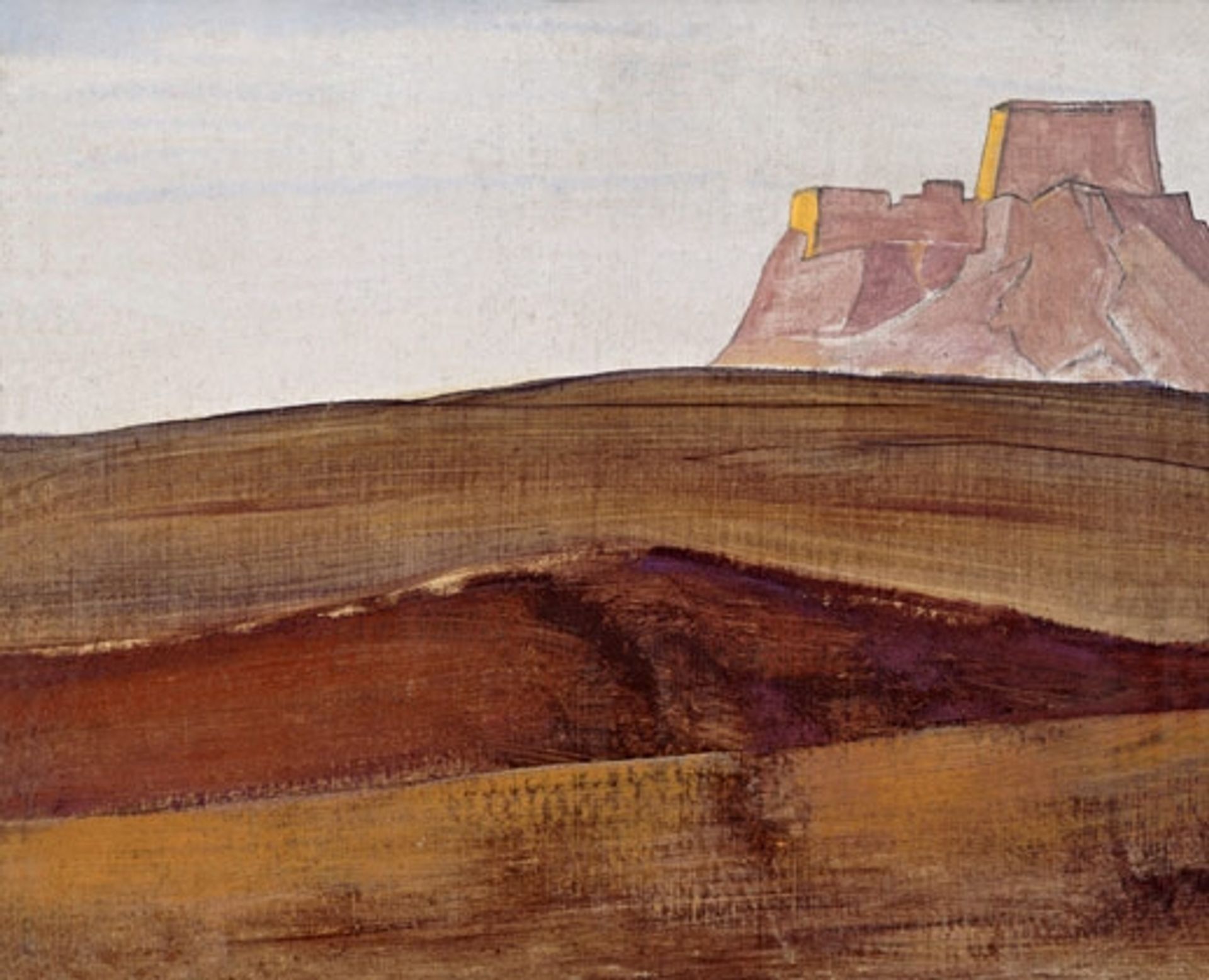
Curator: This is Nicholas Roerich’s “Tarbagatai,” currently held here at the Rose Art Museum. What catches your eye first about it? Editor: Definitely that fortress-like mountain range. It's like a sleeping giant bathed in sunset hues. I’m really responding to the texture, seeing that landscape. It really embodies that rugged isolation you can get in a Roerich work. Curator: Right, isolation is key. Roerich was deeply interested in theosophy, the spiritual quest, which definitely influenced his approach to rendering the landscape. We see that search for the divine encoded even in the layers of oil-paint he's applied. Editor: The layers! They do build this interesting tension. There’s this immediacy of raw brushwork, juxtaposed against a sense of timeless monumentality. It feels simultaneously ancient and like something built just last week, right? Like it could still smell like drying plaster! Curator: Well, materiality certainly played a part, the paints that were available, Roerich’s application... Consider his fascination with Asian cultures too. He travelled extensively. Those stark colors and simplified forms are reminiscent of Tibetan thangkas. Editor: That’s interesting... It kind of explains the way that light bounces, which lends itself to feeling like you’re stepping through some portal, or gazing out over the first sunrise on Earth. It brings this mythic sensibility, maybe. Curator: Perhaps mythic in its resonance. He aimed, I believe, to distill the landscape to its spiritual essence, mirroring theosophical pursuits to reveal inner truths via simplified presentation. Editor: And that's probably why it doesn’t need people. Their absence is the very thing that charges it with presence! Curator: Indeed. He's really emphasizing our small role, that's the feeling. We might consider it from a labor perspective also—it is this simplification itself that conveys this. Editor: To sum it up? Curator: Something about it makes you aware of a sense of scale—your scale within some universal equation. Editor: I'm ready for an adventure after spending time with this vista. Something monumental is out there calling our names.
Tarbagatai

Nicholas Roerich
1874 - 1947Location
Rose Art Museum (Brandeis University), Waltham, MA, USArtwork details
- Medium
- painting, oil-paint
- Location
- Rose Art Museum (Brandeis University), Waltham, MA, US
- Copyright
- Public domain
Tags
painting
oil-paint
landscape
oil painting
romanticism
realism
Comments
No comments
About this artwork
Curator: This is Nicholas Roerich’s “Tarbagatai,” currently held here at the Rose Art Museum. What catches your eye first about it? Editor: Definitely that fortress-like mountain range. It's like a sleeping giant bathed in sunset hues. I’m really responding to the texture, seeing that landscape. It really embodies that rugged isolation you can get in a Roerich work. Curator: Right, isolation is key. Roerich was deeply interested in theosophy, the spiritual quest, which definitely influenced his approach to rendering the landscape. We see that search for the divine encoded even in the layers of oil-paint he's applied. Editor: The layers! They do build this interesting tension. There’s this immediacy of raw brushwork, juxtaposed against a sense of timeless monumentality. It feels simultaneously ancient and like something built just last week, right? Like it could still smell like drying plaster! Curator: Well, materiality certainly played a part, the paints that were available, Roerich’s application... Consider his fascination with Asian cultures too. He travelled extensively. Those stark colors and simplified forms are reminiscent of Tibetan thangkas. Editor: That’s interesting... It kind of explains the way that light bounces, which lends itself to feeling like you’re stepping through some portal, or gazing out over the first sunrise on Earth. It brings this mythic sensibility, maybe. Curator: Perhaps mythic in its resonance. He aimed, I believe, to distill the landscape to its spiritual essence, mirroring theosophical pursuits to reveal inner truths via simplified presentation. Editor: And that's probably why it doesn’t need people. Their absence is the very thing that charges it with presence! Curator: Indeed. He's really emphasizing our small role, that's the feeling. We might consider it from a labor perspective also—it is this simplification itself that conveys this. Editor: To sum it up? Curator: Something about it makes you aware of a sense of scale—your scale within some universal equation. Editor: I'm ready for an adventure after spending time with this vista. Something monumental is out there calling our names.
Comments
No comments